6

Problem 1

$$ {\rm f}\left(n\right) = \frac{1}{n}\, \left[{\rm f}\left(n - 1\right)k_{0} + {\rm f}\left(n-2\right)k_{1}\right]\tag{1} $$

( This can also be written as ${\rm Q}\left(n\right) = k_{0}\frac{{\rm Q}\left(n - 1\right)}{n - 1} +k_{1}\frac{{\rm Q}\left(n - 2\right)}{n - 2}$ provided ${\rm Q}\left(n\right) = n{\rm f}\left(n\right) $ )

where $k_{0},\,k_{1}$ are constants. ${\rm f}\left(0\right)=3,\,{\rm f}\left(1\right)=5$. The variable coefficient $\frac{1}{n}$ is making lot of issues here. It blocks the proper expansion.

Question

Please help me to find the solution of the recurrence in terms of $n$ ( implies ${\rm f}\left(n\right)$ ) and also the summation of the recurrence up to infinity ( $ sum = \sum_{n = 0}^{\infty}{\rm f}\left(n\right)$ ).

Note::

  1. Partial answers are also welcome. We can discuss that here. This recursion forms a structure of Fibonacci look like tree. I have attached a pic here. You can see Red nodes to indicate $k_0$ multiplication and green to indicate $k_1$ multiplication. You can see the index of the tree expands like a Fibonacci sequence(starts from 5)
  2. Some of the generating function smart manipulations can be looked in to this famous e book for reference link:-generatingfunctionology!

  3. I know a method of using ODE. But I am trying to solve it with out ODE so that I can extent this to higher dimension like matrices in similar structure questions. Please avoid ODE solution or any matrix exponential. A method using series would be more desirable
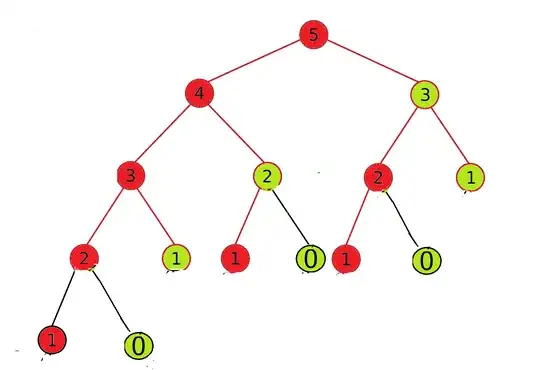
    enter image description here

Problem 2( extended Matrix version of problem 1)

We have a given matrix recurrence ,

$ (\curlyvee_i,\curlyvee_{i-1})_{1\times2}= (\curlyvee_{i-2},\curlyvee_{i-3})_{1\times2}{\begin{bmatrix}A_{i-1}A_i+B_i & A_{i-1} \\B_{i-1}A_i & B_{i-1} \end{bmatrix}}_{2\times2} \tag 1$

$A_i= r\frac{\Im1}{i},B_i= r^2\frac{\Im2}{i} \tag 2$

$ \Im1=\left( \begin{array}{ccc} 0 & -n_0 & m_0 \\ n_0 & 0 & -l_0 \\ -m_0 & l_0 & 0 \\ \end{array} \right), \Im2=\left( \begin{array}{ccc} 0 & -(n_1-n_0) & (m_1-m_0) \\ (n_1-n_0) & 0 & -(l_1-l_0) \\ -(m_1-m_0) & (l_1-l_0) & 0 \\ \end{array} \right).\tag3$

$l_1,m_1,n_1,l_0,m_0,n_0,r$ all are constants can't alter at all

Given Data about the problem

  1. Dimensions of $A_i,B_i,\curlyvee_i$ are $3\times3$ and $A_i,B_i$ are skew symmetric matrices with diagonal zero
  2. Our initial condition is given as $(\curlyvee_1,\curlyvee_{0})_{1\times3} $
  3. Properties of $\Im1,\Im2$ useful for simplification are given below

    For each matrices $\Im1 ( a=l_0,b=m_0,c=n_0), \Im2 ( a=l_1-l_0,b=m_1-m_0,c=n_1-n_0)$,let $p = \sqrt{a^2+b^2+c^2}$. It is true that $\wp^3 = -(a^2+b^2+c^2)\wp = -p^2\wp$ ($\wp$ represents matrices $\Im1, \Im1$ ,select a,b,c accordingly). Hence, $\wp^{2m+1} = (-1)^mp^{2m}\wp \tag 4$ and $\wp^{2m} = (-1)^{m-1}p^{2m-2}\wp^2 \tag 5$. In essence it says both matrices $\Im1, \Im2$ satisfies this property. courtesy @JimmyK4542

Question 1. How do we solve this recurrence in terms of n. Is there any way to take out n from the $3\times3$ matrices in recursion so that we can go for easy simplification. ?

NB :: I would like to have a solution with out using ODE or matrix exponential as I can extent to tensors etc. Please avoid such solution. Those were discussed earlier. Another version of the same question I posted as graph problem is given here. I didnt get any response to that,so I made it simplified as matrix recursion here. I haven been trying lot of methods on it none is successful coz of the properties of $A_i$

Note :: Bounty will be awarded to the helpful suggestions which leads to solution.

Efforts done so far

  1. Tried to evaluate using power series simple method. Result:: failed ,Reason :: varying n blocks the procedure
  2. Tried to make another equivalent series by substitution. Result :: failed,Reason :: it still went back to old issues. (not sure any nice substitution exists such that we can get form that is solvable..trying)
  3. Made it as graph problem .I see a finite structure in Tree and node coloring.. If we go with graph theory method to get an expression for general case n and later add all as series up to infinity , we can find a sequence some thing like GP. We may end up in a finite expression. Result :: Failed ,Reason:: It was tough to get that common expression for a graph based on node contribution
  4. Made it as matrix recursion, Result :: failed, could not decompose the matrix recursion component to separate n
  5. Tried to compare or extract some properties from Fibonacci tree as it has same structure. Result :: Failed,Reason:: we will still end up in varying coefficient ..
Nirvana
  • 1,767
  • @Quang Hoang,@Bridgeburners,@MPW Will it work like our earlier solution link!. Here we cant expand freely (beacuse of n contribution on both side)as we did there. Please share your thoughts.. Thanks – Nirvana Jul 29 '14 at 17:02
  • By the way, there is no need to assume that $f(n)$ will be a matrix, as each column act independently from each other; so assume them to be vectors will do. – Gina Jul 29 '14 at 18:35
  • yes.. I just meant.. Let us have general solution that solves for simple case and general 2D case.. thanks for your thoughts – Nirvana Jul 29 '14 at 18:38
  • I don't know if anyone has mentioned this to you yet, but you can make a substitution $f(n) = g(n) / n!$ to get $g(n) = k_0, g(n-1)+ k_1,(n-1),g(n-2)$ and then you can work out a sequence without divisions. – DanielV Aug 04 '14 at 06:34
  • @DanielV That is a nice reduction. Thanks for that. But it will still will reach on that varying n issue while evaluation. Would you elaborate bit – Nirvana Aug 04 '14 at 07:03
  • I do not understand your subscripts (1 x 3) and (3 x 3) what are you trying to say about the object they are subscripted to when you list them, is it correct that the dimensions of the matrix in the recursion grows with larger i? – Sidharth Ghoshal Aug 05 '14 at 05:39
  • It has changed..was a typing mistake.. please check.. – Nirvana Aug 05 '14 at 05:46
  • There are many very minor edits to this post. It is best to collect changes into one larger edit. It is not permitted to make edits simply to keep a question on the front page. If a question is not getting enough attention, improve the question with significant edits or start a bounty. – robjohn Aug 05 '14 at 10:14
  • I am not making edits to get more attention. It is already on bounty. I have added changes to avoid confusion based on replies I get..Thanks – Nirvana Aug 05 '14 at 14:22

3 Answers3

5

So I do realize you wanted to avoid a matrix exponential answer, now I would like to post one here just so other people running into this question can see what that looks like:

$$ \textbf{MATRIX SOLUTION}$$

Let: $$L(f(n)) = f(n) - f(n-1)$$ Notice therefore:

$$L^2(f(n)) = f(n) - 2f(n-1) + f(n-2)$$

Therefore we can re-write as

$$f(n) = \frac{k_1}{n}(L^2 (f(n)) - 2L(f(n)) + f(n)) + \frac{k_0}{n}(f(n) - L(f(n)))$$

use $f = f(n)$ for cleaner appearance and use standard operator notation (no parenthesis between L and f)

$$f = \frac{k_1}{n}(L^2 f - 2Lf + f) + \frac{k_0}{n}(f - Lf)$$

Which simplifies to

$$\frac{k_1}{n}L^2f + \left(-\frac{2k_1+k_0}{n}\right)Lf + \left(\frac{k_0 + k_1 - n}{n} \right)f = 0 $$

We now multiply through by $n$ and divide by $k_1$

$$L^2f - \left(\frac{2k_1+k_0}{k_1}\right)Lf + \left(\frac{k_0 + k_1 - n}{k_1} \right)f = 0 $$

And move all terms besides $L^2f$ to the other side

$$L^2f = \left(\frac{2k_1+k_0}{k_1}\right)Lf - \left(\frac{k_0 + k_1 - n}{k_1} \right)f $$

Now generate a vector $G = \begin{bmatrix} f \\ Lf \end{bmatrix} $

At this point it becomes evident that if we define $L$ to act component by component on matrices then:

$$LG = \begin{bmatrix} - \frac{k_0 + k_1 - n}{k_1} && 0 \\ 0 && \frac{2k_1 + k_0}{k_1} \end{bmatrix}G$$

Traditionally to solve equations of the type

$$Lf = bf$$

exploits the fact that

$$L(2^{Q(n)}) = (2^{LQ(n)}-1)2^{Q(n)}$$

In other words we are seeking a matrix $H$ such that

$$ 2^{LH(n)} - I_2 = \begin{bmatrix} - \frac{k_0 + k_1 - n}{k_1} && 0 \\ 0 && \frac{2k_1 + k_0}{k_1} \end{bmatrix}$$

Meaning

$$2^{LH(n)} = \begin{bmatrix} - \frac{k_0 - n}{k_1} && 0 \\ 0 && \frac{3k_1 + k_0}{k_1} \end{bmatrix} $$

At this point we must find the components of:

$$\log_2 \left( \begin{bmatrix} - \frac{k_0 - n}{k_1} && 0 \\ 0 && \frac{3k_1 + k_0}{k_1} \end{bmatrix} \right) $$

This is a tricky calculation which requires we replace the 0 components with a variable z. Then compute the logarithm treating, z as a real variable. Then for each component $c_i$ solve

$$Lu = c_i$$

to assemble the components of $H(n)$

from here

$$2^{H(n)}$$

will be the solution of the system

And therefore the dot product of the top row of $2^{H(n)}$ with the vector $\begin{bmatrix} c_0 \\ c_1 \end{bmatrix}$ is the general solution to our problem

At this point take the limit as $z \rightarrow 0$ to recover the solution

$$ \textbf{SERIES SOLUTION} $$

We note that given the linear operator described above

$$Lf = f(n) - f(n-1)$$

We can generate a Taylor-like series by first observing the existence of a product rule

$$L(f*g) = f(n)g(n) - f(n-1)g(n-1) = g*Lf + f*Lg - Lg*Lf $$

And second observing that

$$L \left( \frac{1}{n!} \prod_{i=1}^{n}{(x +i-1)}\right) =\frac{1}{n!} \prod_{i=1}^{n-1}{(x+i-1)} $$

Thereby allowing us to generate a "series"

$$f(x) = f(a) + Lf(a)x + \frac{L^2f(a)}{2!}x(x+1) + \frac{L^3f(a)}{3!}x(x+1)(x+2)... $$

We now recall the original problem:

$$L^2f = \left(\frac{2k_1+k_0}{k_1}\right)Lf - \left(\frac{k_0 + k_1 - n}{k_1} \right)f $$

We can consider the values of

$$ \begin{matrix} L^2f && L^3f && L^4f && ... && L^rf \end{matrix}$$

At which point it becomes evident

$$ L^rf = \left(2 + \frac{k_0}{k_1}\right)L^{r-1}f + \frac{r-2}{k_1}L^{r-3}f + \left(\frac{n}{k_1} - 1 - k_0+ \frac{r-2}{k_1} \right)L^{r-2}f$$

This can be re-written by noting $L^rf = X(r)$ and therefore

$$X(r) = aX(r-1) + (r-2)bX(r-3)+ (c + b(r-2))X(r-2)$$

Whereas $X(0) = 3, \ X(1) = (5-3) = 2$ and $$a = \left(2 + \frac{k_0}{k_1}\right), \ b = \frac{1}{k_1}, \ c = \left(\frac{n}{k_1} - 1 - k_0 \right) $$

Now the solution to the problem is

$$f(n) = \sum_{i=0}^{\infty} \left[ \frac{X(i)}{i!} \prod_{j=1}^{i} (n + j - 1) \right]$$

$$ f(n) = X(0) + X(1)n + \frac{X(2)}{2}n(n+1) + \frac{X(3)}{3!}n(n+1)(n+2) ... $$

Of course finding a closed form for $X$ seems to be a still intriguing problem but not impossible since it is of the exact same form as the original problem: we can create a matrix solution or series solution for $X$ (depending on personal preference...) but to address the concerns of dividing by $k_0$ and $k_1$ our solution terms can instead be written as:

$$ k_1*L^rf = \left(2k_1 + k_0\right)L^{r-1}f + (r-2)L^{r-3}f + \left(n - k_1 - k_0*k_1+ (r-2) \right)L^{r-2}f$$

Thus we can still attempt to solve for each individual $L^{r}f$ and generate series terms... I am curious how this will play out and whether any inconsistent systems will be formed (if they are formed: does that mean there cannot exist a solution to said equation, or does it require the creating of a new flavor of functions outside of all others, much like how we can create an imaginary constant to deal with the unsolvable $\sqrt{-1}$ problem)

  • Appreciate ur effort.Thanks There will be an issue when terms like $k_i$ are denominators. Because skew symmetric matrix with dimension 3 has determinant zero. So it nullifies that possibility... Problem 2 is the matrix extension of the same problem.. Any with out which is acceptable to problem 1 for all matrices will solve problem 2 automatically.. – Nirvana Aug 04 '14 at 05:39
  • So if I understand correctly, $k_0, k_1$ are constant matrices that can have determinant 0? – Sidharth Ghoshal Aug 04 '14 at 19:51
  • In the question,we are aiming at a series based solution with out ODE. The purpose of it is, to extend the solution to higher dimension like in question 2. Your attempt is true if it is scalar. But that solution cant be extented to matrices. Issue is,if $k_0,k_1$ are skew symmetric cases then you cant have divisions..Beacause determininat will be zero – Nirvana Aug 05 '14 at 01:30
  • So I added to it, I began by generating a series solution to the original problem I had addressed, but showed that generating series terms DOES NOT Require division. In doing so I cannot find a closed form but at least you will always be able to model your equation based on known terms and try to extrapolate about long term behavior based on that... – Sidharth Ghoshal Aug 05 '14 at 02:52
  • I tried to see if I can solve the $X(i)$ equation using mathematica but there appears to be no closed form in terms of elementary functions... Not sure if a faster algorithm for generating terms exist – Sidharth Ghoshal Aug 05 '14 at 02:58
  • Thanks.It is a nice attempt. Let me start thing from $X(i)$. I will post soon,my thinking in short time.. – Nirvana Aug 05 '14 at 03:08
  • I have one doubt. Assume we have that X(r). But can we write f(n) the infinite series in closed form? Then only finding a solution X(r) will be fruitful,I guess.. Shall we think about some sort of substitution to the original one so that it will convert the entire varying coefficient stuff to a solvable non varying coefficient recurrence. Then it can be solvable..I guess.. – Nirvana Aug 05 '14 at 03:11
  • X(r) is a recursion like f(n) with varying coefficient..basically we are in confusion in f(n),because of the varying coefficient in f(n). By solving it,we again ended in another same issue. And also we have two issues now.. One is to find the closed form of infinite series f(n) and also other is the varying coefficient x(r)..Thanks for ur effort..I am thinking from your concept of x(i) now – Nirvana Aug 05 '14 at 03:19
  • If it helps the $X(r)$ problem does have a closed form when it's just $r*X(r)$ by itself (gamma function) and the constant cases lead to exponentials, my gut tells me there is a closed form in terms of gamma functions and exponentials (or perhaps more complex hyper geometric functions) – Sidharth Ghoshal Aug 05 '14 at 05:29
1

Let we set $a_n=f(n)$, and $$ g(x) = \sum_{n=0}^{+\infty} a_n x^n.$$ Since: $$ x\cdot g'(x) = \sum_{n=1}^{+\infty} n\, a_n x^{n},$$ $$ x\cdot g(x) = \sum_{n=1}^{+\infty} a_{n-1} x^{n},$$ $$ x^2\cdot g(x) = \sum_{n=2}^{+\infty} a_{n-2} x^{n},$$ the recursion gives that $g(z)$ is a solution of the differential equation: $$ x\cdot g'(x)-5x = k_0(x\cdot g(x)-3x)+k_1 x^2\cdot g(x), $$ i.e: $$ g'(x) = (k_0+k_1x)g(x)+(5-3k_0),$$ with the constraint $g(0)=3$. Assuming that the inhomogeneous part does not affect really much the behaviour of the coefficients of the Taylor series, we have: $$ a_n\approx [x^n]e^{k_0 x+\frac{k_1}{2}x^2} = \sum_{j=0}^{\lfloor n/2\rfloor}\frac{k_0^{n-2j}k_1^{2j}}{4^j j!(n-2j)!},$$ and $$\sum a_n = g(1)\leq C\cdot e^{k_0+\frac{k_1}{2}}.$$

Jack D'Aurizio
  • 361,689
  • Will it take care matrices of $3\times 3$?. Because that e term will create bit issue when it comes to matrices – Nirvana Jul 29 '14 at 18:22
  • Note that he wants a method that works for $k_0,k_1$ a matrix (i.e. a system of recurrences.) – Semiclassical Jul 29 '14 at 18:23
  • I am no just thinking to take that n as -(1-n) and expand as series of GP and trying something there..Still it goes on like same – Nirvana Jul 29 '14 at 18:24
  • Let us focus on the scalar,beacuse it will be simpler..But avoid ODE methods..Let us try with generating functions..So it can be extended to higher dimension later even toit is tensors – Nirvana Jul 29 '14 at 18:26
  • I don't think you can avoid the problem: if $k_0$ and $k_1$ are arbitrary matrices, then that includes off-diagonal terms which couple different components of $f(n)$. And it's exactly that which is making the ODE approach painful---you won't be able to avoid it by any method (that I'm aware of,a t any rate.) @Rejo_Slash – Semiclassical Jul 29 '14 at 18:29
  • 3
    @Rejo_Slash:I don't think generating function's method lend to higher dimension either. A large assumption when using generating function is that multiplication commute, which isn't the case with matrices. – Gina Jul 29 '14 at 18:29
  • Imagine there was no $\frac{1}{n}$. Then generating function can give u the SUM easily..The DF coefficients must be matrices and powers must be variable x of single dimension – Nirvana Jul 29 '14 at 18:34
  • @Rejo_Slash: The $1/n$ isn't the issue; understanding it is like understanding the homogeneous part of a regular ODE. It's the inhomogeneous part that's the problem, especially in higher dimension where it generally creates a coupled system. – Semiclassical Jul 29 '14 at 18:37
  • I meant,when ever I try a new method that "n" fellow kills all my efforts.. So I wish if that n was not there – Nirvana Jul 29 '14 at 18:40
  • @Semiclassical: 1st order coupled ODE is not that bad to solve explicitly: there are known algorithm to find the answer explicitly; but it seems like we are looking for a general solution without having access to the explicit values for $k_{0},k_{1}$. Rather odd I would say, as the initial values are given explicitly. – Gina Jul 29 '14 at 18:58
  • Fair enough, I shouldn't overstate things. I'm just trying to emphasize that the ODE way of approaching this isn't 'unusual' in how painful it gets when getting a general solution to generic matrix $k$'s. Any approach is going to have to deal with those issues. @Gina – Semiclassical Jul 29 '14 at 19:00
0

We can rewrite it as

$-( f(n-1)) =\{k_1f(n-3)+k_1f(n-3)n+k_1f(n-3)n^2+k_1f(n-3)n^3+..+\infty\}+\{k_0f(n-2)+k_0f(n-2)n+k_0f(n-2)n^2+k_0f(n-2)n^3+..+\infty\}\tag1$

from $-f(n-1)=\frac{1}{1-n}(k_0f(n-2)+k_1f(n-3))\tag 2$.Taking summation up to infinity in n from both ends we get the terms involving $\sum_{n=0}^{\infty} f(n)$ on both sides. But some infinite terms on RHS will still exist. We need some smart ways to tackle it with existing infinite series with known finite sum. What is your take guys..Please share

NB :: Have a look at some existing series a) example series 1 ! b) example series 2-page 52 !

NB:: I am now thinking about converting it to another series so that can tackle it better(something like $K(n)=nf(n-1)$,just thinking only..;))

Nirvana
  • 1,767