4

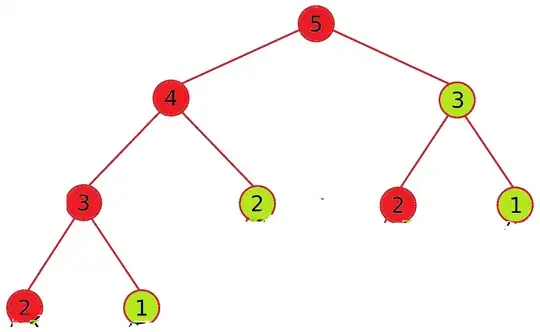
This is an interesting question where we are trying to solve another recursion which has same tree structure as the given recursion and also has term similarities

Given Data in question

  1. $F_n=F_{n-1}+F_{n-2}$, where $F_1=F_2=1$, we have $F_n= \frac{(1+\sqrt{5})^n-(1-\sqrt{5})^n}{2^n\sqrt{5}}$ and generating function $g(x)= \sum_{n=0}^{\infty}F_nx^n=\frac{x}{1-x-x^2}$
  2. More details of Fibonacci recursion and properties can be found here! .

Question

Can we find solution for a)$Q_n$(interms of n) b) $ g(x)= \sum_{n=0}^{\infty}Q_nx^n $ for the given recursion below $nQ_n=Q_{n-1}+Q_{n-2}\tag 3$ $Q_1=Q_2=1$,by using the above results, given the fact that both follows same recursion tree (in structure) even though results are different? if so please answer enter image description here
NB :: This is not a home work problem. Logic is simple,the varying n will make it tough. And no prof will give it as home work. I am trying this for weeks/months.. It is not simple. Attempt on a similar problem by me can be found here

NB :: I know a method of using ODE. But I am trying to solve it with out ODE so that I can extent this to higher dimension like matrices in similar structure questions. Please avoid ODE solution

Nirvana
  • 1,767
  • Please avoid being judgmental with out reading the question. Havent you seen the varying n there ?Which professor will give this question as home work.. I am out of college for long.. This is a simplified version of the problem I am trying to solve for months..You gave negative for this? What is wrong with you.. See a different version of it I tried here.Since I didnt get answer, I thought to try in different persepctive.. After thinking of this I posted it.now got a reply "free home work service" &^#$% – Nirvana Jul 31 '14 at 06:25
  • @Rejo_Slash Some people (like me) like to see what the purpose of a question is so that we don't end up doing someone else's homework or whatever. "I'm out of college and have been working on this for months" is a great addition to a question in my opinion and would help you if you state in the question. – DanielV Jul 31 '14 at 06:28
  • Thanks DanielV for the suggestion.. Got really itched by seeing that quote " free homework service".. – Nirvana Jul 31 '14 at 06:36
  • I don't even understand what the question is. Do you want a formula for $Q_n$ in the same way as you have it for $F_n$? – 5xum Jul 31 '14 at 06:38
  • @5xum Yes.. I tried all normal cases I know..So thought to extract something from similar recursion $F_n$ – Nirvana Jul 31 '14 at 06:40
  • Why the fact that you want to consider matrix cases should prevent you to use ODE techniques? These extend pretty well to matrix settings... – Did Jul 31 '14 at 07:21
  • Yes It will prevent. Reason is,the non commutativity in matrices..It will happen when you try to solve it by using integrating factors.. It wont be flexible as normal case.. – Nirvana Jul 31 '14 at 07:23
  • No it does not, one just has to be careful to not use commutativity since it is illegal for matrices, but many things work fine. (Unrelated: Please use @.) – Did Jul 31 '14 at 21:16

2 Answers2

1

g'(x) = 1 + 2x + (1+x)g(x)

I am not giving the derivation in case this is a homework question, but it should be easy to work out.

Once you get this, you can solve this integral using standard techniques. Try wolfram:

http://www.wolframalpha.com/input/?i=g%27%28x%29+%3D+1+%2B+2x+%2B+%281%2Bx%29g%28x%29

Now to get $Q_n$ compare coefficients of x.

Wonder
  • 4,789
  • I know the derivation of this.. I needed one with out ODE. Reason is I have to extent it to a similar problem with matrices. I forgot to mention that .. I will edit now – Nirvana Jul 31 '14 at 07:01
  • Given that no multiplication of elements from $Q_{n-1}$ and $Q_{n-2}$ is going on, even if you use matrices won't it boil down to a recurrence of this form for each element? – Wonder Jul 31 '14 at 07:06
  • I meant an extented version of the same structure.. if $nQ_n=Q_{n-1}K_1+Q_{n-2}K_2$ where $K_1,K_2 $,are matrices then we cant extent it as we cant make sure commutative properties.. – Nirvana Jul 31 '14 at 07:11
1

Calculating the $Q_n$ for $n=0\ldots 11$ gives,

$n!Q_n = A_n$ with $\{A_n\}_{n\in\mathbb N_0} = \{1,1,2,4,10,26,76,232,764,2620,9496,35696,\ldots\}$

at least the comments on

http://www.oeis.org

should give you some hints for the respective matching sequences.

andre
  • 1,264
  • You are implying if we find this series in n we can come to the solution? But wouldn't that be empirical..? – Nirvana Jul 31 '14 at 13:23
  • Series what series? I hope you mean sequence. The first thing one should do, if one encounters an unknown sequence, is to calculate some elements of the sequence and consult www.oeis.org, which is a great source of background information. The next thing is to see, if there are some closed formulae for your sequence, which are also often provided on www.oeis.org. You haven't even provided some information, in what situation your sequence appeared and what kind of calculations you had tried before your post. I'm implying nothing here. But for a proof one should use all available information. – andre Jul 31 '14 at 14:34
  • no no .please inform me what information you are missing.. – Nirvana Jul 31 '14 at 14:43
  • most of the time you only need first two initial values, if you have a given recurrence. Then we can manipulate on it by power series etc.. I had given link of my previous post related to this where I tried thanks – Nirvana Jul 31 '14 at 14:45
  • I simply provided some information for others, who would like to work on this problem further. You haven't even specified what kind of form you are expecting for your question a). – andre Jul 31 '14 at 14:53
  • I had specified ..I have updated now for more specifically..Thanks – Nirvana Jul 31 '14 at 14:55
  • So $Q_n = (Q_{n-1} + Q_{n-2})/n$ is an expression in $n$, which can be shown using complete induction, and a) is solved? – andre Jul 31 '14 at 15:02
  • Oh no no... What I meant was to get an expression with out Qs..fully on n.. means $Q(n)=U(n)$.. where $U(n)$ doest not contain any Q terms..thanks andre – Nirvana Jul 31 '14 at 15:06
  • try to proof the hermite polynomial hint on www.oeis.org. – andre Jul 31 '14 at 15:16