I would like to simulate a quantum algorithm where one of the steps is "Square root of Swap gate" between 2 qubits.
How can I implement this step using the IBM composer?
I would like to simulate a quantum algorithm where one of the steps is "Square root of Swap gate" between 2 qubits.
How can I implement this step using the IBM composer?


Here is a SQRT(SWAP) construction which only requires CNOTs in one direction, Hadamards, S gates ($Z^{\frac{1}{2}}$), S dagger gates ($Z^{-\frac{1}{2}}$), T gates ($Z^{\frac{1}{4}}$) and T dagger gates ($Z^{-\frac{1}{4}}$):
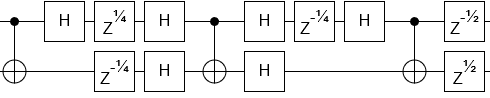
You should be able to encode it directly into the composer.

What you want to do is a rotation on the subspace spanned by $|01\rangle$ and $|10\rangle$ which rotates it by $\sqrt{X}$. To this end, you can first do a CNOT, which maps this subspace to $\{|01\rangle,|11\rangle\}$. Now you need to do the $\sqrt{X}$ rotation on the first qubit, conditioned on the second qubit being one. Implementing controlled-$U$ gates using CNOTs is a standard construction, which can be found in a range of places, see e.g. https://arxiv.org/abs/quant-ph/9503016. Depending how you do this step, you might have to fix the "global" phase of the 1st qubit (given the 2nd is $|1\rangle$). Finally, you need to undo the CNOT.

Every 2-qubit gate has a "Paulinomial decomposition" which means it can be written as a polynomial of Pauli matrices.
For the gate you want:
$ \sqrt{ \mbox{SWAP} } = \begin{bmatrix} 1 & 0 & 0 & 0 \\ 0 & \frac{1}{{2}} (1+i) & \frac{1}{{2}} (1-i) & 0 \\ 0 & \frac{1}{{2}} (1-i) & \frac{1}{{2}} (1+i) & 0 \\ 0 & 0 & 0 & 1 \\ \end{bmatrix} = \frac{1-i}{4}\left(X_1X_2+Y_1Y_2+Z_1Z_2\right) +\frac{3+i}{2}I, $
where $X_i$ is an $X$ gate applied to the $i^\textrm{th}$ qubit.

