I always like to see and prove this visually:
One can find $A$,$B$ and $C$ points on the plane such that
\begin{align*}
\overrightarrow{AB}&={\overrightarrow{u}}\\ {\overrightarrow{BC}}&=\overrightarrow{v}\\
\overrightarrow{AC}&=\overrightarrow{AB}+\overrightarrow{BC}=\overrightarrow{u}+\overrightarrow{v}.
\end{align*}
Now fix points $A$ and $B$.
The questions that arise are the following: if we could move C to another position C', how should we move it such that:
- the vectors $\overrightarrow{BC}$ and $\overrightarrow{BC'}$ have
the same length:
$\lvert\overrightarrow{BC'}\rvert=\lvert\overrightarrow{v}\rvert=\lvert\overrightarrow{BC}\rvert$?
- the distance
$\lvert\overrightarrow{AC'}\rvert=\lvert{\overrightarrow{u}+\overrightarrow{v}}\rvert$ from $A$ to $C'$ is the largest possible?
- what value would this largest distance take?
In other words, how should we rotate the vector $\overrightarrow{v}={\overrightarrow{BC}}$ around B such that the distance $\lvert\overrightarrow{u}+\overrightarrow{v}\rvert=\lvert\overrightarrow{AC}\rvert$ from $A$ to $C$ maximizes? What will be the max value?
The answer to $(1)$ are all the points $C'$ in the plane belonging to the circle with centre B and radius $\lvert{\overrightarrow{BC'}}\rvert=\lvert{\overrightarrow{v}}\rvert$.
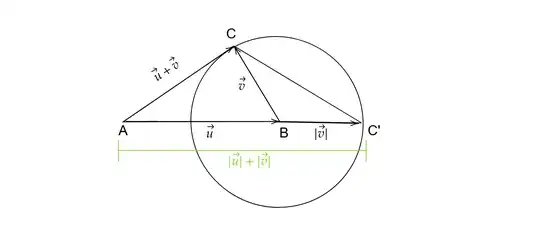
Geometrically, the answer to $(2)$ seems to be the point $C'$ in the figure.
If this is the case, then the answer to (3) is obvious: $$\lvert{\overrightarrow{AC'}}\rvert=\lvert{\overrightarrow{AB}+\overrightarrow{BC'}}\rvert=\lvert{\overrightarrow{AB}}\rvert+\lvert{\overrightarrow{BC'}}\rvert
=\lvert{\overrightarrow{u}}\rvert+\lvert{\overrightarrow{v}}\rvert.$$
But why $C'$ in the figure is the right point?
We can use simple arguements from Euclidean Geometry to prove this arguement:
For the triangle $\triangle C'BC$ we have $\lvert{\overrightarrow{BC}}\rvert=\lvert{\overrightarrow{BC'}}\rvert$, hence the angles $\widehat{BC'C}=\widehat{BCC'}$ will be equal. We also have $\widehat{BCC'}\leq \widehat{ACC'}$, hence $\widehat{AC'C}=\widehat{BC'C}=\widehat{BCC'}\leq \widehat{ACC'}$. The last inequality holds for the triangle $\triangle ACC'$, and so the same inequality will hold for the segments that are opposite to these angles on that triangle:
$$\widehat{AC'C}\leq \widehat{ACC'}\implies \lvert{\overrightarrow{AC}}\rvert\leq \lvert{\overrightarrow{AC'}}\rvert.$$
Particularly, it holds that
\begin{align*}
\lvert{\overrightarrow{u}+\overrightarrow{v}}\rvert&=\lvert{\overrightarrow{AB}+\overrightarrow{BC} }\rvert\\
&=\lvert{\overrightarrow{AC}}\rvert\\
&\leq \lvert{\overrightarrow{AC'}}\rvert\\
&=\lvert{\overrightarrow{AB}}\rvert+\lvert{\overrightarrow{BC'}}\rvert\\
&=\lvert{\overrightarrow{AB}}\rvert+\lvert{\overrightarrow{BC}}\rvert\\
&=\lvert{\overrightarrow{u}}\rvert+\lvert{\overrightarrow{v}}\rvert
\end{align*}
which is exactly the triangle inequality and the reason that is called that way.


