Below is a introduction that contains some background to my question. The question is found at the bottom.
By calculating the eigenvalues of the matrix defined by the recurrence:
$\displaystyle T(n,1)=1, T(1,k)=1, n \geq k: -\sum\limits_{i=1}^{k-1} T(n-i,k), n<k: -\sum\limits_{i=1}^{n-1} T(k-i,n)$
mentioned in: Do these series converge to the von Mangoldt function? we get eigenvalues whose signs appear to be equal to a rearrangement of the Möbius function but whose magnitudes differ:
Example: The $6 \times 6$ determinant equal to zero:
$$\begin{vmatrix} 1-\lambda&1&1&1&1&1 \\ 1&-1-\lambda&1&-1&1&-1 \\ 1&1&-2-\lambda&1&1&-2 \\ 1&-1&1&-1-\lambda&1&-1 \\ 1&1&1&1&-4-\lambda&1 \\ 1&-1&-2&-1&1&2-\lambda \end{vmatrix}=0$$
gives eigenvalues:
{-5.2439, -3.4641, 3.4641, 2.5169, -2.2730, 0}
Compare this with the eigenvalues from the $7$x$7$ determinant:
{-6.8444, -5.2217, -3.4641, 3.4641, 3.0150, -1.9489, 0}
From Todd Timberlake's paper "Random numbers and random matrices: Quantum chaos meets number theory" (2005-2006) I learned that one needs to unfold the eigenvalues in order to plot their distribution. I did not understand the unfolding process so I asked Todd Timberlake via email how to do it for a finite list of eigenvalues (all in all $11$ eigenvalues in my mail). In the answer he said that the unfolding approximation method should not be applied to only $11$ eigenvalues.
From his paper I also read the following sentence:
"Furthermore, it indicates that if the prime numbers are eigenvalues of some quantum system, then the classical counterpart of that system should be integrable."
Putting the lambdas "$\lambda$" along the diagonal rarely seems to give integer values. Instead we can try putting them at all elements:
$$\begin{vmatrix} 1-\lambda&1-\lambda \\ 1-\lambda&-1-\lambda \end{vmatrix}=0$$
This gives the equation:
$$-2 + 2 \lambda = 0$$
and we see that $\lambda$ is integer.
Now this works up to a $4$x$4$ matrix or so, after that the $\lambda$:s become zero. But this is not the right thing to do as this is like taking the determinant of the original matrix. And because $\lambda$ is not an eigenvalue anymore we will instead of $\lambda$ use $x$.
Another option is to insert the $-x$ into the recurrence instead. Now this gives the sequence of real numbers I am going to ask a question about, but with negative signs. Because I want the sequence to be positive I therefore insert "$x$" into the recurrence which then becomes:
$\displaystyle T(n,1)=1, T(1,k)=1, n \geq k: x -\sum\limits_{i=1}^{k-1} T(n-i,k), n<k: x -\sum\limits_{i=1}^{n-1} T(k-i,n)$
This then gives a matrix that starts as this $6$x$6$ determinant equal to zero:
$$\begin{vmatrix}1&1&1&1&1&1 \\ 1&-1+x&1&-1+x&1&-1+x \\ 1&1&-2+x&1&1&-2+x \\ 1&-1+x&1&-1&1&-1+x \\ 1&1&1&1&-4+x&1 \\ 1&-1+x&-2+x&-1+x&1&2-2x \end{vmatrix} = 0$$
which results in the equation:
$\displaystyle 180 x - 306 x^2 + 184 x^3 - 46 x^4 + 4 x^5 = 0$
for which the $5$ solutions are:
$\displaystyle x=0,\; x=3/2,\; x=2,\; x=3,\; x=5$
The polynomials for the $1$ x $1$ to $n$ x $n$ determinants start:
$\displaystyle \begin{align*} &1=0\\ &-2+x=0\\ &6-5 x+x^2=0\\ &-6 x+5 x^2-x^3=0\\ &30 x-31 x^2+10 x^3-x^4=0\\ &180 x-306 x^2+184 x^3-46 x^4+4 x^5=0\\ &-1260 x+2322 x^2-1594 x^3+506 x^4-74 x^5+4 x^6=0\\ &1260 x^2-2322 x^3+1594 x^4-506 x^5+74 x^6-4 x^7=0\\ &-2520 x^3+4644 x^4-3188 x^5+1012 x^6-148 x^7+8 x^8=0\\ &-25200 x^3+61560 x^4-59744 x^5+29248 x^6-7552 x^7+968 x^8-48 x^9=0 \end{align*}$
The $n$:th polynomial appears to have $n-1$ solutions, when counting solutions equal to zero, and $n$:th polynomial also appears to have those $n-1$ solutions in common with the $n+1$:th polynomial. This allows us to order the solutions which then become the following infinite sequence $a_n$ starting:
$\displaystyle a_n = (), 2,3,0,5,\frac{3}{2},7,0,0,\frac{5}{3},11,0,13,\frac{7}{4},\frac{15}{7},0,17,0,19,0,\frac{7}{3},\frac{11}{6},23,0,0,\frac{13}{7},0,0,29,\frac{15}{11},31...$
The number of distinct primes dividing the number $n$, $\omega(n)$, appears to describe this sequence and there are similarities with the Möbius function. But I find it difficult to understand $\dfrac{15}{7}$, for example.
The Mathematica program for printing the matrix for the determinant with its polynomial and solutions is:
Clear[nn, t, n, k, M, x];
nn = 12; (*size of matrix*)
t[n_, 1] = 1;
t[1, k_] = 1;
t[n_, k_] :=
  t[n, k] =
   If[n < k,
    If[And[n > 1, k > 1], x - Sum[t[k - i, n], {i, 1, n - 1}], 0],
    If[And[n > 1, k > 1], x - Sum[t[n - i, k], {i, 1, k - 1}], 0]];
M = Table[Table[t[n, k], {k, 1, nn}], {n, 1, nn}];
MatrixForm[M]
Det[M] (*polynomial*)
Solve[Det[M] == 0, x] (*solutions to the polynomial*)
My question is: Are all the primes found among the solutions to the polynomials above? And can you describe the sequence of solutions $a_n$ using $\omega(n)$?
Edit: 16.9.2011
Plot of the 32:nd polynomial:
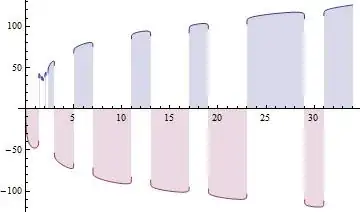
Edit 2: 16.9.2011
The Mathematica code for the plot is:
Clear[nn, t, n, k, M, x];
nn = 32;(*size of matrix*)t[n_, 1] = 1;
t[1, k_] = 1;
t[n_, k_] :=
  t[n, k] =
       If[n < k,
    If[And[n > 1, k > 1], x - Sum[t[k - i, n], {i, 1, n - 1}], 0],
    If[And[n > 1, k > 1], x - Sum[t[n - i, k], {i, 1, k - 1}], 0]];
M = Table[Table[t[n, k], {k, 1, nn}], {n, 1, nn}];
MatrixForm[M];
Plot[{Log[Det[M]], -Log[-Det[M]]}, {x, 0, nn + 2}, Filling -> Axis]
Edit 18.11.2012: It appears that by using the formula by Wolfgang Schramm, one gets the terms of the sequence $a_n$ as solutions to much simpler polynomials that have the form:
$$\sum\limits_{k=1}^{k=n} T(n,k) \cdot \cos(-2 \pi \frac{k}{n}) = 0$$
But this way there is only one solution per polynomial compared to the determinant polynomial that gives n-1 consecutive terms of the sequence $a_n$ as its solutions.
Edit 3.7.2022:
Replace $x$ with $i*(-1)^{(-s)}$ and solve for $s$ instead:
(*start*)TableForm[Table[Clear[nn, t, n, k, M, x, c];
  nn = mm;
  t[n_, 1] = 1;
  t[1, k_] = 1;
  t[n_, k_] :=
   t[n, k] =
    If[n < k,
     If[And[n > 1, k > 1],
      I*(-1)^(-s) - Sum[t[k - i, n], {i, 1, n - 1}], 0],
     If[And[n > 1, k > 1],
      I*(-1)^(-s) - Sum[t[n - i, k], {i, 1, k - 1}], 0]];
  M = Table[Table[t[n, k], {k, 1, nn}], {n, 1, nn}];
  MatrixForm[M];
  Det[M]; FullSimplify[(s /. Solve[Det[M] == 0, s])], {mm, 2, 10}]]
MatrixForm[M]
TableForm[N[%%, 14]]
(*end*)
$$M=\left( \begin{array}{cccccccccc} 1 & 1 & 1 & 1 & 1 & 1 & 1 & 1 & 1 & 1 \\ 1 & -1+i (-1)^{-s} & 1 & -1+i (-1)^{-s} & 1 & -1+i (-1)^{-s} & 1 & -1+i (-1)^{-s} & 1 & -1+i (-1)^{-s} \\ 1 & 1 & -2+i (-1)^{-s} & 1 & 1 & -2+i (-1)^{-s} & 1 & 1 & -2+i (-1)^{-s} & 1 \\ 1 & -1+i (-1)^{-s} & 1 & -1 & 1 & -1+i (-1)^{-s} & 1 & -1 & 1 & -1+i (-1)^{-s} \\ 1 & 1 & 1 & 1 & -4+i (-1)^{-s} & 1 & 1 & 1 & 1 & -4+i (-1)^{-s} \\ 1 & -1+i (-1)^{-s} & -2+i (-1)^{-s} & -1+i (-1)^{-s} & 1 & 2-2 i (-1)^{-s} & 1 & -1+i (-1)^{-s} & -2+i (-1)^{-s} & -1+i (-1)^{-s} \\ 1 & 1 & 1 & 1 & 1 & 1 & -6+i (-1)^{-s} & 1 & 1 & 1 \\ 1 & -1+i (-1)^{-s} & 1 & -1 & 1 & -1+i (-1)^{-s} & 1 & -1-i (-1)^{-s} & 1 & -1+i (-1)^{-s} \\ 1 & 1 & -2+i (-1)^{-s} & 1 & 1 & -2+i (-1)^{-s} & 1 & 1 & -2-i (-1)^{-s} & 1 \\ 1 & -1+i (-1)^{-s} & 1 & -1+i (-1)^{-s} & -4+i (-1)^{-s} & -1+i (-1)^{-s} & 1 & -1+i (-1)^{-s} & 1 & 4-4 i (-1)^{-s} \end{array} \right)$$
Solving for $s$ appears to give always real part one half:
$$\begin{array}{llllll} \frac{1}{2}+\frac{i \log (2)}{\pi } & \text{} & \text{} & \text{} & \text{} & \text{} \\ \frac{1}{2}+\frac{i \log (2)}{\pi } & \frac{1}{2}+\frac{i \log (3)}{\pi } & \text{} & \text{} & \text{} & \text{} \\ \frac{1}{2}+\frac{i \log (2)}{\pi } & \frac{1}{2}+\frac{i \log (3)}{\pi } & \text{} & \text{} & \text{} & \text{} \\ \frac{1}{2}+\frac{i \log (2)}{\pi } & \frac{1}{2}+\frac{i \log (3)}{\pi } & \frac{1}{2}+\frac{i \log (5)}{\pi } & \text{} & \text{} & \text{} \\ \frac{1}{2}+\frac{i \log \left(\frac{3}{2}\right)}{\pi } & \frac{1}{2}+\frac{i \log (2)}{\pi } & \frac{1}{2}+\frac{i \log (3)}{\pi } & \frac{1}{2}+\frac{i \log (5)}{\pi } & \text{} & \text{} \\ \frac{1}{2}+\frac{i \log \left(\frac{3}{2}\right)}{\pi } & \frac{1}{2}+\frac{i \log (2)}{\pi } & \frac{1}{2}+\frac{i \log (3)}{\pi } & \frac{1}{2}+\frac{i \log (5)}{\pi } & \frac{1}{2}+\frac{i \log (7)}{\pi } & \text{} \\ \frac{1}{2}+\frac{i \log \left(\frac{3}{2}\right)}{\pi } & \frac{1}{2}+\frac{i \log (2)}{\pi } & \frac{1}{2}+\frac{i \log (3)}{\pi } & \frac{1}{2}+\frac{i \log (5)}{\pi } & \frac{1}{2}+\frac{i \log (7)}{\pi } & \text{} \\ \frac{1}{2}+\frac{i \log \left(\frac{3}{2}\right)}{\pi } & \frac{1}{2}+\frac{i \log (2)}{\pi } & \frac{1}{2}+\frac{i \log (3)}{\pi } & \frac{1}{2}+\frac{i \log (5)}{\pi } & \frac{1}{2}+\frac{i \log (7)}{\pi } & \text{} \\ \frac{1}{2}+\frac{i \log \left(\frac{3}{2}\right)}{\pi } & \frac{1}{2}+\frac{i \log \left(\frac{5}{3}\right)}{\pi } & \frac{1}{2}+\frac{i \log (2)}{\pi } & \frac{1}{2}+\frac{i \log (3)}{\pi } & \frac{1}{2}+\frac{i \log (5)}{\pi } & \frac{1}{2}+\frac{i \log (7)}{\pi } \end{array}$$
Edit a while later:
A more eigenvalue like equation:
(*start*)
mmm = 6;
TableForm[Table[Clear[nn, t, n, k, M, x, c];
  nn = mm;
  t[n_, 1] = 1;
  t[1, k_] = 1;
  t[n_, k_] :=
   t[n, k] =
    If[n < k,
     If[And[n > 1, k > 1], -Sum[t[k - i, n], {i, 1, n - 1}], 0],
     If[And[n > 1, k > 1], -Sum[t[n - i, k], {i, 1, k - 1}], 0]];
  M = Table[Table[t[n, k], {k, 1, nn}], {n, 1, nn}];
  MatrixForm[M];
  Det[M];
  FullSimplify[(s /.
     NSolve[Det[M - I*(-1)^(s)*IdentityMatrix[mm]] == 0, s])], {mm, 1,
    mmm}]]
MatrixForm[M - I*(-1)^(s)*IdentityMatrix[mmm]]
(*end*)
where key equation is:
NSolve[Det[M - I*(-1)^(s)*IdentityMatrix[mm]] == 0, s]
$$\left( \begin{array}{cccccc} 1-i (-1)^s & 1 & 1 & 1 & 1 & 1 \\ 1 & -1-i (-1)^s & 1 & -1 & 1 & -1 \\ 1 & 1 & -2-i (-1)^s & 1 & 1 & -2 \\ 1 & -1 & 1 & -1-i (-1)^s & 1 & -1 \\ 1 & 1 & 1 & 1 & -4-i (-1)^s & 1 \\ 1 & -1 & -2 & -1 & 1 & 2-i (-1)^s \end{array} \right)$$
This gives numerical zeros:

But those don't have the same consistent signs on the real part.
Added 26.12.2022:
(*start*)
(*Mathematica*)
Clear[nn, t, n, k, M, x];
nn = 16;(*nn = the size of the matrix*)
t[n_, 1] = 1;
t[1, k_] = 1;
t[n_, k_] :=
  t[n, k] =
   If[n < k,
    If[And[n > 1, k > 1],
     1/n^(-x - 1) - Sum[t[k - i, n], {i, 1, n - 1}], 0],
    If[And[n > 1, k > 1],
     1/k^(-x - 1) - Sum[t[n - i, k], {i, 1, k - 1}], 0]];
M = Table[Table[t[n, k], {k, 1, nn}], {n, 1, nn}];
MatrixForm[M]
polynomial = Det[M];
Factor[polynomial]
(*end*)
$$t(\text{n$\_$},1)=1; t(1,\text{k$\_$})=1; t(\text{n$\_$},\text{k$\_$})\text{:=}t(n,k)=\text{If}\left[n<k,\text{If}\left[n>1\land k>1,\frac{1}{n^{-x-1}}-\sum _{i=1}^{n-1} t(k-i,n),0\right],\text{If}\left[n>1\land k>1,\frac{1}{k^{-x-1}}-\sum _{i=1}^{k-1} t(n-i,k),0\right]\right]$$
6x6 matrix:
$$\left( \begin{array}{cccccc} 1 & 1 & 1 & 1 & 1 & 1 \\ 1 & 2^{x+1}-1 & 1 & 2^{x+1}-1 & 1 & 2^{x+1}-1 \\ 1 & 1 & 3^{x+1}-2 & 1 & 1 & 3^{x+1}-2 \\ 1 & 2^{x+1}-1 & 1 & -2^{x+1}+4^{x+1}-1 & 1 & 2^{x+1}-1 \\ 1 & 1 & 1 & 1 & 5^{x+1}-4 & 1 \\ 1 & 2^{x+1}-1 & 3^{x+1}-2 & 2^{x+1}-1 & 1 & -2^{x+2}-3^{x+1}+6^{x+1}+2 \end{array} \right)$$
The factored determinant has the Euler product for the Riemann zeta function in it:
$$45\ 2^{x+4} \left(2^x-1\right)^3 \left(3^x-1\right)^2 \left(5^x-1\right)$$
The determinant of the 16x16 matrix also has the Euler product as a factor in it:
$$875875\ 2^{7 x+15} 3^{x+6} \left(2^x-1\right)^8 \left(3^x-1\right)^5 \left(5^x-1\right)^3 \left(7^x-1\right)^2 \left(11^x-1\right) \left(13^x-1\right)$$
when setting $x=-s$, that is.


And the zeros appear where non-square-free integers would lie. – 2'5 9'2 Sep 13 '11 at 14:56