Consider a 3x3 chessboard with 9 elements. The elements are colored with black and white paints.
The task is to find the number of different chessboards of this type exist.
I don't know how to start with this problem....
Consider a 3x3 chessboard with 9 elements. The elements are colored with black and white paints.
The task is to find the number of different chessboards of this type exist.
I don't know how to start with this problem....
Suppose that rotating them does not matter, then we have two colors for each square and
so a total of $2^9$ possibillities.
For the other case, (possibillities that can be made by rotation of another possibillity are considered the same) we can use group theory. I will asume here that the bottom of the board is just black. Because we have $4$ possible roations and no mirroring (because the bottom of the board is black) we get as symmetry group $C_4$, the cyclic group of order $4$. No we will check the orbis of the squares after rotations. This will give us the following: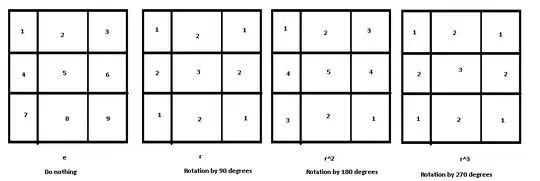
So for the total possibillities we get (by The Counting Theorem): $$ \frac{1}{|G|}\sum_{g\in G} |X^g| = \\ \frac{1}{|C_4|} (1\cdot 2^9 + 4 \cdot 2^3 + 2 \cdot 2^5+ 4 \cdot 2^3)= \\ \frac{1}{4}(1\cdot 2^9 + 4 \cdot 2^3 + 2 \cdot 2^5+ 4 \cdot 2^3)= 160. $$ Where $X$ is the set of colourings of the chessboard and $X^g$ is the subset of $X$ consisting of those points which are left fixed by the element $g \in G$. So this will give us a total of $160$ chessboards, If the back of the chessboard is also in account, for example see-through, please add this to the question. This will give the symmetric group $D_4$ and some extra possobillities, for if you want to work it out.

If you consider rotations and reflections to be the same.
Number of $n\times n$ binary matrices under action of dihedral group of the square $D_4$.
$$a(n)=\begin{cases}\dfrac{1}{8}\left(2^{n^2}+2\cdot2^{n^2/4}+3\cdot2^{n^2/2}+2\cdot2^{(n^2+n)/2}\right) & n= 0\pmod2 \\ \dfrac{1}{8}\left(2^{n^2}+2\cdot2^{(n^2+3)/4}+2^{(n^2+1)/2}+4\cdot2^{(n^2+n)/2}\right)& n= 1\pmod2\end{cases}$$ \begin{align*} a(3)&=\,\dfrac{1}{8}\left(2^{3^2}+2\cdot2^{(3^2+3)/4}+2^{(3^2+1)/2}+4\cdot2^{(3^2+3)/2}\right)\\ &=\,\dfrac{1}{8}\left(2^{9}+2\cdot2^3+2^5+4\cdot2^6\right)=\dfrac{2^9+2^4+2^5+2^8}{8}=\,\quad{\large\color{red}{102}} \end{align*}

