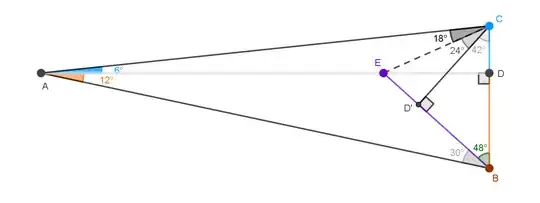
Consider a $\triangle ABC$ with $\angle A = 18^{\circ},~\angle B = 78^{\circ},~\angle C = 84^{\circ}$. The height $\overline{AD} \perp \overline{BC}$ splits the apex into $\angle DAC = 6^{\circ}$ and $\angle DAB = 12^{\circ}$ as shown below, sideways.
Prove for a point $E \in \overline{AD}$ along the height, $|BE| = |BC|$ if and only if $\angle EBC = 48^{\circ}$.
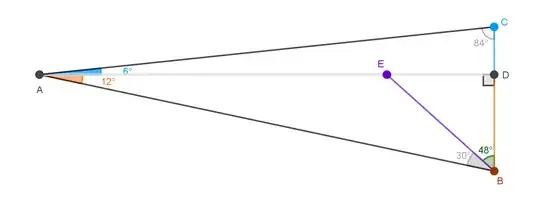 Purely geometric proofs are preferred (using Law of Sines is fine), but the intrigue of this problem is more conveniently expressed trigonometrically:
$$\cos 48^{\circ} = \frac{ \tan 12^{\circ} }{ \tan 6^{\circ} + \tan 12^{\circ} } = \frac{ \sin 12^{\circ} \cos 6^{\circ} }{ \cos 12^{\circ} \sin 6^{\circ} + \sin 12^{\circ} \cos 6^{\circ} } $$
or
$$\cos 48^{\circ} = \frac{ \sin 12^{\circ} \cos 6^{\circ} }{ \sin 18^{\circ} } \hspace{154pt}$$
Namely, $\cos 48^{\circ}$ as a fraction somehow exactly expresses the addition-formula-decomposition of $\sin 18^{\circ}$ into $6^{\circ} + 12^{\circ}$.
Purely geometric proofs are preferred (using Law of Sines is fine), but the intrigue of this problem is more conveniently expressed trigonometrically:
$$\cos 48^{\circ} = \frac{ \tan 12^{\circ} }{ \tan 6^{\circ} + \tan 12^{\circ} } = \frac{ \sin 12^{\circ} \cos 6^{\circ} }{ \cos 12^{\circ} \sin 6^{\circ} + \sin 12^{\circ} \cos 6^{\circ} } $$
or
$$\cos 48^{\circ} = \frac{ \sin 12^{\circ} \cos 6^{\circ} }{ \sin 18^{\circ} } \hspace{154pt}$$
Namely, $\cos 48^{\circ}$ as a fraction somehow exactly expresses the addition-formula-decomposition of $\sin 18^{\circ}$ into $6^{\circ} + 12^{\circ}$.
I have proved the above algebraically, along with several other interesting trigonometric identities associated with this construct. The special angle here is $48^{\circ}$, but in the end the identities become "pentagonal" (it's all about angles $18^{\circ}$ and $36^{\circ}$).
The trigs deserve a separate post (and I've noticed many existing posts about related identities). Here I'm looking for a geometric argument or insight. Here are some vaguely relevant examples demonstrating how I imagine trigonometry-heavy questions can be "understood": a, b (simpler examples for "pentagonal identity"), and 1, 2, 3, 4, 5 (more complex constructs). One can see that I'm pretty lost now and these reference might not even make sense for my context.
Maybe Ceva's Theorem is necessary ($E$ being the concurrent point inside $\triangle ABC$), but I don't know how to implement it in this context without ending up doing trigonometry. The concept of Ceva is certainly geometric (and not algebraic), and embedding in a 30-gon (or 15-gon) is good perspective, but I just don't want crucial steps to rely on trigonometric calculations. In case this whole thing is not as simple as I thought, techniques from projective geometry is welcomed.
This problem emerged from an equilateral triangle configuration involving $\{6^{\circ}, 12^{\circ}, 18^{\circ} \}$. The original context is unhelpful and distracting; as an auxiliary equilateral triangle, it seems like a massive overkill (accompanying angles $\{66^{\circ}, 54^{\circ}, 42^{\circ}, 24^{\circ}\}$ etc are seen left and right). I isolated the construct to present it here.
Failed Attempts
My hunch is that the most sensible underlying geometry of this $48^{\circ}$ (relating to splitting $18^{\circ}$ into $6^{\circ} + 12^{\circ}$) is to view $\overline{BE}$ as one of the isosceles edges of $\triangle BEB'$ as shown below. Point $B'$ in the top right corner of the diagram is the reflection of $B$ with respect to $\overline{AD}$.
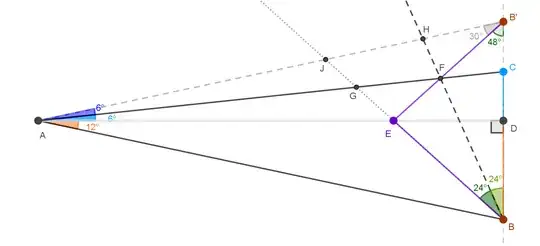 The intended perspective is to view the auxiliary bigger isosceles $\triangle ABB'$ as the "whole picture", to take advantage of the symmetries (with respect to $\overline{AD}$ and $\overline{BH}$) that wasn't explicit.
Everywhere you look, there are angles of special values, angle-biesctors, similar triangles, and isosceles triangles. For example, trying to prove the congruency $\triangle BEB' \equiv \triangle BCG$ seems like a viable strategy. However, so far I haven't found a way out of the tautology of angle-chasing and length-matching.
A similar idea about hidden symmetry is to reflect the entire $\triangle ABC$ with respect to $\overline{BH}$ such that $\overline{BE}$ is the base for the mirrored apex $A'$. The other mirrored vertices are $B'=B$ and $C'=E$ as seen below. This also seemed promising due to the existing $\angle E$ matching $\angle C = 84^{\circ}$ (as in its half $\angle BED = 42^{\circ}$), but it led nowhere.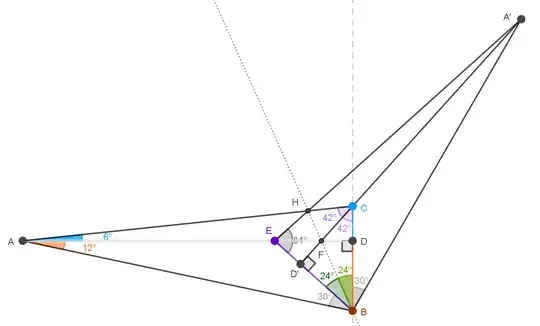
Alternatively, going small, to gain insight from the auxiliary $\overline{CF} \perp \overline{BE}$ constructed below, I failed in the same fashion, just seeing things work nicely but making circular arguments and getting redundant results.