8

How to simplify the following? $$\frac{\sin(102 ^{\circ}) \sin({24} ^{\circ})-\sin({156} ^{\circ})\sin({54}^{\circ})}{\cos({102} ^{\circ}) \sin({24}^{\circ})-\cos({156} ^{\circ})\sin({54} ^{\circ})}$$

My attempt: $$\frac{\sin(102^{\circ}) \sin({24} ^{\circ})-\sin({156} ^{\circ}) \sin({54}^{\circ})}{\cos({102}^{\circ}) \sin({24} ^{\circ})-\cos({156} ^{\circ})\sin({54} ^{\circ})}$$

$$=\frac{ \cos({78}^{\circ})-\cos({126}^{\circ})-\cos({102}^{\circ})+ \cos({210}^{\circ})}{\sin(78^{\circ})+ \sin(126^{\circ})-\sin(102^{\circ})-\sin(210^{\circ})}$$

$$=\frac{ \sin(12^{\circ})+ \sin(36^{\circ})+ \sin(12^{\circ})-\sin(120^{\circ})}{\sin(78^{\circ})+ \sin(54^{\circ})-\sin(78^{\circ})+ \sin(30^{\circ})}$$

$$=\frac{ 2\sin(12^{\circ})+ \sin(36^{\circ})-\sin(60^{\circ})}{\sin(54^{\circ})+\sin(30^{\circ})}$$ But I don’t know how to continue.

I know I can keep splitting the angle using the double-angle formula, but that will make things really messy. The pattern in the question is beautiful but I don’t know how to take advantage of it. Can someone please help with hints for the solution?

Edits: I encountered this problem in this Olympiad Math Competition Q3, where I used the law of sines and got the above expression. I was not allowed to use any calculator during the competition. I know the answer is going to be nice, and this expression should be simplified to the tangent of something. With this context, what steps should I follow to simplify the expression?

Edit2: I understand how to approach this problem now. Based on @Math Guy’s solution, we break the sine and cosine using the product-to-sum formula, then rewrite everything in terms of tangent, trying to make use of $\tan(60^\circ-\theta)\tan(\theta)\tan(60^\circ+\theta)=\tan3\theta$. I would love to see if there are more useful identities like this.

Mr. W
  • 785
  • Hint. Make $x=6 {}^{\circ}$ in your last expression. – Claude Leibovici Dec 14 '24 at 10:05
  • If $x=6^\circ$, the final expression becomes $\frac{ 2\sin2x+ \sin6x-\sin10x}{\sin9x+\sin5x}$ which simplifies to $\frac{2\sin^2 4x}{\sin7x}\tan2x$. Do I need to express everything using $\tan x$? that is a lot of work. – Mr. W Dec 14 '24 at 10:20
  • 1
    Your original question Q3 is a geometric question. If there's a way to start from there, instead of your expression, and get to the answer $6$ more intuitively than from the fraction above, then can one write an answer on that? – Sarvesh Ravichandran Iyer Dec 17 '24 at 12:48
  • @SarveshRavichandranIyer I’m looking for that too. The suggested solution involved adding 3 new points and 9 new lines, which I’m not that talented to spot out. I think the trigonometric solution is probably the most intuitive one. – Mr. W Dec 17 '24 at 14:03
  • 1
    @Mr.W I'm not surprised that additional constructions were required. There are two reasons why. One is that the left-over angle $102 = 180-54-24$ satisfies $54+24+24=102$. On top of that, there are two sides which are identical to each other but not adjacent, so it makes sense to cut and paste the triangle $CPB$ onto the side $AC$ so that $CB$ lies on $AP$. – Sarvesh Ravichandran Iyer Dec 17 '24 at 14:16

9 Answers9

11

You made a small error in the first step, but that doesn't affect the value of the given expression as $\sin(180^\circ-\theta)=\sin\theta$:

$$\require{cancel}\frac{\sin102^{\circ}\sin{24}^{\circ}-\sin{156}^{\circ}\sin{54}^{\circ}}{\cos{102}^{\circ}\sin{24} ^{\circ}-\cos{156}^{\circ}\sin{54}^{\circ}}$$ $$=\frac{\cos{78}^{\circ}-\cos{126}^{\circ}-\cos{102}^{\circ}+ \cos{210}^{\circ}}{\color{red}+\sin78^{\circ}+ \sin126^{\circ}\color{red}-\sin102^{\circ}-\sin210^{\circ}}$$

Since $2\cos A\sin B=\sin(A+B)-\sin(A-B)$, it should've been $$\frac{\cos{78}^{\circ}-\cos{126}^{\circ}-\cos{102}^{\circ}+ \cos{210}^{\circ}}{-\sin78^{\circ}+\sin126^{\circ}+\sin102^{\circ}-\sin210^{\circ}}$$ $$=\frac{\sin12^{\circ}+\sin36^{\circ}+\sin12^{\circ}-\sin60^{\circ}}{\cancel{-\sin78^{\circ}}+\sin54^{\circ}\cancel{+\sin78^{\circ}}+\sin30^{\circ}}$$ $$=\frac{2\sin12^\circ+(\sin36^\circ-\sin60^\circ)}{\sin30^\circ+\sin54^\circ}$$ $$=\frac{\sin12^\circ-\cos48^\circ\sin12^\circ}{2\sin42^\circ\cos12^\circ}$$ $$=\tan12^\circ\cot42^\circ\left(\frac{1-\cos48^\circ}{\sin48^\circ}\right)$$

Using the identity $\frac{1-\cos\theta}{\sin\theta}=\tan\frac\theta2$, the expression becomes

$$\tan12^\circ\tan24^\circ\tan48^\circ$$ $$=\tan24^\circ\frac{(\tan48^\circ\tan12^\circ\tan72^\circ)}{\tan72^\circ}$$

Using the identity $\tan(60^\circ-\theta)\tan\theta\tan(60^\circ+\theta)=\tan3\theta$, we get

$$\frac{\tan36^\circ\tan24^\circ}{\tan72^\circ}$$ $$=\frac{\tan36^\circ\tan24^\circ\tan84^\circ}{\tan72^\circ\tan84^\circ}$$ $$=\frac{\cancel{\tan72^\circ}}{\cancel{\tan72^\circ}\tan84^\circ}$$ $$=\boxed{\tan6^\circ}$$

Integreek
  • 8,530
  • 1
    Why was I downvoted? – Integreek Dec 17 '24 at 14:49
  • 1
    That is genuinely a great solution, I didn't know that tangent identity and it is very useful! Already upvoted. Maybe someone thinks that downvoting others could increase the chance of receiving the bounty. I would accept an answer after a week. – Mr. W Dec 17 '24 at 14:58
10

Formulae $$-2\sin\left(\frac{A+B}{2}\right)\sin\left(\frac{A-B}{2}\right)=\cos(A)-\cos(B)\\2\cos\left(\frac{A+B}{2}\right)\sin\left(\frac{A-B}{2}\right)=\sin(A)-\sin(B)$$ gives (angles expresed in degrees) $$\frac{\sin(102 ^{\circ}) \sin({24} ^{\circ})-\sin({156} ^{\circ}) \sin({54}^{\circ})}{\cos({102} ^{\circ}) \sin({24} ^{\circ})-\cos({156} ^{\circ})\sin({54} ^{\circ})}=E=\frac{(\cos(78)+\cos(210))-(\cos(126)+\cos(102))}{-(\sin(210)+\sin(78))+(\sin(126)+\sin(102))}$$ $$E=\frac{(\sin(12)+\cos(30))-(-\cos(54)-\sin(12))}{-(\sin(30)+\cos(12))+(\sin(54)+\cos(12))}=\frac{2\sin(12)+\cos(30)+\cos(54)}{\sin(54)-\sin(30)}$$ $$\boxed{E=\frac{2\sin(12)-2\sin(12)\sin(42)}{2\sin(42)\cos(12)}=\tan(12)\left(\frac{1}{\sin(42)}-1\right)}$$ We can verify that, in fact $$\frac{\sin(102 ^{\circ}) \sin({24} ^{\circ})-\sin({156} ^{\circ}) \sin({54}^{\circ})}{\cos({102} ^{\circ}) \sin({24} ^{\circ})-\cos({156} ^{\circ})\sin({54} ^{\circ})}\approx 0.105104235266\approx \tan(12)\left(\frac{1}{\sin(42)}-1\right)$$

TonyK
  • 68,059
Ataulfo
  • 32,657
  • The answer should be $\tan(6^\circ)$ – Mr. W Dec 15 '24 at 02:29
  • I did not tell the answer in my question because I was afraid that people might go “verifying the answer” instead of “finding a solution”. – Mr. W Dec 15 '24 at 02:41
  • @Mr. W: In fact, $\tan(6^{\circ})$ also gives the value 0.105104235266. Then $\tan(6^\circ)=\tan(12)\left(\dfrac{1}{\sin(42)}-1\right)$ – Ataulfo Dec 16 '24 at 21:03
  • @Mr.W: Note that $42=30+12$ and try to get tan or sin or cos of $12$ degrees which is $2\times6$ – Ataulfo Dec 16 '24 at 22:28
  • I know how to check the answer numerically by calculator, but I just want to know how to get the answer mathematically. More importantly, what is the thinking process of this kind of problem? – Mr. W Dec 17 '24 at 04:37
  • @TonyK: Thanks you by the edition . I cannot see what have you changed because of my deficient English but I'm sure it was a good thing. – Ataulfo Dec 18 '24 at 12:23
  • @Piquito: I changed the '$=$' signs in the last line to '$\approx$'. – TonyK Dec 18 '24 at 12:30
  • @Mr. W: My English is not good so i cannot fully perceive the meaning of the thinking process of this kind of problem. What I can say about it is to know enough trigonometric identities. On the other hand how you can verify that the largest simplification is $\tan(6^{\circ})$? without a calculator? the answer is Believe in your trigonometric knowledge – Ataulfo Dec 18 '24 at 12:33
  • @Tony K: A change, strictly speaking, correct. Thank you very much. – Ataulfo Dec 18 '24 at 12:36
  • @Piquito: I have filled some contexts. In that question, I was about to take the arctangent of that expression as the final answer, so I know that $\tan(6^\circ)$ is the only answer. I am sorry that I did not say that when you were answering this question. It is quite hard to know whether an expression is the simplest. “Believe in your trigonometric knowledge” is a very good suggestion, I’m here to enrich my trigonometric knowledge. – Mr. W Dec 18 '24 at 12:55
  • @Mr. W: Actually your problem is not as easy as I would wanted to have. – Ataulfo Dec 19 '24 at 17:00
5

Here's a somewhat mechanical algebraic proof. We need to show

$$ A=\frac{\sin(102 ^{\circ}) \sin({24} ^{\circ})-\sin({156} ^{\circ})\sin({54}^{\circ})}{\cos({102} ^{\circ}) \sin({24}^{\circ})-\cos({156} ^{\circ})\sin({54} ^{\circ})} = \tan 6^\circ = B $$

Let's use $t = e^{i 6^\circ}$, and also the identities $\cos x = \frac{e^{ix}+e^{-ix}}{2}$ and $\sin x = \frac{e^{ix}-e^{-ix}}{2i}$, then we get

$$ A=\frac{1}{i}\frac{(t^{17}-t^{-17})(t^4-t^{-4})-(t^{26}-t^{-26})(t^9-t^{-9})}{(t^{17}+t^{-17})(t^4-t^{-4})-(t^{26}+t^{-26})(t^9-t^{-9})} $$

We can get rid of negative powers by multiplying numerator and denominator with $t^{35}$ and using $z=t^2$:

$$ A=\frac{1}{i} \frac{(z^{17}-1)(z^4-1)z^7 -(z^{26}-1)(z^9-1)}{(z^{17}+1)(z^4-1)z^7 -(z^{26}+1)(z^9-1)} $$

Using $z^{30}=1$, we can also use $z^{-4}$ instead of $z^{26}$ and $z^{-13}$ instead of $z^{17}$:

$$ A=-\frac{1}{i} \frac{(z^{13}-1)(z^4-1)-(z^{4}-1)(z^9-1)z^2}{(z^{13}+1)(z^4-1)-(z^{4}+1)(z^9-1)z^2} $$

Fully expanding the numerator and the denominator, we get

$$ A = -\frac{1}{i} \frac{z^{17} - z^{15} - z^{13} + z^{11} + z^6 - z^4 - z^2+1}{z^{17} - z^{15} - z^{13} - z^{11} + z^6 + z^4 + z^2-1} $$

Now, $B$ can also be expressed in terms of $t$ and $z$ as:

$$ B = \frac{1}{i}\frac{t-t^{-1}}{t+t^{-1}} = \frac{1}{i}\frac{t^2-1}{t^2+1} = \frac{1}{i}\frac{z-1}{z+1} $$

In other words, what we should show is that

$$ -\frac{z^{17} - z^{15} - z^{13} + z^{11} + z^6 - z^4 - z^2+1}{z^{17} - z^{15} - z^{13} - z^{11} + z^6 + z^4 + z^2-1} = \frac{z-1}{z+1} $$

Moving LHS to RHS, it turns into showing that

$$\begin{align} &(z-1)(z^{17} - z^{15} - z^{13} - z^{11} + z^6 + z^4 + z^2-1) \\ + &(z+1)(z^{17} - z^{15} - z^{13} + z^{11} + z^6 - z^4 - z^2+1)=0 \end{align}$$

Again, when fully expanded, this turns into

$$ 2 (z^{18}-z^{16}-z^{14}+z^{11}+z^7-z^4-z^2+1)=0 $$

The LHS in the latest expression is divisible by $\Phi_{30}(z) = z^8 + z^7 - z^5 - z^4 - z^3 + z + 1$, the $30$-th cyclotomic polynomial, which is also the minimal polynomial of $z$, i.e. $\Phi_{30}(z)=0$. $\square$

In retrospect, this is quite an inefficient and demanding way to work with it, in particular it hardly allows to reach the $\tan 6^\circ$ form, unless you somehow already know that it is the answer and only want to prove it.

The problem itself is also peculiarly unpleasant for this kind of approaches, as you really need to use $\Phi_{30}(z)$, and not something simpler like $z^{30}-1$. I hoped that it would be possible to apply $z^{30}=1$ to the numerator/denominator to get them into a nicer form directly, but evidently it is not the case.

4

You've already simplified it as $$\frac{ 2\sin(12^{\circ})+ \sin(36^{\circ})-\sin(60^{\circ})}{\sin(54^{\circ})+\sin(30^{\circ})}\tag1$$ Using $$\sin A+\sin B=2\sin\frac{A+B}{2}\cos\frac{A-B}{ 2}$$ $$\sin A-\sin B=2\cos\frac{A+B}{2}\sin\frac{A-B}{ 2}$$ we have $$(1)=\frac{ 2\sin(12^{\circ})+2\cos(48^\circ)\sin(-12^\circ)}{2\sin(42^{\circ})\cos(12^{\circ})}$$ which can be written as $$\frac{ \sin(12^{\circ})- \cos(48^\circ)\sin(12^\circ)}{\sin(42^\circ)\cos(12^\circ)}\tag2$$ Multiplying $(2)$ by $\frac{\cos(6^\circ)}{\cos(6^\circ)}(=1)$ and using $$\cos(6^\circ)\sin(12^\circ)=\cos(48^\circ)\sin(18^\circ)\tag3$$ (A proof of $(3)$ is written at the end of this answer)

we have $$\begin{align}(2)&=\frac{\cos(48^\circ)\sin(18^\circ)- \cos(6^\circ)\cos(48^\circ)\sin(12^\circ)}{\cos(6^\circ)\sin(42^\circ)\cos(12^\circ)} \\\\&=\frac{\cos(48^\circ)\sin(6^\circ+12^\circ)-\cos(6^\circ)\cos(48^\circ)\sin(12^\circ)}{\cos(6^\circ)\sin(42^\circ)\cos(12^\circ)} \\\\&=\frac{\cos(48^\circ)(\sin(6^\circ)\cos(12^\circ)+\cos(6^\circ)\sin(12^\circ))-\cos(6^\circ)\cos(48^\circ)\sin(12^\circ)}{\cos(6^\circ)\sin(42^\circ)\cos(12^\circ)} \\\\&=\frac{\cos(48^\circ)\sin(6^\circ)\cos(12^\circ)}{\cos(6^\circ)\cos(48^\circ)\cos(12^\circ)} \\\\&=\tan(6^\circ)\end{align}$$


In the following, I'm going to write a proof of

$$\cos(6^\circ)\sin(12^\circ)=\cos(48^\circ)\sin(18^\circ)\tag3$$

proof :

$$\begin{align}&2\times (RHS-LHS) \\\\&=\sin(66^\circ)-\sin(30^\circ)-\sin(18^\circ)-\sin(6^\circ) \\\\&=\sin(66^\circ)-\sin(18^\circ)-\sin(6^\circ)-\frac 12 \\\\&=\cos(24^\circ)-\cos(84^\circ)-\sin(18^\circ)-\frac 12 \\\\&=2\sin(54^\circ)\sin(30^\circ)-\sin(18^\circ)-\frac 12 \\\\&=\sin(54^\circ)-\sin(18^\circ)-\frac 12 \\\\&=2\sin(18^\circ)\cos(36^\circ)-\frac 12 \\\\&=2\sin(18^\circ)\cos(36^\circ)\times\underbrace{\frac{\cos(18^\circ)}{\cos(18^\circ)}}_{=1}-\frac 12 \\\\&=\frac{2\sin(18^\circ)\cos(18^\circ)\cos(36^\circ)}{\cos(18^\circ)}-\frac 12 \\\\&=\frac{\sin(36^\circ)\cos(36^\circ)}{\cos(18^\circ)}-\frac 12 \\\\&=\frac{\frac 12\sin(72^\circ)}{\cos(18^\circ)}-\frac 12 \\\\&=0.\ \ \blacksquare\end{align}$$

mathlove
  • 151,597
  • 2
    That is an elegant proof! What inspired you to write down $\cos(6^\circ)\sin(12^\circ)=\cos(48^\circ)\sin(18^\circ)$? It seems that it is a very special case. – Mr. W Dec 17 '24 at 14:29
  • 1
    @Mr.W : Thanks! After getting $(2)$, I tried to multiply $(2)$ by $\frac{\cos(6^\circ)}{\cos(6^\circ)}(=1)$ (because I knew this idea sometimes works) and simplifying the numerator. Then, I noticed that all we want is $(3)$ to get $\tan(6^\circ)$. (To be honest, I used the fact that the answer can be written as $\tan(6^{\circ})$.) By the way, $(3)$ is equivalent to the fact that $\cos(36^\circ)-\cos(72^\circ)=\frac 12$ which may be famous. – mathlove Dec 17 '24 at 15:26
  • 1
    That page is very interesting, the complex root of a polynomial can produce many equations such as $\cos\frac{2\pi}{n}+\cos\frac{4\pi}{n}+…+\cos2\pi=0$. That's a very useful tool! – Mr. W Dec 17 '24 at 22:10
  • 1
    @Mr.W : I agree with you! I'll add something which may interest you. In this page, (30) may interest you. See "Finite products of trigonometric functions" here, "Identities without variables" here. Also, you may like here. – mathlove Dec 18 '24 at 06:15
  • What inspired you to multiply and divide by $\cos18^\circ$? It seems not very intuitive to me. – Integreek Dec 18 '24 at 13:58
  • 1
    @Math Guy : I used the method since $\sin(18^\circ)\cos(36^\circ)$ is of the form $\sin(a)\cos(2a)$ (and it did work). I learned this method when I was a high school student. Multiplying $\displaystyle\sin(a)\prod_{k=1}^{n}\cos(2^ka)$ by $\dfrac{\cos(a)}{\cos(a)}$ and using $\sin(A)\cos(A)=\frac 12\sin(2A)$, we have $\dfrac{\sin(2^{n+1}a)}{2^{n+1}\cos(a)}$. – mathlove Dec 19 '24 at 04:34
  • 1
    Oh, I've used this method to simplify $\displaystyle\prod_{k=0}^n\cos(2^kx)$ as $\displaystyle\frac{\sin\left(2^{n+1}x\right)}{\2^n\sin x}$, but now I see this can be used when there is a cosine as well. – Integreek Dec 21 '24 at 13:28
3

The answer is $$x=16\sin 6^\circ\sin12^\circ\sin24^\circ\sin48^\circ.$$ Indeed, the numerator of the given expression is $$\sin24^\circ(\sin78^\circ-\sin54^\circ)=2\sin^224^\circ\sin12^\circ$$ and by your work, the denominator is $$\frac12(\sin54^\circ+\sin30^\circ)=\cos12^\circ\cos48^\circ.$$ I think the rest is clear.

Since $$x\cot6^\circ=16\cos6^\circ\sin12^\circ\sin24^\circ\sin48^\circ\\ =4(2\sin24^\circ\sin84^\circ)(2\sin12^\circ\sin48^\circ)\\=4(\cos60^\circ+\cos72^\circ)(\cos36^\circ-\cos60^\circ)\\ =4(\tfrac12+\tfrac{\phi-1}2)(\tfrac{\phi}2-\tfrac12)\\ =\phi(\phi-1)=1$$ we have $x=\tan6^\circ$.

Note: $\phi=\frac{1+\sqrt5}2$

Bob Dobbs
  • 15,712
  • 3
    Sorry, I don't quite understand where your sine expression comes from. I also don't understand how to simplify that sine product. I only get $x\cos6^\circ=4\sin24^\circ\sin48^\circ-1+cos96^\circ$. Would you like to explain more? – Mr. W Dec 17 '24 at 15:25
  • @Mr.W Sorry, I was talking through my hat in the begining. I edited my answer. – Bob Dobbs Dec 18 '24 at 05:09
2

I simplified the given expression, but its final value $\tan 6^\circ$ evades me. My progress:

Let $N$ be the numerator of the given expression and $D$ be its denominator. Then

$$N=\sin 102^{\circ} \sin {24}^{\circ}-\sin{156}^{\circ}\sin {54}^{\circ}=$$ $$\sin 102^{\circ} \sin {24}^{\circ}-\sin{24}^{\circ}\sin {54}^{\circ}=$$ $$\sin{24}^{\circ}\left(\sin 102^{\circ}-\sin {54}^{\circ}\right)=$$ $$\sin{24}^{\circ}\cdot 2\sin 24^\circ\cos 78^\circ=$$ $$8\sin^2 12^\circ \cos^2 12^\circ\sin 12^\circ.$$

$$D=\cos{102}^{\circ}\sin {24}^{\circ}-\cos{156}^{\circ}\sin{54}^{\circ}=$$ $$-\sin 12^\circ\sin {24}^{\circ}+\cos 24^{\circ}\cos{36}^{\circ}=$$ $$-\frac 12\left(\cos 12^\circ-\cos 36^\circ\right)+\frac 12\left(\cos 60^\circ+\cos 12^\circ\right)=$$ $$\frac 12\left(\cos 36^\circ+\cos 60^\circ\right)=$$ $$\cos 48^\circ\cos 12^\circ.$$

Then $$\frac ND=\frac{8\sin^3 12^\circ\cos 12^\circ}{\cos 48^\circ}=$$ $$\frac{2\cdot\left(3\sin 12^\circ-\sin 36^\circ\right)\cos 12^\circ}{\cos 48^\circ}=$$ $$\frac{3\sin 24^\circ-2\sin 36^\circ\cos 12^\circ}{\cos 48^\circ}=$$ $$\frac{3\sin 24^\circ-\left(\sin 48^\circ+\sin 24^\circ\right)}{\cos 48^\circ}=$$ $$\frac{2\sin 24^\circ-\sin 48^\circ}{\cos 48^\circ}=$$ $$\frac{2\sin 24^\circ\left(1-\cos 24^\circ\right)}{\cos 48^\circ}.$$

Alex Ravsky
  • 106,166
  • 1
    A small mistake. Probably a typo. Please correct. $$\dfrac{N}{D}=\dfrac{2\sin 24^\circ\left(1-\cos 24^\circ\right)}{\cos 48^\circ}.$$ – YNK Dec 20 '24 at 10:17
  • @YNK I corrected the error. Sorry for it and thanks for your attention. – Alex Ravsky Dec 20 '24 at 10:32
2

Another way to solve the original question is via the cot $m$-$n$ theorem which is an application of the sine rule:

$$AC\cot\angle BPA=AP\cot24^\circ-PC\cot54^\circ$$ $$\implies\sin102^\circ\cot(\angle CBP+24^\circ)=\sin54^\circ\cot24^\circ+(\sin54^\circ-\sin102^\circ)\cot54^\circ$$ $$\require{cancel}\begin{align}\implies\cot(\angle CBP+24^\circ)&=\frac{\sin36^\circ}{\cos12^\circ}+\frac{\cos36^\circ\cos24^\circ}{\sin24^\circ\cos12^\circ}-\tan36^\circ\\&= \frac{\sin36^\circ\sin24^\circ+\cos36^\circ\cos24^\circ}{\sin24^\circ\cos12^\circ}-\tan36^\circ\\&=\csc24^\circ-\tan36^\circ\\&=\frac{2\cos6^\circ}{2\sin24^\circ\cos6^\circ}-\frac{\sin36^\circ}{\cos36^\circ}\\&=\frac{2\cos6^\circ}{\frac12+\sin18^\circ}-\frac{\sin36^\circ}{\cos36^\circ}\\&\overset{(1)}{=}\frac{\cos6^\circ+(\cos6^\circ-\cos54^\circ)}{\cos36^\circ}\\&=\frac{\cos6^\circ+\cancel2\cancel{\sin30^\circ}\sin24^\circ}{\cos36^\circ}\\&=\frac{\cos6^\circ+\cos66^\circ}{\cos36^\circ}\\&=\frac{2\cos30^\circ\cancel{\cos36^\circ}}{\cancel{\cos36^\circ}}\\&=\sqrt3\end{align}$$ $$\implies\angle CBP+24^\circ=30^\circ$$ $$\therefore\boxed{\angle CBP=6^\circ}$$

$(1)$: $\frac12+\sin18^\circ=\cos36^\circ$

Proof:

Consider the equation $$\sin3x=\cos2x\tag1$$ $$\implies\cos\left(\frac\pi2-3x\right)=\cos2x$$ $$\implies\frac\pi2-3x=2n\pi\pm2x$$ $$\implies5x, x=2n\pi+\frac\pi2$$ $$\implies\sin x=1,\sin\frac\pi{10},-\sin\frac{3\pi}{10}\tag2$$ Also, observe that $(1)$ can be rewritten as a cubic in $\sin x=t$: $$3t-4t^3=1-2t^2$$ $$\implies4t^3-2t^2-3t+1=0$$ $$\implies(t-1)(4t^2+2t-1)=0\tag3$$ From $(2)$ and $(3)$, $$t^2+\frac{t}2-\frac14=\left(t-\sin\frac\pi{10}\right)\left(t+\sin\frac{3\pi}{10}\right)$$ By Vieta’s formula, $$\sin18^\circ-\sin54^\circ=-\frac12$$ $$\implies\sin18^\circ+\frac12=\sin36^\circ$$ Q.E.D.

Integreek
  • 8,530
2

As i saw the question, i tried to find first a natural geometric proof of problem Q3 in the Olympiad competition, as linked by OP. Now i have one, and although this answer does not have in its main focus the simplification of the given fraction involving trigonometric expression, it may be useful (for the community) so see how the present question emerged from Q3, and how to attack it seeing through the geometric prism. There will be four parts, $\bf(A)$ a natural geometric approach of Q3, $\bf(B)$ how does the OP fraction appear from Q3, and why we want it as $\tan x$ for an explicit angle $x$, $\bf(C)$ a simplification of this fraction (and this part addresses explicitly the question), and $\bf(D)$ an alternative way to attack the Olympiad problem Q3 by trigonometric means.


$\bf(A)$ Yes, i agree, randomly searching for auxiliary points, lines, and circles that solve the problem Q3 in a synthetic manner (three new points and nine new lines is too much!) is risky in the condition of an Olympiad. Trigonometry would be also my weapon of choice. But there is one natural idea! Try to realize the given constellation of points "inside a regular polygon". There is a psychological barrier to do so, when the angles involved are $24^\circ$ and $54^\circ$ with a gcd of $6^\circ$, because this leads to a regular polygon with $180^\circ/6^\circ=30$ sides. (Well, my solutions using regular $n$-gons for similar problems had still a positive echo for $n$ among $3,4,5,6$, but for $n=30$ generally dismissed, although this common multiple covers a lot of regular sub-gons.)

To make it short, here is the realization:
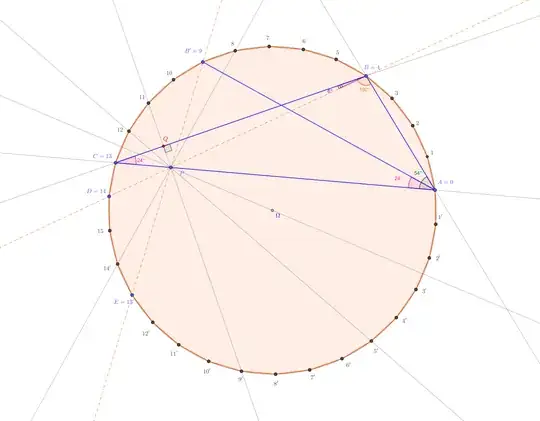
mse problem olympiad hong-kong Q3 2015
solution using a regular 30-gon

The vertices of the $30$-gon are indexed with elements of the group $\Bbb Z/30$ (integers modulo thirty), and we use as representatives $\pm k$ with $k$ from $0$ to $15$. Instead of $-k$ we also write $k'$. Then the given triangle $\Delta ABC$ is realized with $A=0$, $B=4$, and $C=13$. In order to "copy+paste" the segment $BC$ on the line $AC$, it is natural to build the trapezium $CABB'$ with $B'=9$. The point $P$ from the problem makes $\Delta AB'P$ isosceles in $A$ since $AP=BC=AB’$, where $\angle{PAB’}=24^\circ$, so the angles in $B',P$ are $78^\circ$ each. So $B'P$ passes through the vertex $E:=13'$. We also use the point $D=14$, since the problem suggests that the angle in $B$ in $\Delta BCP$ is a "nice angle", and even a raw picture would make us suppose that $BPD$ is a line.

To solve the problem, it is enough to show:

Proposition: (Seven lines concurrence)

The lines $AC=0,13$, and $BD=4,14$, and $B'E=9,13'$ are concurrent in a point $P$ on the common side bisector $b$ of the segments $12,13$ and $0,5'$. The symmetry center $\Omega$ of the $30$-gon is on this side bisector $b$, so through $P$ also pass the reflections $5',12$, and $9',11$, and $8,14'$.

For this, here is a useful lemma, always needed in such situations (when the trigonometric way is allowed). It is also the technique used invariably in such situations in the "555 geometry solutions book". (Solutions to "Geometry in figures", Akopyan, which contains only the problems.) It is Problem 6.10.24 in this book of Chobanov, Dimitrev, Lichev:

Lemma: Let $ABCDEF$ be a cyclic hexagon. Then $AD$, $BE$, $CF$ intersect in a point, iff $AB\cdot CD\cdot EF=BC\cdot DE\cdot FA$.

Proof of the proposition: For the lines $AC$, $BD$, $B'E$ we consider the hexagon $ABB'CDE$, and applying the lemma, we have to show the first and/or the last of the following equivalent relations: $$ \begin{aligned} \underbrace{\sin24^\circ}_{2\sin12^\circ\cos12^\circ} \sin24^\circ\sin18^\circ &= \underbrace{\sin30^\circ}_{1/2}\sin 6^\circ \underbrace{\sin78^\circ}_{\cos 12^\circ} \ , \\ 4\underbrace{\sin12^\circ}_{2\sin6^\circ\cos6^\circ} \sin24^\circ\sin18^\circ &= \sin 6^\circ \ , \\ 8\cos6^\circ\sin24^\circ\sin18^\circ &= 1 \ , \\ 4\Big(\sin(24^\circ+6^\circ)+\sin(24^\circ-6^\circ)\Big)\sin18^\circ &= 1 \ , \\ 2\sin18^\circ +\underbrace{4\sin^2 18^\circ}_{2(1-\cos 36^\circ)} &= 1\ , \\ 1 + 2\cos 72^\circ - 2\cos 36^\circ &= 0\ , \\ 1 + 2\cos 72^\circ + 2\cos 144^\circ &= 0\ , \end{aligned} $$ and the last relation is true, consider the regular pentagon centered in the origin with one vertex in $1$, its center mass is zero, so the sum of projections of the vertices on the $Ox$-axis also vanishes. This shows the first claimed concurrence of $AC,BD,B'E$.

To conclude, we replace one of the lines, $B'E$, by its reflection w.r.t. $b$, which is $8,14'$, and show again the concurrence. (This concludes, since two lines remained, they intersect in the "old" point $P$, which is now on both $B'E$ and its $b$-reflection, so it is on $b$.)

The relation to be shown is: $$ \sin 24^\circ\cdot \underbrace{\sin 30^\circ}_{1/2}\cdot \sin 12^\circ\cdot = \sin 24^\circ\cdot \sin 6^\circ\cdot \underbrace{\sin 84^\circ}_{\cos6^\circ} \ , $$ which is immediate, the formula for the sine of the double angle.

$\square$

This shows the claimed Proposition, and gives a geometric argument for $$ \widehat{CBP} = \widehat{CBD} = \frac 12\overset{\large\frown}{CD}=6^\circ\ . $$ Usually, when a "kind" of an argument is needed geometrically, a similar "kind" of argument is needed also algebrically. Below we will forget about this proof, and restart.


$\bf(B)$ How is the problem Q3 related to the posted question?

Denote by $x$ the angle $x=\widehat{CBP}$. Let $T$ denote the OP fraction, $$ T = \frac {\sin 102^\circ \sin 24^\circ - \sin 156^\circ\sin 54^\circ} {\cos 102^\circ \sin 24^\circ - \cos 156^\circ\sin 54^\circ} \ . $$

Let $Q$ be the projection of $P$ on $BC$. (With the notations from (A), we a posteriori know that $Q$ is on the line $11,9'$ the $b$-reflection of $BD$.)

By the sine theorem, the sides of $\Delta ABC$ are proportional to the sines of the opposite angles, so we may and do rescale and assume that: $$ \begin{aligned} BC &= \sin 54^\circ=\cos 36^\circ\ ,\\ CA &= \sin 102^\circ=\sin 78^\circ=\cos 12^\circ\ ,\\ AB &= \sin 24^\circ\ ,\qquad\text{ and from here:}\\ PC &= AC-AP=AC-BC= \cos 12^\circ -\cos 36^\circ\ ,\\ PQ &= PC\sin 24^\circ = (\cos 12^\circ -\cos 36^\circ)\sin 24^\circ\ ,\\ BQ &= BC-QC=\underbrace{\cos 36^\circ}_{\text{expand }\cos (12^\circ+24^\circ)} - (\cos 12^\circ -\cos 36^\circ)\cos 24^\circ\ ,\\[2mm] \text{Numerator of $T$} &=\sin 102^\circ \sin 24^\circ - \sin 156^\circ\sin 54^\circ\\ &=\sin 78^\circ \sin 24^\circ - \sin 24^\circ\sin 54^\circ=PQ\ ,\\[2mm] \text{Denominator of $T$} &=\cos 102^\circ \sin 24^\circ - \cos 156^\circ\sin 54^\circ\\ &=-\sin 12\sin 24^\circ+\cos 24^\circ\cos36^\circ=BQ\ ,\\[2mm] \tan x &=\frac {PQ}{BQ}=T\ . \end{aligned} $$ This explains the OP strategy to solve the Olympiad problem, and shows that we need an explicit simplification of $T$ in the form of $\tan$ of "something", only this form is useful for obtaining the full one mark for the problem Q3.

An equivalent way would be to use the sine theorem in the form $\displaystyle\frac{\sin(102^\circ-x)}{AP}=\frac{\sin(156^\circ-x)}{AB}$, then expand the sines in terms of $\sin x$, $\cos x$, and isolate the equation for $\tan x$. (The other way is more geometric, and $PQ$ can be "better extracted" for the needs that appear below.)


$\bf(C)$ This part addresses the stated question in the form: "How to simplify the fraction $T$ in five minutes, and which is the reason for the chosen computational path (so that it is not an artificial combination of intermediate relations without natural connection)?"

Because we want to show $T=\tan 6^\circ$, it is important to have product expressions, factors, no addition and subtraction in the numerator and denominator of $T$. At least this is the strategy below. The answer comes only because of the fact, that this strategy works in a (Galois) structural manner, the one good reason to share the thoughts with the community.

A first progress is done by reworking $BQ$, using the picture from $(A)$, and the triangle $\Delta (B,Q,11)$. Its angle in $B$ is $12$ and in our rescaling (radius is $1/2$) $|B,11|=\sin42^\circ=\cos 48^\circ$, so we expect $BQ=\cos12^\circ\cos 48^\circ$, and indeed, this follows from $$ 2\,BQ = \underbrace{2\cos 24^\circ\cos36^\circ}_{=\cos12^\circ+\cos60^\circ} - \underbrace{2\sin 12\sin 24^\circ}_{=\cos12^\circ-\cos36^\circ} = \underbrace{2\cos12^\circ\cos 48^\circ}_{=\cos36^\circ+\cos60^\circ}\ . $$ Also, in the formula for $PQ$ we use the final product form in $$ \cos12^\circ-\cos36^\circ= \cos(24^\circ-12^\circ)-\cos(24^\circ+12^\circ)= 2\sin12^\circ\sin 24^\circ\ $$ And now we are in position to force factors and factorizations, using only angles of the shape $k\cdot 12^\circ$, $k=1,2,4,8,16,\dots$, and try to get rid of the factors in denominator, all but one that should be $\cos 6^\circ$: $$ \small \begin{aligned} T &= \frac{PQ}{BQ} = \frac {2\sin12^\circ\sin^2 24^\circ}{\cos12^\circ\cos 48^\circ} = \frac {4\sin^212^\circ\sin^2 24^\circ}{2\sin12^\circ\cos12^\circ\cos 48^\circ} \\ &= \frac {4\sin^212^\circ\sin 24^\circ}{\cos 48^\circ} = \frac {8\sin^212^\circ\sin 24^\circ\sin48^\circ}{2\sin48^\circ\cos 48^\circ} = \frac {16\cos 6^\circ\sin 6^\circ\sin12^\circ\sin 24^\circ\sin48^\circ}{\sin96^\circ} \\ &=16\sin 6^\circ\sin12^\circ\sin 24^\circ\sin48^\circ \\ &=\frac{\sin6^\circ}{\cos6^\circ}\ \cdot\ \underbrace{16\sin12^\circ\sin 24^\circ\sin48^\circ \sin 96^\circ}_{=1} \\ &=\tan 6^\circ\ . \end{aligned} $$ In order to conclude, let us show that the underbraced product is indeed one:

Lemma: Consider the following expressions $E,F$: $$ \begin{aligned} E &=16\cos12^\circ\cos 24^\circ\cos48^\circ \cos 96^\circ\ , &&\text{then: } & E &= -1\ ,\\ F &=16\sin12^\circ\sin 24^\circ\sin48^\circ \sin 96^\circ\ , &&\text{then: } & F &= +1\ . \end{aligned} $$ We need only the expression for $F$, but OP asks for related or unrelated relations that may be helpful in similar situations.

Proof: Of course, $E\ne 0$, so we get: $$ \begin{aligned} E\sin12^\circ &= 16\cos96^\circ\cos 48^\circ\cos24^\circ \cos 12^\circ\sin12^\circ\\ &= 8\cos96^\circ\cos 48^\circ\cos24^\circ \sin24^\circ\\ &= 4\cos96^\circ\cos 48^\circ\sin48^\circ\\ &= 2\cos96^\circ\sin96^\circ\\ &= \sin192^\circ\\ &= -\sin12^\circ\ . \end{aligned} $$ For $F$ there is no similar trick, but we can compute: $$ \begin{aligned} 4\sin12^\circ\sin48^\circ &= 2\cos36^\circ-2\cos 60^\circ=2\cos36^\circ-1\ , \\[2mm] 4\sin24^\circ\sin96^\circ &= 2\cos72^\circ-2\cos 120^\circ=2\cos72^\circ+1\ , \\[2mm] F&=(4\sin12^\circ\sin48^\circ)(4\sin24^\circ\sin96^\circ) \\ &=(2\cos36^\circ-1)(2\cos72^\circ+1) \\ &=4\cos36^\circ\cos72^\circ +\underbrace{(2\cos36^\circ-2\cos72^\circ-1)}_{=0} \\ &=2\cos(72^\circ-36^\circ) + 2\cos(72^\circ+36^\circ) =2\cos36^\circ-2\cos72^\circ \\ &=1\ . \end{aligned} $$ We have used exactly the same regular pentagon mass point projection argument as in $(A)$. $\square$

Note: An argument from Galois theory for both equalities works as follows. Let $\zeta=\zeta_{30}=\cos \frac\pi{15}+i\sin \frac\pi{15}$ be this primitive cyclotomic root of unity of order $30$. Consider $u=\zeta+\frac 1{\zeta}=2\cos \frac \pi{15}$ and $v=\zeta-\frac 1{\zeta}=2i\sin \frac \pi{15}$. Up to an algebraic unit of norm one, they are $1\pm \zeta^2$, which are elements of norm $1$ over $\Bbb Q$. To compute "the norm", we build the product of all the Galois conjugates. The sign is extracted from the known signs of the factors. Note that the "Frobenius" map $\Phi$ given by $\zeta\to\Phi\zeta:=\zeta^2$ brings $u,v$ in further conjugates, and using them we arrive at the claimed products $E,F$.


$\bf(D)$ Here is an other trigonometric approach for the same Olympiad problem $Q3$.

Let $x$ be the angle to be computed. We start with a proportion of areas, $$ \frac {BC\cdot BP\cdot \sin x} {BP\cdot BA\cdot \sin (102^\circ -x)} = \frac {\operatorname{Area}(BCP)} {\operatorname{Area}(BPA)} = \frac {CP}{PA} = \frac {CP}{BC} \ , $$ which gives: $$ \small \begin{aligned} \frac {\sin x} {\sin (102^\circ -x)} &= \frac{AB\cdot CP}{BC^2} = \frac{\sin24^\circ(\cos 12^\circ- \cos36^\circ)}{\sin^2 54^\circ} = \frac{2\sin12^\circ\sin^2 24^\circ}{\cos^2 36^\circ} \\ &= \frac{4\sin6^\circ\cos6^\circ\sin^2 24^\circ}{\cos^2 36^\circ} = \frac {\sin 6^\circ}{\cos 6^\circ} \cdot \underbrace{\left( \frac{4\cos 6^\circ\sin 24^\circ}{2\cos 36^\circ} \right)^2}_{=1} \ , \end{aligned} $$ because of the same pentagon mass center argument, $$ 4\cos 6^\circ\sin 24^\circ = 2\sin(24^\circ+6^\circ) + 2\sin(24^\circ-6^\circ) = 1+ 2\sin18^\circ = 1+ 2\cos 72^\circ = 2\cos 36^\circ\ . $$ The resulted equation is now rephrased equivalently: $$ \small \begin{aligned} \frac {\sin x} {\sin (102^\circ -x)} &= \frac {\sin 6^\circ}{\cos 6^\circ} \\ 2\sin x\cos 6^\circ &=2\sin (102^\circ -x)\sin 6^\circ\ , \\ \sin(x+6^\circ) + \sin(x-6^\circ) &= \cos(96^\circ-x) - \cos(108^\circ-x) \ , \end{aligned} $$ and observe now that the angles $x-6^\circ$ and $96^\circ-x$ sum up to $90^\circ$, so the corresponding trigonometric function that appear as terms above cancel each other, we obtain then $\sin(x+6^\circ)=-\cos(108^\circ-x)$, i.e. $\sin(x+6^\circ)=\sin(18^\circ-x)$, which leads to $x=6^\circ$.

$\square$


Above there are three more or less different proofs for $x=6^\circ$, $x$ being the wanted angle in $Q3$. One of them addressed directly the simplification of the given expression $T$, the other two are indirect (regarding the question), and give a geometric, respectively a simpler trigonometric approach.

Mr. W
  • 785
dan_fulea
  • 37,952
2

By $x = 6^\circ$ we have

$$\frac{\sin102^\circ\sin24^\circ-\sin156^\circ\sin54^\circ}{\cos102^\circ\sin24^\circ-\cos156^\circ\sin54^\circ} =\frac{\sin(90^\circ+2x)\sin (4x)-\sin(180^\circ-4x)\sin(90^\circ-6x)}{\cos(90^\circ+2x)\sin(4x)-\cos(180^\circ-4x)\sin(90^\circ-6x)}=$$

$$=\frac{\cos(2x)\sin (4x)-\sin(4x)\cos(6x)}{-\sin(2x)\sin(4x)+\cos(4x)\cos(6x)}=\frac{\sin(4x)(\cos(2x)-\cos(6x))}{-\sin(2x)\sin(4x)+\cos(4x)\cos(6x)}=\ldots$$

and, by sum to product and product to sum identities, we obtain

$$\ldots=4\frac{\sin^2(4x)\sin(2x)}{\cos(6x)+\cos(10x)}=2\frac{\sin^2(4x)\sin(2x)}{\cos(8x)\cos(2x)}=\frac{2\tan^2(4x)}{1-\tan^2(4x)}\tan(2x)=\tan(8x)\tan(4x)\tan(2x)$$

with

$$\tan 48^\circ\tan 24^\circ\tan 12^\circ=\tan 6^\circ \tag 1$$

which can be obtained from the general identity

$$\tan \theta\tan(60^\circ-\theta)\tan(60^\circ+\theta)=\tan3\theta$$

using $\theta =6^\circ $ and $\theta =18^\circ $ such that

$$\begin{cases}\tan 6^\circ\tan 54^\circ\tan 66^\circ=\tan 18^\circ \\\\\tan 18^\circ\tan 42^\circ\tan 78^\circ=\tan 54^\circ \end{cases} \implies \tan 6^\circ\tan 42^\circ \tan 66^\circ\tan 78^\circ=1$$

which is equivalent to $(1)$.

user
  • 162,563