100

Inadvertently, I find this interesting inequality. But this problem have nice solution?

prove that $$\ln{2}>(\dfrac{2}{5})^{\frac{2}{5}}$$

This problem have nice solution? Thank you.

ago,I find this $$\ln{2}<\left(\dfrac{1}{2}\right)^{\frac{1}{2}}=\dfrac{\sqrt{2}}{2}$$

following is my some nice methods, use this inequality $$\dfrac{x-y}{\ln{x}-\ln{y}}>\sqrt{xy},x>y$$ then we let $x=2,y=1$

so $$\ln{2}<\dfrac{\sqrt{2}}{2}$$

solution 2:

since $$\dfrac{1}{n+1}\le\dfrac{1}{2}\cdot\dfrac{3}{4}\cdots\dfrac{2n-1}{2n}$$ then $$\ln{2}=\sum_{n=0}^{\infty}\dfrac{1}{(n+1)2^{n+1}}<\sum_{n=0}^{\infty}\dfrac{(2n)!}{(n!)^22^{3n+1}}=\dfrac{1}{\sqrt{2}}$$

solution 3

since $$(1+\sqrt{2})^2(t+1)-(t+1+\sqrt{2})^2=t(1-t)>0$$ so $$\ln{2}=\int_{0}^{1}\dfrac{1}{t+1}dt<\int_{0}^{1}\left(\dfrac{1+\sqrt{2}}{t+1+\sqrt{2}}\right)^2dt=\dfrac{\sqrt{2}}{2}$$ solution 4:

$$\ln{2}=\dfrac{3}{4}-\dfrac{1}{4}\sum_{n=1}^{\infty}\dfrac{1}{n(n+1)(2n+1)}<\dfrac{3}{4}-\dfrac{1}{4}\left(\dfrac{1}{1\times 2\times 3}-\dfrac{1}{2\times 3\times 5}\right)=\dfrac{7}{10}<\dfrac{\sqrt{2}}{2}$$

solution 5 $$\dfrac{1}{\sqrt{2}}-\ln{2}=\sum_{n=1}^{\infty}\dfrac{\sqrt{2}}{(4n^2-1)(17+2\sqrt{2})^n}>0$$

But $$\ln{2}>\left(\dfrac{2}{5}\right)^{\frac{2}{5}}$$ I can't have this nice solution

Thank you everyone can help.

math110
  • 94,932
  • 17
  • 148
  • 519
  • 1
    $\ln 2$ is slightly larger (found numerically). – vadim123 May 03 '13 at 14:08
  • Yes, I hope this ineqaulity have some methods,But I can't – math110 May 03 '13 at 14:11
  • 45
    $\ln 2=0.6931471...,(2/5)^{2/5}=0.6931448...$ Speechless... – JSCB May 03 '13 at 14:11
  • yes, I have see have Mathematical methods to prove,Thank you everyone – math110 May 03 '13 at 14:15
  • Wow, this is difficult...where did you get all these problems? – Shuhao Cao May 03 '13 at 14:23
  • 1
    Thank you @ShuhaoCao, I accidentally found surprised while playing with a calculator – math110 May 03 '13 at 14:25
  • Someone please solve, I keep on refreshing page waiting for answer – Dreamer78692 May 03 '13 at 14:32
  • prove that $2>e^{(\frac{2}{5})^{\frac{2}{5}}}$? – long tom May 03 '13 at 14:42
  • 12
    I know it's not the kind of answer you're looking for, but it's worth pointing out that you can turn a numerical calculation into a rigorous proof by showing for example that $\ln(2)^5=(\int_1^2\frac 1x\mathrm dx)^5>(\frac 1n\sum_{i=1}^n\frac 1{1+i/n})^5>\left(\frac 25\right)^2$, where $n$ is some large positive integer. – Jacob H May 03 '13 at 15:12
  • why $\left(\sum_{i=1}^{n}\dfrac{1}{1+i/n}\right)^5>(\dfrac{2}{5})^2$? @JHH,Thank you – math110 May 03 '13 at 15:19
  • @math110 Well, the left-hand side is a numerical approximation to $(\int_1^2\frac 1x\mathrm dx)^5$ obtained by bounding the area under the curve of $\frac 1x$ by the area of a sequence of rectangles of width $\frac 1n$. And it's not hard to see that the sequence of values obtained converges to the value of the integral. So if the inequality is true, then there is some large value of $n$ such that what I wrote above is a proof that can be checked numerically. But of course I haven't actually shown that the inequality is true. – Jacob H May 03 '13 at 15:33
  • $$x^x~=~a\qquad=>\qquad x~=~\dfrac{\ln a}{W(\ln a)}$$ See Lambert W function for more details. Now, for $a=\ln2$, we have $x=0.4000402600\ldots$ – Lucian Jul 24 '14 at 16:20
  • This approximation is mentioned by Gourdon and Sebah http://plouffe.fr/simon/articles/log2.pdf (page 19) – Jaume Oliver Lafont Jan 08 '16 at 10:35
  • Modifying this integral to evaluate to $\log^5(2)-\left(\frac{2}{5}\right)^{2}$ while keeping the integrand positive would be nice.

    $$\int_0^1 \frac{5\log^4(1+x)}{1+x}dx = \log^5(2) \approx 0.1600027$$

    – Jaume Oliver Lafont Apr 15 '16 at 08:00
  • One possible way of approaching the problem would be to show that the function derived from the limit definition of $\ln(x)$, $f(x)=\left(\frac{2^x-1}{x}\right)^5-\frac{4}{25}$, is strictly increasing near $0$ but has a root around $-10^{-6}$. This proves the inequality since if $\ln(2)^5$ equalled $(2/5)^2$, $f(x)$ should approach $(0,0)$. – Jam Mar 28 '19 at 18:40

8 Answers8

43

This problem seems to be so hard to prove "elegantly" without aid of calculator, is because you have managed to find such a good approximation! One would need to estimate really well to be able to prove that one is greater than the other.

Continued fractions can be used to give a proof:

$$\left(\dfrac{2}{5}\right)^2 = \dfrac{4}{25} = \cfrac{1}{6 + \cfrac{1}{4}}$$ is a convergent of the the continued fraction of $$(\log 2)^5 = [0; 6, 4, 592, 1, \dots]$$ If you take the CF of $(\log 2)^5$ for granted, the proof of what you want falls right out: $\frac{4}{25}$ is a convergent which is smaller (the convergents alternate bigger/smaller).

Note the apperance of the huge $592$ term, which tells you that $\dfrac{4}{25}$ will be a good approximation, because the convergent corresponding to the $592$ term is greater than $(\log 2)^5$.

Perhaps a more compelling "reason" for it being a good approximation is that the continued fractions of $\log 2 = [0; 1, 2, 3, 1, 6, 3, 1, \dots]$ and $\left(\frac{2}{5}\right)^{2/5} = [0; 1, 2, 3, 1, 6, 3, 2,\dots]$, match up to a good $6$ terms! The $7^{\text{th}}$ term tells you that $\log 2$ must be greater: the parity of the position where two CFs first differ determines if the one with the greater number in that position is greater or not (which also explains the alternating property mentioned above).

If you absolutely want a proof which needs no calculator (i.e. can be verified manually in an hour or so :-)), here is one (with calculations missing):

Take the power series

$$\log (1+x) - \log (1-x) = 2\sum_{n=0}^{\infty} \frac{x^{2n+1}}{2n+1}$$

and set $x = \frac{1}{3}$, you get $\log 2$ on the left.

Now you can truncate the power series at any point, and get a smaller number than $\log (1+x) - \log (1-x)$ , as coefficients are all positive.

Now if you truncate the series at $n=4$ (include $n=4$ term) you get the value $\dfrac{4297606}{6200145}$ which is greater than $\left(\dfrac{2}{5}\right)^{2/5}$. This you can see (manually) by computing the fifth power and computing the (numerator of the) difference of the two fractions you get.

I won't go into more details, as they are quite tedious to do so completely manually without the aid of any calculators, and this is probably not what you were expecting anyway.

Interestingly, it might be easier to do the computations if you work in base $9$ or $3$ (because of the powers of $\frac{1}{3}$, you can quickly read off some of the digits, like spigot algorithms).

Aryabhata
  • 83,877
21

$$ \left(2 \over 5\right)^{2/5} = 0.69314\color{#ff0000}{\Large 4}843155146\ldots\,, \qquad\qquad \ln\left(2\right) = 0.69314\color{#ff0000}{\Large 7}180559945\ldots $$

So$\ldots$

Felix Marin
  • 94,079
  • 21
    It is quite telling that your proof, which simple and correct, got downmodded to -2; while Sami's proof, being complex and incorrect, got to +10. This is why no one wants to fund math departments. – DanielV Jan 25 '14 at 21:01
  • 4
    @DanielV If you want to see a more dramatic example, check this. It happens several times. Sometimes ago, I got a closed expression (not a series, just in terms of $\arctan$)for a two dimensional Laplace equation while the other answers where unclear and they don't show the solution. My solution was closed. It's important to point out that the closing was promoted by some user who is always doing "bullying" to my answers. I don't understand what is the moderators role. I never answer that user comments espclly because he/she is anonymous. Thanks. – Felix Marin Mar 21 '14 at 22:58
15

Hmm, first I thought the following would allow to compute the proof mentally, but, well... although I find it a remarkable simplification I'll need the pocket calculator in the end. But let's see:

$$\ln(2) \gt (2 / 5)^{2 /5} = \left({16 \over 100 }\right)^{1/5} $$ We have also $$ \ln(2) = \ln \left( 1+1/3 \over 1-1/3 \right) = 2\left( {1\over3} + {1\over 3^3 \cdot 3} + {1 \over 3^5 \cdot 5}+ \cdots \right) \\ = {2 \over 3} \left( 1 + { 1 \over 9\cdot3 } + {1 \over 81 \cdot 5}+ \cdots ) \right) $$ Turn the factor 2/3 to the the rhs then $$ 1 + 1/27 + 1/81/5+ 1/729/7 \cdots \gt \left( {3^5 \over2 \cdot 100 }\right) ^{1/5}= \left( 1+{43\over 200}\right)^{1/5} $$

Now in general we have for a fifth root $$ (1+x)^{1/5} = 1 + x/5 - 2(x/5)^2 + 6(x/5)^3 - 21(x/5)^4 + 399/5 (x/5)^5 - \cdots $$

Thus we must evaluate $$ 1 + 1/27 + 1/81/5+ 1/729/7 \cdots \gt 1 +43/1000 - 2(43/1000)^2 + \cdots $$

"In principle" this can be done with paper & pen only because the terms decrease quickly, and some adaptions of denominators are possible, however, that was too tidy for me. I found using a calculator (Pari/GP) that we must evaluate the lhs with 4 terms and the rhs with 5 terms (of course excluding the 1's) to get the decision - because after that the partial sums in the lhs still increase but in the rhs decrease.

6

Take $f (x) = \frac {5} {2} \log x + \log 5 - x$. Obviously, $f$ is defined on the interval $]0, \infty[$. Since $f ' (x) = \frac {5} {2x} - 1$, it is easy to see that $f$ increases on $]0, \frac {5} {2}]$, take its maximum at $x = \frac {5} {2}$ and decreases on $[\frac {5} {2}, \infty[$. Also, since $f_{\max} = f (x_{\max}) > 0$ and $f (0+) = f (\infty-) = - \infty$, there are exactly two non-negative real numbers $x_1 < \frac {5} {2}$ and $x_2 > \frac {5} {2}$ such that $f (x_1) = f (x_2) = 0$. Thus, we conclude that $f (x) \geqslant 0$ on $[x_1, x_2]$. Since $x_1 < (2/5)^{2/5} < x_2$, we should have $f \left ((2/5)^{2/5} \right) > 0$, that is, $$\log 2 - (2/5)^{2/5} >0,$$ as desired.

  • 2
    (-1): This answer makes the wholly unprecedented assumption that $x_1<(2/5)^{2/5}$, which is the entire crux of the proof. Without justifying that assumption, this proof is woefully incomplete. – Jam Mar 29 '19 at 20:46
5

Your question is interesting, but it boils down to the property of $x^x$.

You can derive from your inequality an implicit form $y^x \ln^y(x)-x^x$, $y=5$, $x=2$ and simply try to solve by $y$ this equality, $y^x\ln^y(x)-x^x=0$

This equation surprisingly has a closed form solution $y=\frac{x\,W(\ln(\ln(x)))}{\ln(\ln(x))}$ where $W$ is Lambert function, an inversion of $We^W=z$. Now simply:

$$\frac{W(\ln(\ln(2)))}{\ln(\ln(2))} \approx 2.4997... < \frac{5}{2}$$

This is the reason for your inequality.

On the other hand the solution of

$$\frac{W(\ln(\ln(x)))}{\ln(\ln(x))} = \frac{5}{2}$$ is $x=e^{(\frac{2}{5})^\frac{2}{5}} \approx 1.999 < 2$ again fits your inequality

From here you can see that any proof is nothing more than computation exercise and probably the simplest one is to take first few digits of $\ln(2)$ and raise it to fifth power. Lambert function is an object of its own, and if you attach it to something like $\ln(\ln(2))$ you have to expect employing some highly precise technique.

This is the entire and the shortest proof:

$$ (ln(2) \cdot 10^6)^5 > 693145^5=160000181024126357095762965625>0.16 \cdot 10^{30} = (\frac{2}{5})^2 \cdot 10^{30}$$

Interesting part is to explain the reason we have so close match in the first place. One of the interesting equivalent forms is $f(x)=e^{(\frac{1}{x})^\frac{1}{x}}-2$ We want to know what is happening around $f(\frac{5}{2})$

$f(x)=e^{(\frac{1}{x})^\frac{1}{x}}-2$ has the minimum at $e^{(1/e)^{1/e}}-2$ at $x=e$. One of the two zeros is at $x=\frac{W(\ln(\ln(2)))}{\ln(\ln(2))}$ which means $f(\frac{5}{2})<0$
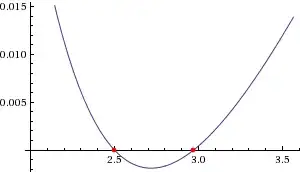
function in the region around 2

Still, this does not explain the closeness of the zero itself to 2.5. Let us look back to $y=\frac{x\,W(\ln(\ln(x)))}{\ln(\ln(x))}$
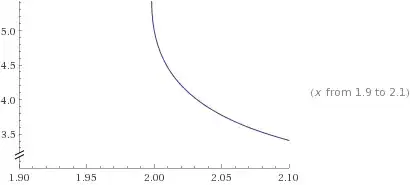
almost vertical slope

The reason the point $x=2,y=5$ is so close to the curve $y=\frac{x\,W(\ln(\ln(x)))}{\ln(\ln(x))}$ is that the function is almost vertical around 2.

After some not so difficult calculations you can find that the first derivative of $y=\frac{x\,W(\ln(\ln(x)))}{\ln(\ln(x))}$ has one of the factors as $\frac{1}{W(\ln(\ln(x))) + 1}$ and this is the key point since $W(\ln(\ln(x)))=-1$ has the solution $x=e^{(1/e)^{1/e}}$ which is as we have shown smaller than but very close to 2.

We have $y(e^{(1/e)^{1/e}})=e \cdot e^{(1/e)^{1/e}} \approx 5.43...$ Since the function is almost vertical around 2, this means that moving from 5.43 to 5 we would still remain close to 2.

In essence, a really technically complete proof requires to find a good estimation for

$$\frac{e \cdot e^{(\frac{1}{e})^{\frac{1}{e}} }-5}{2-e^{(\frac{1}{e})^{\frac{1}{e}}}}$$

and to prove that this is larger than the average slope for $y=\frac{x\,W(\ln(\ln(x)))}{\ln(\ln(x))}$ in the interesting region. This would mean that we could not reach 2 going from $e^{(1/e)^{1/e}}$ down the slope.

However, this or any similar method would require the precision that is definitely higher than purely calculating six-digit fifth power, but it is interesting to reveal the magic behind the inequality nevertheless.

  • Is the other zero related to $log(2)\approx\left(\frac{1}{3}\right)^\frac{1}{3}$? – Jaume Oliver Lafont Jan 04 '16 at 15:38
  • Yes. $e^{(\frac{y}{x})^{\frac{y}{x}}}-2=0$ has two real solutions $y=\frac{x\ln(\ln(2))}{W(\ln(\ln(2)))} \approx 0.40004x \approx \frac{2}{5}x $ and $y=\frac{x\ln(\ln(2))}{W_{-1}(\ln(\ln(2)))} \approx 0.33663x \approx \frac{1}{3}x$ From the graph above, it is obvious that 3 is close to another zero of $e^{(\frac{1}{x})^\frac{1}{x}}-2$ as well. –  Jan 04 '16 at 18:10
  • So we have $$\left(\frac{2}{5}\right)^\frac{2}{5} < log(2) <\left(\frac{1}{3}\right) ^\frac{1}{3}$$ – Jaume Oliver Lafont Jan 27 '16 at 22:28
4

There is a remarkable series converging to $\ln(2)$ on Wikipedia: $$\ln(2)=\sum_{k=0}^\infty\frac{2}{2k+1}\left(\frac{7}{31^{2k+1}}+\frac{3}{161^{2k+1}}+\frac{5}{49^{2k+1}}\right)$$ although I don't see a source for why this is true.

Summing just the $k=0$ and $k=1$ terms, gives $$\begin{align} \ln(2)&>\frac{29558488681560}{42643891494953}\\ \ln(2)&>0.693147\\ \left(\ln(2)\right)^5&>(0.693147)^5\\ \left(\ln(2)\right)^5&>0.160002\\ \left(\ln(2)\right)^5&>\frac{4}{25}\\ \ln(2)&>\left(\frac{2}{5}\right)^{2/5}\\ \end{align}$$

2'5 9'2
  • 56,991
  • 1
    This is a Machin like formula related to

    $log(2)=2*\left(7atanh\left(\frac{1}{31}\right)+3atanh\left(\frac{1}{161}\right)+5atanh\left(\frac{1}{49}\right)\right)$

    http://numbers.computation.free.fr/Constants/Log2/log2.html

    – Jaume Oliver Lafont Jan 04 '16 at 16:02
1

Using the Taylor series $$\ln \frac{1+x}{1-x} = \ln (1 + x) - \ln(1 - x) = 2\sum_{k=0}^\infty \frac{x^{2k+1}}{2k+1}, \quad -1 < x < 1;$$ letting $x = 1/3$, we have $$\ln 2 = 2\sum_{k=0}^\infty \frac{1}{3^{2k+1}(2k+1)}. \tag{1}$$

Using Bernoulli inequality, we have, for all $a > 0$, $$(2/5)^{2/5} = \frac{1}{a^2}\left(\frac{2}{5}a^5\right)^{2/5} \le \frac{1}{a^2}\left(1 + \left(\frac{2}{5}a^5 - 1\right)\cdot \frac25\right) = \frac{4}{25}a^3 + \frac{3}{5a^2}$$ with equality if and only if $a^5 = \frac52$.

It suffices to prove that, there exists $a > 0$ such that $$\frac{4}{25}a^3 + \frac{3}{5a^2} < \ln 2.$$ When $a^5 \approx \frac 52$, from $\frac{4}{25}a^3 + \frac{3}{5a^2} = \frac{4a^5}{25a^2} + \frac{3}{5a^2} \approx \frac{4\cdot (5/2)}{25a^2} + \frac{3}{5a^2} \approx \ln 2$, we have $a^2 \approx \frac{1}{\ln 2} \approx \frac{81}{56} = 1.4464$ and $a \approx 1.2$ where we have used (1) to get $\ln 2 \approx 2\sum_{k=0}^1 \frac{1}{3^{2k+1}(2k+1)} = \frac{56}{81}$. Letting $a = \frac{6}{5}$, it suffices to prove that $$\frac{4}{25}(6/5)^3 + \frac{3}{5(6/5)^2} < \ln 2.$$ Using (1), we have $$\ln 2 > 2\sum_{k=0}^5 \frac{1}{3^{2k+1}(2k+1)} = \frac{15757912}{22733865}.$$ It suffices to prove that $$\frac{4}{25}(6/5)^3 + \frac{3}{5(6/5)^2} < \frac{15757912}{22733865}$$ which is true.

We are done.

River Li
  • 49,125
0

The Newton-Raphson method for $x=\left(\frac{2}{5}\right)^{2/5}$ is $x_{n+1}=\frac45x_n+\frac{4}{125x_n^4}$. Take $x_0=1$ and assume that each $x_n\geq\left(\frac{2}{5}\right)^{2/5}$. Compute the iterations up to $x_5=0.693145$, using a sufficient level of precision, around $6$ decimals. Finally, compute the upper bound of $e^{x_5}$ with the first $8$ terms of its Taylor series plus another $8$th term.

$$1.999997=\sum_{n=0}^8\frac{(x_5)^n}{n!}+\frac{(x_5)^8}{8!}\geq e^{x_5}\geq e^{\left[\left(\frac25\right)^{2/5}\right]}$$

Therefore, $\ln(2)\geq\left(\frac25\right)^{2/5}$. The exercise is a question of how few arithmetic operations you need to reach the inequality. This method has a total of $36$ multiplications, $16$ divisions and $14$ additions *, which is feasible to do within an hour or so, despite being rather tedious.


* Each Newton-Raphson iteration takes $5$ multiplications, $2$ divisions and $1$ addition. For $n>0$, each term in the series takes at most $2$ multiplications, assuming the previous power of $x_5$ and factorial were stored. Each term also requires $1$ division and $1$ addition. The $n=0$ and repeated $n=8$ terms of the series are single additions.

Jam
  • 10,632
  • 3
  • 29
  • 45
  • we may take out the assumption of $x_n\geq(2/5)^{2/5}$ by demonstrating a change of sign of $25x^5-4$ around $0.693145$. This adds some multiplications and additions to our total of arithmetic operations.
  • – Jam Mar 29 '19 at 20:48