-1

How can I find the radius of a circle inscribed like below?

I thought about this formula

$$r=\frac{2A}{p}$$ with $A$ as area, $p$ as perimeter and $r$ as the radius of the inscribed circle, but I do not know whether it is befitting.enter image description here
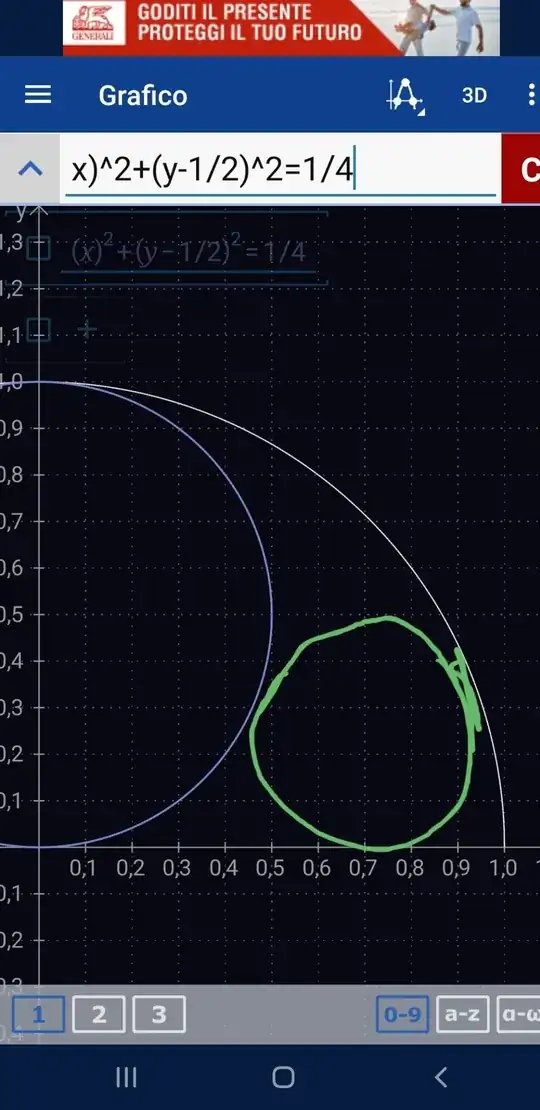
us er
  • 150
  • Solve for the positive value of $y$ when $x=0$ in the figure, that's the diameter. Then divide by 2. – 79037662 Sep 19 '19 at 18:41
  • The formula $r = \frac{2A}{p}$ only works for those figure all of its tangent lines are at a common distance to the center of inscribed circle. This isn't the case here. Instead, you are placing a small circle inside a semi-circle. The radius of small circle is 1/2 of that of semicircle. – achille hui Sep 19 '19 at 18:44
  • No, I mean the iscribed circle between the half circle and the bigger fourth of circle – us er Sep 19 '19 at 18:52
  • 1
    Why didn't you try to improve https://math.stackexchange.com/questions/3359069/radius-of-a-circle-inscribed-in-a-figure instead of cluttering the site with a new copy of the same thing? – Gerry Myerson Sep 20 '19 at 06:42
  • That was not a copy, the first one was general, while this one was specific for this case. – us er Sep 20 '19 at 09:38
  • 1
    It's close enough that you ought to have included in each question a link to the other. – Gerry Myerson Sep 22 '19 at 02:52

1 Answers1

1

Method 1 - boring coordinate geometry.

Let

  • $A = (0,\frac12)$ be the center of the blue circle with radius $\frac12$.
  • $B = (x,y)$ be the center of the green circle and $r$ be its radius.

Since the distance between $B$ and $x$-axis is $r$, $y = r$.

Since the distance between $B$ and origin is $1-r$, we have

$$x^2 + r^2 = (1-r)^2 \implies x^2 = (1-r)^2 - r^2 = 1 - 2r$$

Since the distance between $A$ and $B$ is $\frac12+r$, we have

$$x^2 + \left(\frac12-r\right)^2 = \left(\frac12+r\right)^2 \implies x^2 = \left(\frac12+r\right)^2 - \left(\frac12-r\right)^2 = 2r $$

Combine these, we get $1-2r = 2r \implies r = \frac14$.

Method 2 - circle inversion

Under circle inversion with respect to the unit circle.

  • The circular arc of the semicircle get mapped to itself.
  • The green circle of radius $\frac12$ get mapped to the line $y = 1$.
  • The blue circle get mapped to a circle sandwiched between $x$-axis and the line $y = 1$.

This means the diameter of the inverted blue circle is $1$. The nearest and farthest points on it are at a distance $1$ and $2$ from the origin. Invert it back, the farthest and nearest points on the original blue circle is at a distance $1$ and $\frac12$ from the origin.

From this, we can deduce the radius of blue circle $r = \frac12(1 - \frac12) = \frac14$.

Method 3 - consult the oracle (aka google)

This question looks familiar and I thought I have seen this before. A google search reveals similar questions have been asked at least two times before (and I have even answered one of them).

  1. Circle inscribed in a semicircle (5 months ago)
  2. Two tangent circles are inscribed in a semicircle, one touching the diameter's midpoint; find the radius of the smaller circle (9 months ago)
achille hui
  • 125,323
  • 1
    More recently, https://math.stackexchange.com/questions/3359069/radius-of-a-circle-inscribed-in-a-figure was something like this (and from the same user, us er). – Gerry Myerson Sep 20 '19 at 06:40
  • 2
    @GerryMyerson hmm... you are right, the OP should improve that question instead of creating this one. – achille hui Sep 20 '19 at 06:57