We will approach this problem two fold.
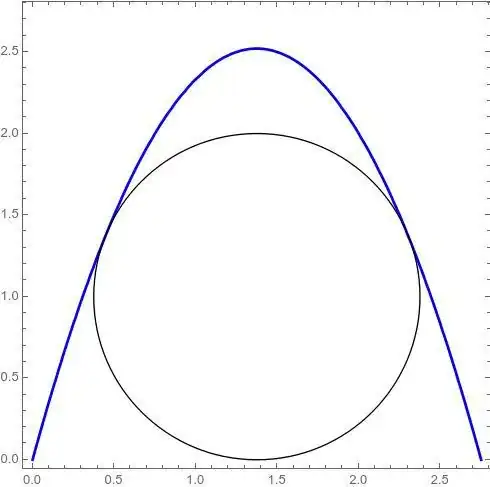
$A-$Two contacts between the path and the circle. $\left(\frac dr \le 1.375\right)$
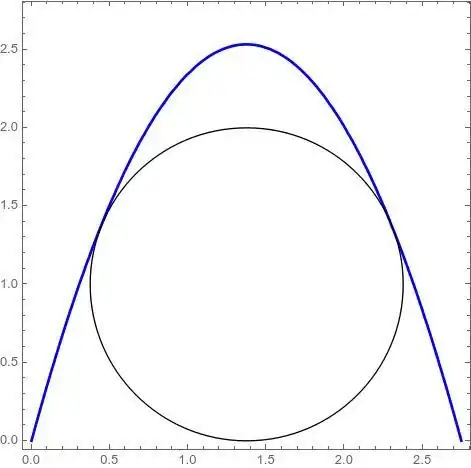
$B-$One contact between the path and the circle. $\left(1.375\lt \frac dr\right)$
For the first case, we will use a tangency technique and for the second case, a Lagrange multipliers formulation.
Case $A$:
Giving
$$
\cases{
y = a x + b x^2\\
(x-d)^2+(y-r)^2= r^2
}
$$
eliminating $y$ we get
$$
p(x)=d^2-2 d x-2 a r x+a^2 x^2-2 b r x^2+x^2+2 a b x^3+b^2 x^4=0
$$
Now, having two tangent points $(x_1,x_2)$ then should be true for $\forall x$, that $p(x)=k(x-x_1)^2(x-x_2)^2$ or
$$
\left\{
\begin{array}{rcl}
d^2-k x_1^2 x_2^2 & = &0\\
-2 a r-2 d+2 k x_1^2 x_2+2 k x_1 x_2^2 & = & 0 \\
a^2-2 b r-k x_1^2-4 k x_1 x_2-k x_2^2+1 & = & 0\\
2 a b+2 k x_1+2 k x_2 & = & 0\\
b^2-k & = & 0\\
\end{array}
\right.
$$
Solving we get
$$
\cases{
k=\frac{1}{4 (d-r)^2}\\
x_1=d-\sqrt{d (2 r-d)}\\
x_2=d+\sqrt{d (2 r-d)}\\
a=\frac{d}{d-r}\\
b=-\frac{1}{2 (d-r)}
}
$$
We know also that
$$
\cases{
a = u\tan\theta\\
b = -\frac{g}{2u^2\cos^2\theta}
}
$$
so for $1\le \frac dr\le 1.375$ we can use this formulation to solve the problem.
Case $B$:
Here the problem is solved using the lagrangian
$$
\cases{
g_1(x,y,u,s,c) = y- u \frac sc x + \frac{g x^2}{u^2c^2} = 0\\
g_2(s,c) = s^2+c^2-1 = 0\\
g_3(x,y) = (x-d)^2+(y-r)^2-r^2 = 0\\
L(x,y,u,s,c,\lambda_i,\mu,\delta) = u + \lambda_1g_1(x.y,u,s,c)+\lambda_2 g_2(s,c) + \lambda_3 g_3(x,y)+\lambda_{4,5}\left(\nabla_{x,y}g_1 - \mu\nabla_{x,y}g_3\right)+\lambda_6\left(\frac sc-\frac{2\tan(r/d)}{1-\tan²(r/d)}-\delta^2\right)
}
$$
Here, the last constraint, reveals that the start angle understood as $\theta^*$, obeys $ = \arctan(s^*/c^*) > \arctan\left(\frac{2\tan(r/d)}{1-\tan²(r/d)}\right)$
Follows a MATHEMATICA script illustrating the cases $A$ and $B$
(*****************************)
(**  for 1 <= d/r <= 1.375  **)
(*****************************)
Clear[k]
g1 = y - (a x + b x^2);
g2 = (x - d)^2 + (y - r)^2 - r^2;
g3 = First[Eliminate[{g1 == 0, g2 == 0}, y]] - k (x - x1)^2 (x - x2)^2;
coefs = CoefficientList[g3, x];
sols = Quiet@Solve[coefs == 0, {k, x0, x1, x2, a, b}];
parms = {d -> 1.375, r -> 1, g -> 10};
solb = Solve[g (a^2 + u^2) == -2 b u^4, u][[2]];
sols0 = {u, a, b} /. solb /. sols /. parms;
choosed = {};
For[k = 1, k <= Length[sols0], k++,
  If[RealValuedNumberQ[N[sols0[[k, 1]]]],
   AppendTo[choosed, sols0[[k]]]]];
choosed = Sort[choosed];
choosed // N
g10 = g1 /. Thread[{a, b} -> {choosed[[1, 2]], choosed[[1, 3]]}] /. parms;
Show[ContourPlot[g10 == 0, {x, 0, 2 d} /. parms, {y, 0, 2 d} /. parms], Graphics[Circle[{d, r}, r] /. parms], PlotRange -> {{0, 2 d}, {0, 2 d}} /. parms, ImageAspectRatio -> 1]
(*****************************)
(**    for 1.375 <= d/r     **)
(*****************************)
g1 = y - u  sin/cos x + 1/2 g x^2/u^2/cos^2;
g2 = (x - d)^2 + (y - r)^2 - r^2;
g3 = sin^2 + cos^2 - 1;
L = u + lambda1 g1 + lambda2 g2 + lambda3 g3 + {lambda4, lambda5}.(Grad[g1, {x, y}] - mu Grad[g2, {x, y}]) + lambda6 (sin/cos - N[2 Tan[r/d]/(1 - Tan[r/d]^2)] - s^2);
vars = {x, y, u, t, sin, cos, lambda1, lambda2, lambda3, lambda4, lambda5, lambda6, mu, s};
equs = Grad[L, vars];
parms = {g -> 10, d -> 1.375, r -> 1};
equs0 = equs /. parms;
sols = Quiet@Solve[equs0 == 0, vars];
nsols = Length[sols];
psols = {u, ArcTan[sin/cos], (2 u^3 cos sin)/g} /. parms /. sols /. {C[1] -> 0} // N;
choosed = {};
For[k = 1, k <= nsols, k++,
 If[RealValuedNumberQ[psols[[k, 1]]] && psols[[k, 3]] > ((d + r) /. parms) && psols[[k, 1]] > 0, AppendTo[choosed, psols[[k]]]]]
choosed = Sort[Union[choosed]]
grfs = ContourPlot[((y - u Tan[t] x + 1/2 g x^2/u^2/Cos[t]^2) /. parms /. Thread[{u, t} -> {choosed[[1, 1]], choosed[[1, 2]]}]) == 0, {x, 0, 2 d} /. parms, {y, 0, 2 d} /. parms, ContourStyle -> {Blue, Thick}];
Show[grfs, Graphics[Circle[{d, r}, r] /. parms], PlotRange -> {{0, 2 d}, {0, 2 d}} /. parms, ImageAspectRatio -> 1]
Unresolved question: how to determine exactly the transition point between procedures? $(1.375...)$


