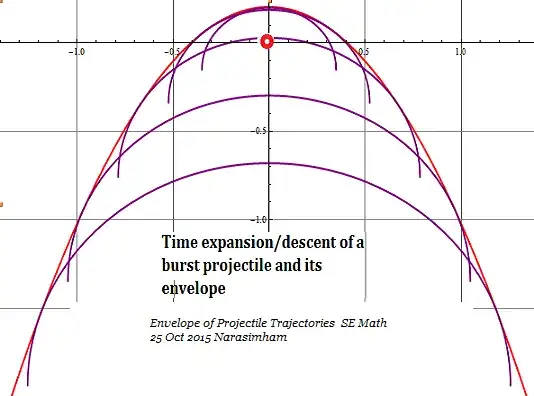
I shall outline the method how we get the parabola. Usual notation
$$ \ddot y = -g, \quad \dot y = - g t + v \sin \theta , \quad y =- g t^2/2 + v t \sin \theta\, +0 \tag {1} $$
$$\ddot x = 0, \quad \dot x = v \cos \theta = \text{const}, \quad x = v t \cos \theta +0 \tag{2}.$$
Eliminating time $t$ between $(1)$, $(2)$ you got this parabola equation already.
Let $\tan \alpha = T$; parabola equation in other words
$$ y = x T - g/2 \cdot (x/ v \cos\theta)^2 = x T - ( g x^2/2 v^2) ( 1+T^2) .\tag{3} $$
Differentiate partially with respect to $T$ and simplify, $T = v^2 / gx .\tag{4}$
Eliminate $T$ between $(3)$ and $(4)$
$$ y = v^2/2g - g x^2 /(2 v^2) = H - x^2/(4H) \tag{5}, $$
same as what was obtained before by Jack and Blue.
If you denote height reached by projectile on vertical firing $ H = v^2/(2g) \tag{6} $ you would notice that the envelope is profiled exactly as a parabolic mirror with focus at gun delivery point, focal length is exactly H. Vertical force of gravity is acting like light :)..
The above procedure method is indicated by Blue in Wiki, is referred to as C-discriminant method to obtain envelopes and singular solutions.
Like what you said in your edit and I about mirror, they are ploys for remembering curves using similarities..
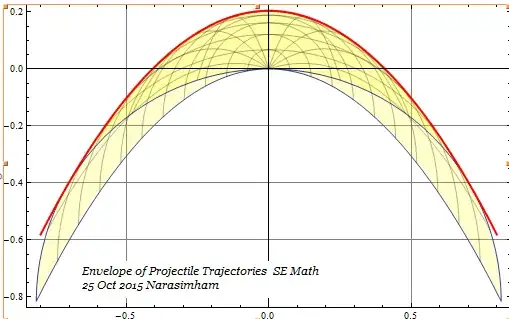
For the image I took values of $ g=9.8 \, \mathrm{m/s^2}, \quad v = 2 \, \mathrm{m/s} $
The partial differentiation way and elimination is the right way to look at, perhaps not as what you said (standard solution.. way).
EDIT2:
The answer to your second question, i.e., to determine if it is going to be a parabola envelope without going through all of analysis... I can only reply with extended C-discriminant, strengthening the same result by another path.
$p$ discriminant method is also relevant, but I defer it, but best is to refer to differential calculus books of authors e.g., A.R. Forsythe.
I shall expand on the C-discriminant, wherein a two parameter system of equations variation of any of the two parameters leads to the same parabola envelope. This is in reply to your question , Why do you also plot partial concentric circles?
Well, they are circles alright, but not concentric circles. They expand and come down slowly with time. What you can see as plotted are the peripheries traced out descending with time .
But first quickly watch some fireworks to see what I am discussing about:
Expanding & Descending Fire-Works Circle Periphery
It is common experience to see fire ball bright splinters expanding to bigger circles as the entire cluster comes down slowly with time. The periphery of burst splinters is a portion of a circle whose radius increases during slow descent. The center of circle is always descending by gravity.
The two parameters are $ \theta, t $ angle of elevation at first burst or fire, and time $t$.
By C-discriminant method the parabola envelope is the eliminant of either $\theta$ variable or
$$ F(x,y,\theta) =0 ,\, F_{\theta } (x,y,\theta) =0 \tag{6} $$
or $t$ time variable.
$$ F(x,y, t) =0 ,\, F_{t } (x,y, t) =0. \tag{7} $$
The first one is already discussed, the second one is expanding/descending fireworks circles as already stated.
In the latter case working is:
$$ x = v t \cos \theta , \quad y = v t \sin \theta - g t^2/2 \tag{8}$$
$$ \left(\frac{x}{vt}\right)^2 + \left(\frac{y+ gt^2/2}{vt}\right) ^2 = 1 \tag{9}$$
$$ x^2 + ( y + g t^2/2)^2 = v^2t^2. \tag{10} $$
which is a Circle.
To find its envelope, as before partially differentiate with respect to time $t$ and cancel $ 2t$ on either side of equation , bring $ v^2/g$ to right side :
$$ y + gt^2/2 = v^2/g \tag {11} $$
$$ x^2 + (v^2/g)^2 = 2 v^2/g * ( v^2/g-y) \tag {12} $$
$$ x^2 + ( 2 H)^2 += 4 H ( v^2/g -y )\tag{13} $$
$$ x^2 = 4 H ( H-y) \tag{14} $$
which is the same parabola envelope obtained earlier with $\theta $ as parameter. End points $ ( x=0, \quad y=H ; x= 2 H, \quad y= 0 ) $
Although circle end traces are visible in a fireworks display it needs imagination as before with variable gun barrel angle to see that each circle is tangent to a fixed envelope. Hope you enjoyed it.