`I am in the first year of college and know mathematical analysis in a very rigorous context, from high school/ math olympiads Imo's etc. But the concept of $df$ seems totally weird and unmathematical. For example if you have $$f(x_1,...x_n)$$ how can you talk about the partial derivative $\frac{δx_1}{δf}$ or how can you say $$df= \sum \frac{δf}{δx_i}dx_i$$ When $df$ by itself meens nothing. Also wy if $$f(x,y)=g(u,v)$$. then $df=dg $. It seems so strange to work with functions with no argument. Where can i learn this stuff in a rigorous way. I even tried to view d/dx as an operator between the vector spaces of functions but still everything is unrigorous.
Asked
Active
Viewed 195 times
0

-
Do you understand the difference between $\delta x$ and $\mathrm{d}x$? Also if you did math olympiads then this should not be that difficult to understand. – yiyi Oct 24 '14 at 17:50
-
Yes just didn't know how to put the symbol in latex. I changed it. – Paul Oct 24 '14 at 17:51
1 Answers
0
Because you updated your question.
Read what Paul's Online Math Notes have to say on Partial Derivatives.
Your you can read section 5.3 of Introduction to Real Analysis by Trinity University
Quoting the previous link
Definition 5.3.1 Let $\Phi$ be a unit vector and $X$ a point in $\mathbb{R}^n$. The directional derivative of $f$ at $X$ in the direction of $\Phi$ is defined by
$$ \frac{\partial f(X)}{\partial \Phi} = \lim\limits_{t \to 0} \frac{f(X+ t\Phi) - f(X)}{t} $$
if the limit exists. That is, $\partial f(X)/\partial\Phi$ is the ordinary derivative of the function $h(t) = f(X+t\Phi)$ at $t=0,$ if $h^{\prime}(0)$ exists.
Read this answer here on this site.
Or here on Dr. Math
Here a picture from 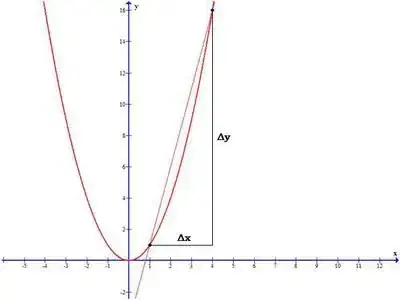
Hope that this gives you enough to read to understand.

Glorfindel
- 4,000

yiyi
- 7,458