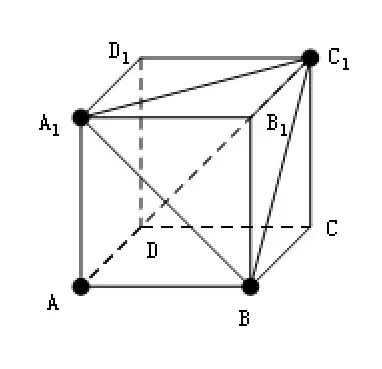
Given an point $P \in \mathbb{R}^3$, let $(x_P,y_P,z_P) = (u_P +\frac12, v_P + \frac12, w_P + \frac12 )$ be its coordinates. In order for this point $P$ lying on or inside the
cube $[0,1]^3$, the coordinates need to satisfy:
$$ 0 \le x_P, y_P, z_P \le 1 \quad\iff\quad |u_P|, |v_P|, |w_P| \le \frac12 \tag{*1}$$
Now pick any four points $A, B, C, D$ from $[0,1]^3$ and construct a tetrahedron
$\Delta_{ABCD}$. The volume of $\Delta_{ABCD}$ will be given by the formula:
$$\text{Vol}(\Delta_{ABCD})
= \frac16
\left|\det\begin{bmatrix}
x_A & y_A & z_A & 1\\
x_B & y_B & z_B & 1\\
x_C & y_C & z_C & 1\\
x_D & y_D & z_D & 1
\end{bmatrix}
\right|
= \frac16
\left|\det\begin{bmatrix}
u_A & v_A & w_A & 1\\
u_B & v_B & w_B & 1\\
u_C & v_C & w_C & 1\\
u_D & v_D & w_D & 1
\end{bmatrix}
\right|
$$
We can view the determinant at the right as the determinant for 4 vectors in $\mathbb{R}^4$:
$$\begin{cases}
\vec{u} &= (u_A, u_B, u_C, u_D),\\
\vec{v} &= (v_A, v_B, v_C, v_D),\\
\vec{w} &= (w_A, w_B, w_C, w_D),\\
\vec{\eta} &= (1, 1, 1, 1)
\end{cases}$$
It is clear $(*1)$ implies $|\vec{u}|, |\vec{v}|, |\vec{w}| \le 1$ and $|\vec{\eta}| = 2$.
This allow us to bound the determinant at the right and hence the volume of the tetrahedron
as
$$\text{Vol}(\Delta_{ABCD}) \le \frac16 |\vec{u}||\vec{v}||\vec{w}||\vec{\eta}| \le \frac16 ( 1 \times 1 \times 1 \times 2) = \frac13\tag{*2}$$
We know the volume $\frac13$ is achievable. The two obvious configurations are given below
- $A = (0,1,1), B = (1,0,1), C = (1,1,0), D = (0,0,0)$.
- $A = (1,0,0), B = (0,1,0), C = (0,0,1), D = (1,1,1)$.
This means the maximum volume we seek is $\frac13$.
Are there other configurations? The answer is NO.
To achieve this maximum volume, the inequalities in $(*2)$ has to reduce to equalities.
This leads to
$$\begin{align}
& |\vec{u}| = \vec{v} = \vec{w}| = 1\\
\implies & |u_P| = |v_P| = |w_P| = \frac12 \;\text{ for }\; P = A,B,C,D.\\
\implies & x_P, y_P, z_P = 0 \text{ or } 1 \;\text{ for }\; P = A,B,C,D.\\
\implies & A, B, C, D \;\text{ are vertices of the cube }\; [0,1]^3
\end{align}
$$
There are only finitely many combinations to check and by brute force, there are no more configurations which maximize the volume.