1

Suppose that $ \Delta(x,y) = x^T\Delta y $ where $ \Delta$ is a symplectic matrix of form given in https://en.wikipedia.org/wiki/Symplectic_matrix

If I define an inner product $ \alpha(x,y) = \Delta(x,Ay) = x^T\alpha y $ (which implies that $ \alpha = \Delta A $)

then is it true that A is a symplectic matrix?

Using the fact that $ \Delta(x,y) = -\Delta(y,x) $ , I have reached the conclusion that

$ A^{T}\Delta = -\Delta A $

It is clear from this equation that $ A^T = -A $ satisfies the equation, though I am not sure that it is the only solution. Is there any other way to prove that A is indeed a skew-symmetric matrix? Assume all entries of all matrices to be real.

Refer the text in context from the book by Holevo on quantum information:
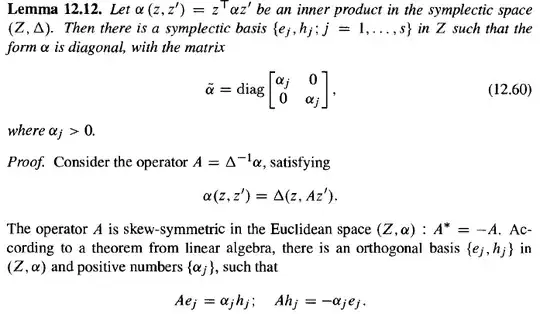
enter image description here

  • $\alpha$ is your inner product, but what kind of object is $\alpha$ in $\alpha=\Delta A$? Where does $A$ come from? If you take an arbitrary $A$, define $\alpha$, why should $A$ be skew-symmetric? – daw Oct 09 '14 at 13:52
  • @daw the author has used $ \alpha $ twice to maintain uniformity in representation of the inner product. I have used the fact that $ \Delta(x,Ax) = -\Delta(Ax,x) \implies x^{T}\Delta Ax = -x^{T}A^{T}\Delta x $ This gives the expression: $\Delta A = -A^{T} \Delta $ Since $\alpha = \Delta A$ this implies that $ \alpha = \alpha^T $. So you could say that $\alpha$ is a symmetric matrix. Do check the edited post in which I have put up the text as mentioned in the book. – user55552 Oct 09 '14 at 17:45
  • related: https://math.stackexchange.com/q/2208699/173147 – glS Aug 23 '23 at 01:59

1 Answers1

0

One should note, that $\Delta$ is the matrix representing the symplectic form on the vector space.

The matrix $A$ is symplectic if $$ A^T\Delta A=\Delta. $$ Now $A=\Delta^{-1}\alpha$. Thus using $\Delta^T = -\Delta = \Delta^{-1}$ $$ A^T\Delta A = (\alpha^T\Delta^{-T})\Delta \Delta^{-1}\alpha = \alpha\Delta\alpha. $$ In order that $A$ is symplectic, $\alpha$ has to be symplectic as well.

Does this make sense?

daw
  • 54,637
  • 2
  • 44
  • 85
  • It does make sense, however I'm still not able to figure out how this implies that A is skew symmetric. There's something similar given in http://en.wikipedia.org/wiki/Symplectic_group#Sp.28n.29 where they claim that A is skew hermitian. Does that help? – user55552 Oct 11 '14 at 11:12