Here is the material for a proof. My little knowledge in mathematics does not allow me to fill the gaps, but surely someone else can.
Let $S$ be the infinite fraction.
The first thing to do is to flatten the fraction. By that I mean to express $S$ as a product of fractions $p/q$, with $p, q \in \mathbb{N}$. In other words, find and expression $P$, such that $P := \prod \frac pq = S$.
@karvens' comment got me started:
I think the question is about the closed form for:
$\frac{1}{2}\frac{4}{3}\frac{6}{5}\frac{7}{8}\cdots$
Obviously all naturals occur inside $P$, the only real problem is to find out whether or not a fraction is proper (i.e. when to swap numerator and denominator). It turns out¹ that there is a profound link between this problem and the Thue-Morse sequence (I now see that others had already pointed this out). In fact, we can write:
$$P := \prod_{n = 0}^\infty \left ( \frac{2n + 1}{2n + 2} \right )^{\left [ (-1)^{t_n} \right ]}$$
where $t_n$ denotes the $n$-th digit (either $0$ or $1$) in the infinite Thue-Morse sequence. $t$ starts as follows (first $32$ digits):
$$01101001100101101001011001101001\dots$$
With the expression $\displaystyle\frac{2n + 1}{2n + 2}$ we are able to scan all natural numbers in pairs and when $t_n$ is $1$, we swap. Expansion of $P$ to the first fractions yields:
$$\frac{1}{2}\cdot\frac{4}{3}\cdot\frac{6}{5}\cdot\frac{7}{8}\cdot\frac{10}{9}\cdot\frac{11}{12}\cdot\frac{13}{14}\cdot\frac{16}{15}\cdot\frac{18}{17}\cdot\frac{19}{20}\cdot\frac{21}{22}\cdot\frac{24}{23}\cdot\frac{25}{26}\cdot\frac{28}{27}\cdot\frac{30}{29}\cdot\frac{31}{32}$$
Now, it can be demonstrated that:
$$P = \frac {\sqrt{2}} 2 = \frac 1 {\sqrt{2}}$$
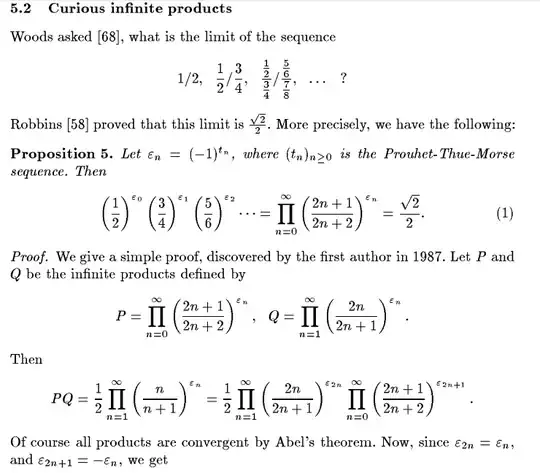
See Allouche and Shallit 2003, pp. 153 and 204. On page 204 there are typos, you can find the corrections here (pdf).
I tried to find those pages online, but Google Books has only 4 unrelated example pages. Also, I couldn't find this result mentioned anywhere online but on MathWorld (Wikipedia does not reference this result explicitly). MathWorld mentions two other interesting products as well.
Note: as @Gottfried Helms stated in the comments below, this result is already in a paper of 1998/1999 of Shallit/Allouche, The ubiquitous Prouhet-Thue-Morse sequence.
[1]: I did some experimenting with a small Python program. Here it is: https://gist.github.com/rubik/bbb903734c6221f81ed0
EDIT: I've added a Haskell translation of the algorithm. After compilation it takes a little less time than the Python one.