6

I am reading Stillwell's Numbers and Geometry. There is an exercise about Egyptian fractions which is the following:
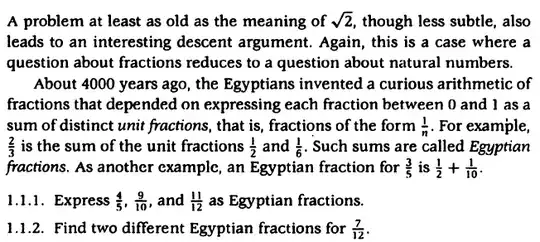
enter image description here

I've tried to do it in the following way - Expressing an arbitrary fraction $\frac{n}{m}$ as the sum of two aribtrary egipcian fractions:

$$\frac{1}{a}+\frac{1}{b}=\frac{n}{m}$$

$$\frac{1}{a}+\frac{1}{b}-\frac{n}{m}=0$$

$$\frac{bm+am-abn}{abm}=0$$

Then solving for $a$ yields:

$$a=\frac{b m}{b n-m}$$

And then expressing it as a function:

$$f(b)= \frac{b m}{b n-m}$$

I have tested with $\frac{n}{m}=\frac{3}{4}$ on Mathematica and all the sums of unit fractions I've obtained equals $\frac{3}{4}$. Is this correct? I'm afraid there's something wrong and I'm not seeing it.

Red Banana
  • 24,885
  • 21
  • 101
  • 207
  • Really it's just easier to actually find some integers by testing a few. Just remember that the denominators should have factors or multiples of the denominator you're going for in them.

    http://mathworld.wolfram.com/EgyptianFraction.html has some discussion of them, including links to common algorithms, but I suspect guess and check is the best option for these.

    – Adam Hughes Jul 16 '14 at 18:36
  • It may be that $n/m=3/4$ only has one way to do it. But in part 2 of the problem they're asking about $n/m=7/12.$ – coffeemath Jul 16 '14 at 18:38
  • That this was done by ancient Egyptians is frequently asserted in print and on the web. What's the actual history? Mathematicians often repeat what they think is history but isn't. They all hear the stories from each other. If it is true, then why did Egyptian arithmeticians do this? – Michael Hardy Jul 16 '14 at 18:46
  • Sometimes more than two terms must be used. For instance $\frac{4}{5}$ can't be written as the sum of just two unit fractions. One possibility is $\frac{4}{5}=\frac{1}{2}+\frac{1}{5}+\frac{1}{10}$ – paw88789 Jul 16 '14 at 18:51
  • 3 components of a solution there. http://math.stackexchange.com/questions/450280/erdös-straus-conjecture/831870#831870 – individ Jul 16 '14 at 19:00

2 Answers2

2

Here's one systematic method to see if there are ways of expressing a fraction as a sum of two Egyptian fractions:

$$\begin{align}\frac{4}{5}=\frac{1}{m}+\frac{1}{n} &\Leftrightarrow 4mn=5m+5n \\ &\Leftrightarrow 5m-4mn+5n=0 \\ &\Leftrightarrow \left(2m-\frac{5}{2}\right)\left(\frac{5}{2}-2n\right)=-\frac{25}{4}\\ &\Leftrightarrow (4m-5)(5-4n)=-25\end{align}$$

Notice that $m,n$ are integers, and so $(4m-5),(5-4n)$ are integers too. Therefore, those have to be divisors of $25$ and there are finitely many divisors of $25$, allowing you to test all possible combinations.

You can use a similar method for three fractions (if no representation using two fractions is possible), but as it has been pointed out in the comments already, it's better to test some small fractions until you get what you want.

1

As I said a decision for 3 terms there. Erdős-Straus conjecture

As for the answers of two terms, the decision is not always exist.

For the equation: $$\frac{1}{X}+\frac{1}{Y}=\frac{b}{A}$$

You can write a simple solution if the number on the decomposition factors as follows: $$A=(k-t)(k+t)$$
then: $$X=\frac{2k(k+t)}{b}$$ $$Y=\frac{2k(k-t)}{b}$$

or: $$X=\frac{2t(k-t)}{b}$$ $$Y=\frac{-2t(k+t)}{b}$$

First decide so $b=1$ and then I look at what other values have solutions.

individ
  • 4,405