3

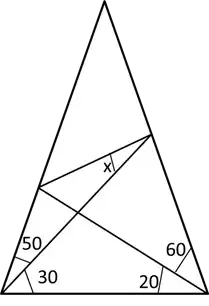
Please look at the following figure:

enter image description here

All the angles are in degrees. I have to find $x$.


I am really no good at solving geometry problems. I tried to search the internet for similar problems and came up with this: https://www.duckware.com/tech/worldshardesteasygeometryproblem.html . The two problems mentioned on the page are very similar so I tried to see if the solutions to them can be applied to this problem but it didn't help. I have zero idea about the problem given my inexperience in these kind of geometry problem.

Any help is appreciated. Thanks!

Pranav Arora
  • 11,315

2 Answers2

4

The angle in question does not seem to be a rational number of degrees. It is approximately

$$x\approx17.877987144333100702669230434486544610886743725521319531393624°$$

It is characterized by

$$1216\,\cos^6x - 3264\,\cos^4x + 2916\,\cos^2x - 867 = 0$$

Since this is a cubic equation in $\cos^2x$ you could write down an explicit formula for the solution of that in terms of radicals, take the square root, then the arc cosine of that, and would end up with an explicit exact formula for the angle in question. Not a nice formula, though, and you'll need complex numbers along the way even though the final result is real:

$$x=\arccos\sqrt{ \frac{17}{19}-\frac{1+\sqrt{-3}}{152} \sqrt[3]{\frac{-17+19\sqrt{-3}}2} -\frac{7 (1-\sqrt{-3})}{76 \sqrt[3]{-68+76\sqrt{-3}}} }$$

The condition for the sine has a bit easier coefficients:

$$1216\sin^6x - 384\sin^4x + 36\sin^2x - 1=0$$

But basing the explicit formula on that cubic equation has little effect on the overall complexity; it still looks as complicated as it does with the cosine.

I found this by executing the construction using exact algebraic numbers. The cosine in particular relates to the dot product of the unit length direction vectors of the two lines. For the negative result, I looked at the continued fraction representation, which should have had a notable step if this were a rational number. I also tried finding a minimal polynomial of degree up to 24, so it seems that $x$ is probably not even algebraic.

MvG
  • 44,006
  • Preliminarily, I don’t believe it’s necessary to solve any polynomial equations. I think I have a method of expressing $\tan(x)$ rationally in terms of $\sqrt3$ and the trig functions of $80^\circ$. But I have some chores and a meeting to get out of the way. Perhaps I’ll have something written up in six hours. – Lubin Jul 09 '14 at 21:38
  • @Lubin: No need to include $\sqrt3$: $$x=\arctan\frac{2\cos80°(2\cos^280°-1)(8\cos^480°-8\cos^280°+1)}{\sin80°(32\cos^680°-32\cos^480°+8\cos^280°-1)}\x=\arctan\frac{2\cos80°(2\sin^280°-1)(8\sin^480°-8\sin^280°+1)}{\sin80°(32\sin^680°-64\sin^480°+40\sin^280°-7)}$$ Obtained this by expressing my construction in terms of these trigonometric functions, then simplifying the result using $\sin^2+\cos^2=1$ But I guess you had other means in mind, so I'm still interested what you'll come up with. – MvG Jul 09 '14 at 22:46
  • Yes, you seem to have used the Cubic Formula, which I have never been comfortable with. – Lubin Jul 10 '14 at 02:43
  • @MvG: Thank you for the response. Seeing the ugly answer, I feel that the teacher who gave this problem to my brother accidentally switched the angles. Thank you once again! :) – Pranav Arora Jul 10 '14 at 03:02
  • You didn’t say how you got your sextic equation in cosine, did you? – Lubin Jul 10 '14 at 04:31
  • @Lubin: That's simply the minimal polynomial of the algebraic number I computed. – MvG Jul 10 '14 at 04:56
  • Yes, but what method did you use for computing that algebraic number? Was it just a repeated application of Law of Cosines, or something else? – Lubin Jul 10 '14 at 13:25
  • @Lubin: Here is the sage code of what I did. Essentially coordinate-based construction, using homogeneous coordinates and projective geometry. – MvG Jul 10 '14 at 14:06
2

I think it’s sufficient to handle this with coordinate geometry. I’m going to place the lower left vertex of the triangle at the origin, and the lower right vertex at $(1,0)$. Let’s name all five of the small triangles making up the figure, starting at the top, triangle $\alpha$. Then, going around the perimeter clockwise, the triangle containing your angle $x$ will be called $\beta$, then $\gamma$ is the upper triangle with a vertex at the lower right vertex of the whole thing, then $\delta$, and finally $\varepsilon$.

So I’ll say that the whole triangle is $\alpha+\beta+\gamma+\delta+\varepsilon$, and any of the smaller ones may be described as the sum (union) of a subset of the five named ones. Let’s also name $A$ as the common vertex of $\alpha$, $\beta$, and $\varepsilon$, and $B$ as the common vertex of triangles $\alpha$, $\beta$, and $\gamma$. What’s crucial to our discussion is the problem of finding the slope of the line segment $\overline{AB}$.

Let’s make some preliminary observations. The big triangle is isosceles, having angles of 80 at both vertices on the horizontal axis. (I’m going to omit the degree sign from here on.) Since the angle of 80 shows up again and again, I’m going to use the notation $T=\tan80$, $S=\sin80$, and $C=\cos80$. So we see that the top vertex has coordinates $(\frac12,T/2)$. Notice also that there’s another $(80,80,20)$ isosceles triangle, it’s the triangle $\delta+\varepsilon$, which has the point $A$ as the top one of its vertices. So we have similar triangles, and we can get the length $\ell$ of the segment from the origin to $A$. Using leg/base, we get $$ \frac{\frac12\sec80}1=\frac1\ell\,,\qquad\ell=2C\,. $$ Thus the coordinates of $A$ are $(2C^2,2CS)$.

Now $B$ is at the intersection of the line $Y=X/\sqrt3$, because $\tan30=1/\sqrt3$, and the line of slope $T$ passing through $(1,0)$, so its equation is $Y=-T(X-1)$. Solve these two first for $X$, then for $Y$: $$ X=\frac T{T+\frac1{\sqrt3}}\,,\qquad Y=X/\sqrt3=\frac T{1+\sqrt3T}\,. $$ From this, the slope $m$ of $\overline{AB}$ is $$ \frac{\frac T{1+\sqrt3}-2CS} {\frac{\sqrt3T}{1+\sqrt3T}-2C^2} =\frac{T-2CS(1+\sqrt3T)}{\sqrt3T-2C^2(1+\sqrt3T)}\,, $$ which works out numerically to $m=.2147833$. Now we need the angle between this and a line of slope $1/\sqrt3$, so we get $$ \tan x=\frac{\frac1{\sqrt3}-m}{1+\frac m{\sqrt3}}=\frac{1-\sqrt3m}{\sqrt3+m} =.3225670\,, $$ which gives $x=17.8779872^\circ$. I did all these numerics on my HP15-C !
Lubin
  • 65,209