1

enter image description here

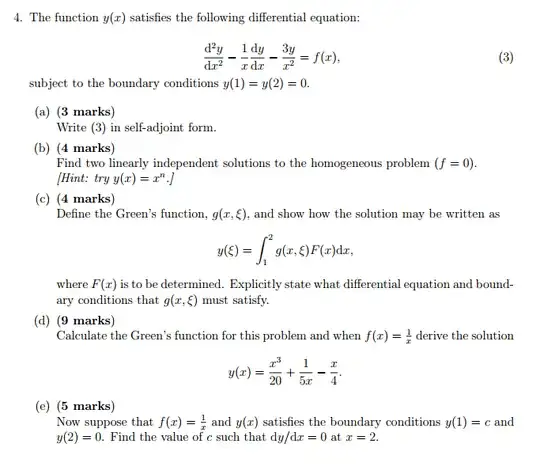
For part a) I get $\frac{d}{dx}\Big[ \frac{1}{x}\frac{dy}{dx}\Big] - \frac{3g}{x^3}=\frac{f(x)}{x}$

for part b) the two solutions are $1/x$ and $x^3$.

part c) is not hard to prove and I will not do so here

for part d) I get stuck.

I get that $Lg=\delta(x-\xi)$ and $g(1,\xi)=g(2,\xi)=0$

$\implies g(x,\xi) = \left\{ \begin{array}{ll} \frac{A}{x}+Bx^3 & \mbox{if } 1<x<\xi \\ \frac{c}{x}+Dx^3 & \mbox{if } \xi<x<2 \end{array} \right.$

plugging in the BC's I get

$\implies g(x,\xi) = \left\{ \begin{array}{ll} \frac{A}{x}-Ax^3 & \mbox{if } 1<x<\xi \\ \frac{C}{x}-\frac{Cx^3}{16} & \mbox{if } \xi<x<2 \end{array} \right.$

then using the continuity condition I get

$\frac{A}{\xi}-A{\xi}^3=\frac{C}{\xi}-\frac{C\xi^3}{16}$ which gives that

$A=\frac{C(16-\xi^4)}{16(1-\xi^4)}$

then using $\frac{1}{p(\xi)}\Big[g'(\xi^+,\xi)-g'(\xi^-,\xi)\Big]=1$ I get that

$\Big[ 3C\xi^2+\frac{16C}{\xi^2}\Big] - \Big[C \Big(\frac{\xi^4-16}{\xi^4-1} \Big)\Big(3\xi^2+\frac{1}{\xi^2}\Big)\Big]=1$

$\implies 3C\xi^2+\frac{16C}{\xi^2} - 3C\xi^2 \Big(\frac{\xi^4-16}{\xi^4-1} \Big)-C\Big(\frac{\xi^4-16}{\xi^4-1}\Big)\frac{1}{\xi^2}=1$

I would like a worked solution to part d) in this question and in return I am offering a bounty.

Trajan
  • 5,366
  • 3
  • 29
  • 76

2 Answers2

1

The (a) and (b) are trivial to show. Let us start from (c). To find the Green's function, as you mentioned, we need to solve $Lg=\delta(x-\xi)$. For the sake of simplicity, I use the common form of the Green's function instead of solving a BVP and you can find relative theorems and procedures in some references (such as Wolfgang Walter, Ordinary Differential Equations P252 or the link given by @Jeb). The Green's function is given by: $$ g(x,\xi)=\left\{ \begin{array}{l} \dfrac{x^4\xi^4-16x^4-\xi^4+16}{60x\xi^2}\qquad x\leq \xi\\[3mm] \dfrac{x^4\xi^4-16\xi^4-x^4+16}{60x\xi^2}\qquad x> \xi\\ \end{array} \right. $$ Then (c) is solved.

From a simple computation, namely the convolution of Green's function and RHS function $f(x)$, we have:

$$ y(x)=\int_1^2 g(x,\xi)f(\xi) d\xi=\int_1^x \dfrac{x^4\xi^4-16\xi^4-x^4+16}{60x\xi^3} d\xi+\int_x^2 \dfrac{x^4\xi^4-16x^4-\xi^4+16}{60x\xi^3} d\xi\\ =\dfrac{4x^4-15x^2-4}{60x}-\dfrac{x^4-16}{60x}=\dfrac{x^4-5x^2+4}{20x} $$ Thus (d) is valid.

For (e), we should note that the $x^3$ and $1/x$ are still the independent solutions to the homogeneous problem $Ly=0$ in spite of the initial data at $x=1$ shift from $0$ to $c$. What is more, it easy to check that the $y(x)=-x/4$ is a particular solution to $f(x)=1/x$ in RHS (Hint: by plug $y(x)=kx$ in the ODE to solve a $k$). So the solution of $Ly=1/x$ with $y(1)=c$ and $y(2)=0$ can be written as $$ y(x)=k_1x^3+\dfrac{k_2}{x}-\dfrac{x}{4} $$ where $k_1$ and $k_2$ are constant to be determined. Using BC, we have: $$ y(x) = \dfrac{1}{5x}+\dfrac{16c}{15x}+x^3(-\dfrac{c}{15}+\dfrac{1}{20})-\dfrac{x}{4} $$ Solving $y'(x)|_{x=2}=0$ obtain $c=\dfrac{9}{32}$.

Lion
  • 2,178
0

Since it seems the greens function bit is the only thing troubling you, have a look here

Jeb
  • 4,228
  • 1
  • 14
  • 13
  • Im pretty sure I understand how to Green's functions. The answer just wont fall out for me – Trajan May 19 '14 at 21:05
  • In the link they derive the general form of the greens function. I think it'd be beneficial for you to go over it...since you can just plug in your fundamental solutions to get the Green's function. – Jeb May 19 '14 at 21:09