9

This question is a "corollary" (if you will) to the World's Hardest Easy Geometry Problem (external website). Formally, this is called Langley's Problem. The objective of that problem was to solve for angle $x^{\circ}$, with the given angles of $10^{\circ}, 70^{\circ}, 60^{\circ}, 20^{\circ}$. Someone presented a solution to that problem. Here's also a rather colorful and interactive solution to a problem like this, but with different angles.

Now, I wanted to generalize this problem, replacing the angles of $10^{\circ}, 70^{\circ}, 60^{\circ}, 20^{\circ}$ with angles of $W^{\circ}, X^{\circ}, Y^{\circ}, Z^{\circ}$, respectively (see below picture).
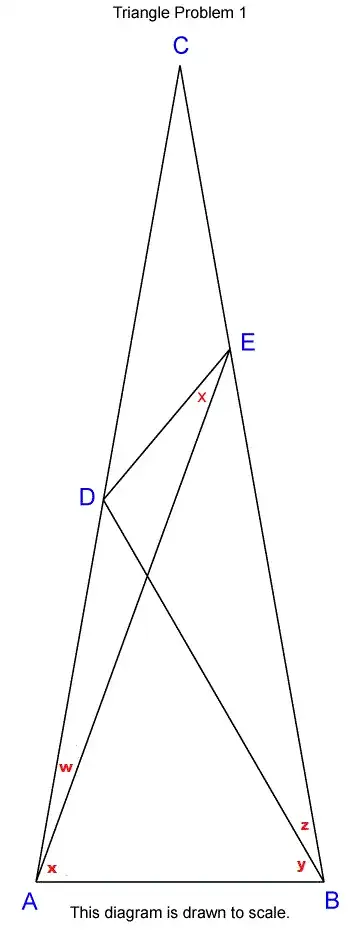
enter image description here

How can we derive an analytical expression of angle $x^{\circ}$, in terms of $W^{\circ}, X^{\circ}, Y^{\circ}, Z^{\circ}$?

Cookie
  • 13,952
  • 1
    Coordinatize, and calculate approximately. – André Nicolas Apr 12 '14 at 05:00
  • That might work for the original problem with fixed degrees. But I'm not sure if placing the triangle on the coordinate grid would work for arbitrary angles $w^{\circ}, x^{\circ}, y^{\circ}, z^{\circ}$. – Cookie Apr 12 '14 at 05:03
  • 4
    You use $x^\circ$ for two distinct angles in your diagram... – Steven Stadnicki Apr 12 '14 at 05:04
  • @StevenStadnicki I changed it to capital $X^{\circ}$ then, to make the distinction, along with capital $W^{\circ},Y^{\circ},Z^{\circ}$. – Cookie Apr 12 '14 at 05:06
  • I don't have a reference to hand, but I'd swear I remember an article either in the AMM or the Intelligencer about generalizations of the problem with 'nice' angles. Digging around on the web suggests that this is called "Langley's Problem" but doesn't turn up what I'm thinking of... – Steven Stadnicki Apr 12 '14 at 05:49
  • 10
    I got a good chuckle from the inclusion of "This figure is drawn to scale". – Michael Joyce Apr 12 '14 at 13:27
  • 2
    I think the problem is more neatly stated without point C. We can just draw a quadrilateral and its diagonals, give four angles at the bottom, and say "find all the angles". Or put $|\overline{AB}|=1$ and say "solve this quadrilateral". – h34 Jun 26 '15 at 15:42
  • See Triangles and Quadrilaterals Revisited. Part 2: The Solution R. A. Diamond and G. A. Georgiou Mathematics in School Vol. 30, No. 5 (Nov., 2001), pp. 11-13 – rogerl Jan 12 '16 at 21:39
  • Langley's Problem only works for those specific angles. The general case has no simple solution. (This Wikipedia article has a nice picture and a solution of Langley's Problem.) – TonyK Jan 13 '16 at 11:30
  • @StevenStadnicki This problem is not by Langley but, according to the link in the OP, by Schor. (Langley's is the same but with w=20°, x=60°, y=50°, z=30°.) – Rosie F Jun 29 '16 at 13:50

5 Answers5

7

Well, I'll give a guide to follow, not a final expression. I called you unknown angle as $\alpha_9$ (in order not to mess, because you have a big $X$ and a small $x$).
Since you know $x$ and $y$ then you know $\alpha_4$.
Since you know $x$, $w$, $z$ and $y$ then you know $\alpha_1$.
Since you know $x$ and $\alpha_5$ then you know $\alpha_3$.
Since you know $w$ and $\alpha_5$ then you know $\alpha_6$.
Then you end up with a system of $4$ equations: $$ \begin{cases} \alpha_1+\alpha_2+\alpha_7=\pi \\ \alpha_4+\alpha_8+\alpha_9=\pi \\ \alpha_2+\alpha_3+\alpha_9=\pi\\ \alpha_6+\alpha_7+\alpha_8=\pi \end{cases} $$ with $4$ unknowns: $\alpha_2, \alpha_7, \alpha_8, \alpha_9$. And $\alpha_9$ is what you are looking for.

enter image description here

Caran-d'Ache
  • 3,612
  • 5
    It seems to me that using only relations between the angles results in an underdetermined system of linear equations. – Zhen Lin Feb 11 '15 at 16:56
  • @ZhenLin - Start with line segment $\overline{AB}$ and draw lines upwards from A, making angles $x$ and $x+w$ with $\overline{AB}$, and from B, making angles $y$ and $y+z$ with it; all points are then determined. – h34 Jun 26 '15 at 09:58
  • That's not what I mean. If you actually use the geometry of the plane then there is no problem. – Zhen Lin Jun 26 '15 at 10:07
  • 2
    Zhen Lin is correct, the 4x4 linear system here is underdetermined, and one needs to find another independent equation from the geometry to resolve the problem. To see this, take the first equation, add the second equation, and subtract the fourth equation. What you end out with is an equation of the form $\alpha_2 + \alpha_9 = [\text{known value}]$, which is of the same form as the third equation. – Nick Alger Jun 29 '16 at 20:52
  • But in this case the problem is that the matrix associated with the system of linear equations in four unknowns $\alpha_2, \alpha_7, \alpha_8$ and $\alpha_9$ given by \begin{pmatrix} 1 & 1 & 0 & 0 \ 0 & 0 & 1 & 1 \ 1 & 0 & 0 & 1 \ 0 & 1 & 1 & 0 \end{pmatrix} is not invertible. – math maniac. Apr 20 '20 at 07:38
5

I have found the equation!

I first tried to insert the latex equation directly here, but that was ugly so I rendered it separately and inserted an image instead: equation for x

Alice Ryhl
  • 8,001
  • 3
    Now, how was this expression derived? :) – Cookie Apr 12 '14 at 15:47
  • 3
    My first attempt at solving it, I used only easy things like sum of all angles in triangle is $\pi$ and so on, but I couldn't solve it that way, so I decided to set the AB line to 1 and then write down what the other lines are in respect to that, when I had an expression for $a_8$, I wrote a computer program that expanded the expression to be in terms of the angles instead of the line lengths. The expression before the expansion was: $\arccos \left(\frac{DE^2 + IE^2 - DI^2}{2DEIE}\right)$ – Alice Ryhl Apr 12 '14 at 20:25
2

There is in principle no problem in obtaining an expression for the top angle in terms of the bottom ones. Let the unlabelled intersection point in the picture be $I$. Let the bottom side be $1$. We can use the Sine Law to find $AI$ and $BI$. We can also find $AD$, and $BE$, and now we know $ID$ and $IE$, so we can solve for the mystery angle.

This does not result in a nice expression for the mystery angle, but it is an expression.

André Nicolas
  • 514,336
0

If one draws a perpendicular line from A and extends line DE to an intersection at, say X, the two resultant triangles allow the equal angles XEA and AEB to be determined at 40 degrees. Angle BED is then 100 degrees and 'x' is 30 degrees.

Thinking outside the triangle(s)?

-2

Refering to the Triangle Problem 1 diagram: If z>=w then x=80-w+arctan[(tan(z+10)-tan(w+10))/(tan(10)^2-tan(z+10)*tan(w+10))] degrees. There is no general solution for x in terms of z and w without using trigonometry since some solutions for x require an infinite series of digits to the right of the decimal point.

Bic
  • 1
  • 1
  • 3
    As it’s currently written, your answer is unclear. Please [edit] to add additional details that will help others understand how this addresses the question asked. You can find more information on how to write good answers in the help center. – Community Mar 14 '22 at 09:55
