A function f such that $$ |f(x)-f(y)| \leq C|x-y| $$
for all $x$ and $y$, where $C$ is a constant independent of $x$ and $y$, is called a Lipschitz function
show that $f(x)=\sqrt{x}\hspace{3mm} \forall x \in \mathbb{R_{+}}$ isn't Lipschitz function
Indeed, there is no such constant C where $$ |\sqrt{x}-\sqrt{y}| \leq C|x-y| \hspace{4mm} \forall x,y \in \mathbb{R_{+}} $$ we have only that inequality $$ |\sqrt{x}-\sqrt{y}|\leq |\sqrt{x}|+|\sqrt{y}| $$ Am i right ?
remark for @Vintarel i plot it i don't know graphically "Lipschitz" mean? what is the big deal in the graph of the square-root function
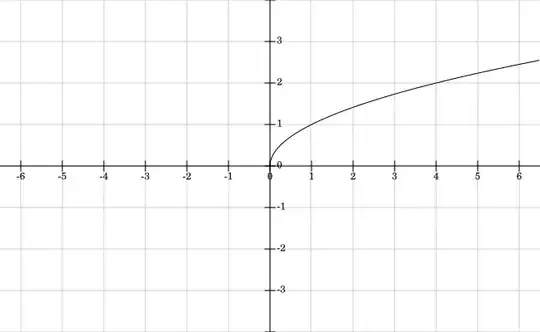
in wikipedia they said
Continuous functions that are not (globally) Lipschitz continuous The function f(x) = $\sqrt{x}$ defined on [0, 1] is not Lipschitz continuous. This function becomes infinitely steep as x approaches 0 since its derivative becomes infinite. However, it is uniformly continuous as well as Hölder continuous of class $C^{0,\alpha}$, α for $α ≤ 1/2$. Reference
1] could someone explain to me this by math and not by words, please ??
2] what does "Lipschitz" mean graphically?


Thus $f$ is Lipschitz if all the secant lines are of bounded slope (is it clear?)
– Vintarel Feb 08 '14 at 00:00