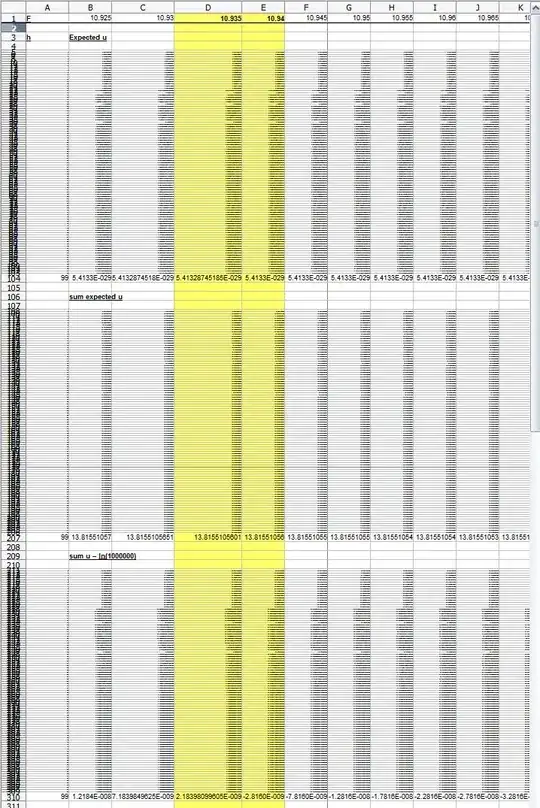
The game works as such: I flip a fair coin until it lands on tails. $h$ is the number of heads obtained until the first tail occurs and the game stops. My payoff from this game is:
$\hat G=2^{h}$
I have a utility function $u(W)=\ln(W)$ and $W=1000000$ in initial wealth. I want to find the maximum amount, $F$, I should be willing to pay to play this game.
I know that $E(U(W-F+\hat G)=U(W)$ and I need to solve that equation for $F$. This is:
$E[\ln (1000000-F+2^{h})]=\ln(1000000)$
As I believe the geometric distribution would be best for modeling this game(as $h$ is essentially the number of trials before the 1st "success", or in this case, failure), I use the pdf of the geometric distribution (with $p=\frac{1}{2}$ assumed) to try to solve for the expected value. Thus, I end up with this:
$\displaystyle \sum_{h=0}^{\infty}\ln(1000000-F+2^h)\cdot\left(\frac{1}{2}\right)^{h+1}=\ln(1000000)$
However, I'm not sure where to go from here. Any guidance would be appreciated. Am I even approaching this problem in the correct way?