Here is an approach that avoids contour integration, although it is strongly motivated by complex-analytic approaches.
Let $I$ denote the integral. We claim that $I - \frac{1}{1+\Omega}$ is zero. Indeed, define $f(z)$ by
$$ f(z) = \frac{1}{\Omega + 1} \cdot \frac{1}{z + \Omega} - \frac{1}{e^z + z}. $$
Then it is not hard to check that
$f(z)$ has no singularity in the region $\mathcal{D} = \mathbb{R} \times [-\pi, \pi]$, and
$f(z) \to 0$ as $\Re(z) \to \pm\infty$ in $\mathcal{D}$, and
$ \iint_{\mathcal{D}} |f'(x + iy)| \, \mathrm{d}x\mathrm{d}y < \infty $.
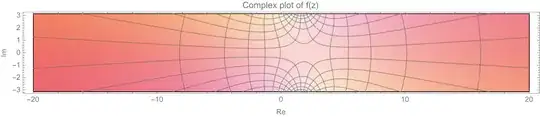
This function is relevant to the integral $I$ by the following relation:
$$
\frac{1}{(e^x - x)^2 + \pi^2} - \frac{1}{(\Omega + 1)[(x + \Omega)^2 + \pi^2]}
= \frac{f(x + i\pi) - f(x - i\pi)}{2\pi i} $$
Integrating both sides with respect to $x$, we get
$$
\begin{align*}
I - \frac{1}{\Omega + 1}
&= \int_{-\infty}^{\infty} \left[ \frac{1}{(e^x - x)^2 + \pi^2} - \frac{1}{(\Omega + 1)[(x + \Omega)^2 + \pi^2]} \right] \, \mathrm{d}x \\
&= \frac{1}{2\pi i} \int_{-\infty}^{\infty} [f(x + i\pi) - f(x - i\pi)] \, \mathrm{d}x \\
&= \frac{1}{2\pi i}\int_{-\infty}^{\infty} \int_{-\pi}^{\pi} i f'(x + iy) \, \mathrm{d}y\mathrm{d}x \\
&= \frac{1}{2\pi} \int_{-\pi}^{\pi} \int_{-\infty}^{\infty} f'(x + iy) \, \mathrm{d}x\mathrm{d}y \\
&= \frac{1}{2\pi} \int_{-\pi}^{\pi} \bigl[ f(x + iy) \bigr]_{x=-\infty}^{x=\infty} \, \mathrm{d}y \\
&= 0.
\end{align*}
$$


