36

I ran across an interesting integral and I am wondering if anyone knows where I may find its derivation or proof. I looked through the site. If it is here and I overlooked it, I am sorry.

$$\displaystyle\frac{1}{\int_{-\infty}^{\infty}\frac{1}{(e^{x}-x)^{2}+{\pi}^{2}}dx}-1=W(1)=\Omega$$

$W(1)=\Omega$ is often referred to as the Omega Constant. Which is the solution to

$xe^{x}=1$. Which is $x\approx .567$

Thanks much.

EDIT: Sorry, I had the integral written incorrectly. Thanks for the catch.

I had also seen this:

$\displaystyle\int_{-\infty}^{\infty}\frac{dx}{(e^{x}-x)^{2}+{\pi}^{2}}=\frac{1}{1+W(1)}=\frac{1}{1+\Omega}\approx .638$

EDIT: I do not what is wrong, but I am trying to respond, but can not. All the buttons are unresponsive but this one. I have been trying to leave a greenie and add a comment, but neither will respond. I just wanted you to know this before you thought I was an ingrate. Thank you. That is an interesting site.

Cody
  • 1,631

3 Answers3

39

We wish to compute $$ \int_{-\infty}^\infty\frac{\mathrm{d}x}{(e^x-x)^2+\pi^2}\tag{1} $$ We will do so by computing the contour integral $$ \int_{\gamma_R}\frac{\mathrm{d}z}{(e^z-z)^2+\pi^2}\tag{2} $$ over a family of contours $\gamma_R$ for suitable values of $R$.

The Singularities

The singularities of the integrand in $(2)$ occur when $(e^z-z)^2+\pi^2=(e^z-z+\pi i)(e^z-z-\pi i)$ vanishes; that is, for $z_k^\pm=x_k^\pm+iy_k^\pm$ where $$ e^{z_k^\pm}-z_k^\pm\pm\pi i=0\tag{3} $$ that is $$ e^{2x_k^\pm}={x_k^\pm}^2+(y_k^\pm\mp\pi)^2\tag{4} $$ and $$ y_k^\pm=\mathrm{atan2}(y_k^\pm\mp\pi,x_k^\pm)\tag{5} $$ In fact, the roots of $(3)$ can be expressed in terms of the multivalued Lambert W function as $$ z_k^\pm=-W_{-k}(1)\pm\pi i\tag{6} $$ The negative indices ensure that $z_0^+$ and $z_k^\pm$ for $k>0$ are in the upper half-plane. In Mathematica, these can be computed as -LambertW[-k,1]+Pi I and -LambertW[-k,1]-Pi I.

Note that as $|z_k^\pm|\to\infty$, $(3)$ precludes $x_k^\pm$ from being negative. In fact, as specified in $(6)$, only $x_0^\pm<0$. Equation $(4)$ says that $$ |y_k^\pm\mp\pi|=\sqrt{e^{2x_k^\pm}-{x_k^\pm}^2}\tag{7} $$ As $|z_k^\pm|\to\infty$, $(5)$ and $(7)$ yield $$ |y_k^\pm|\to\frac\pi2\pmod{2\pi}\tag{8} $$

The Contours

We will use the contours, $\gamma_R=\overline{\gamma}_R\cup\overset{\frown}{\gamma}_R$, which circle the upper half plane, $\overline{\gamma}_R$ passing from $-R$ to $R$ on the real axis, then $\overset{\frown}{\gamma}_R$ circling back counter-clockwise along $|z|=R$ in the upper half-plane. To get the desired decay of the integral along $\overset{\frown}{\gamma}_R$, we will also require that $R\equiv\frac{3\pi}{2}\!\!\!\!\pmod{2\pi}$; this is so that $\overset{\frown}{\gamma}_R$ passes well between the singularities.

Let us also define the curves $\rho^\pm$ to be where $|e^z|=|z\mp\pi i|$. Note that all the singularities of the integrand in $(2)$ lie on $\rho^\pm$.

On $\rho^\pm$, we have $R-\pi\le e^x\le R+\pi$, therefore, $$ \log(R-\pi)\le x\le\log(R+\pi)\tag{9} $$ Furthermore, because $R-|y|=\frac{x^2}{R+|y|}<\frac{\log(R+\pi)^2}{R}$, we have $$ R-\frac{\log(R+\pi)^2}{R}\le|y|\le R\tag{10}\\ $$ Therefore, at $\overset{\frown}{\gamma}_R\cap\rho^\pm$ as $R\to\infty$, $$ \text{on }\overset{\frown}{\gamma}_R\text{, }x^2+y^2=R^2\Rightarrow\left|\frac{\mathrm{d}y}{\mathrm{d}x}\right|=\left|\frac xy\right|\sim\frac{\log(R)}{R}\to0 $$ and $$ \text{on }\rho^\pm\text{, }e^{2x}=x^2+(y\mp\pi)^2\Rightarrow\left|\frac{\mathrm{d}y}{\mathrm{d}x}\right|=\left|\frac{e^{2x}-x}{y\mp\pi}\right|\sim R\to\infty $$ Thus, at $\overset{\frown}{\gamma}_R\cap\rho^\pm$ as $R\to\infty$, $\overset{\frown}{\gamma}_R$ becomes horizontal and $\rho^\pm$ becomes vertical. For example, here is the situation when $R=129.5\pi$:

$\hspace{35mm}$enter image description here
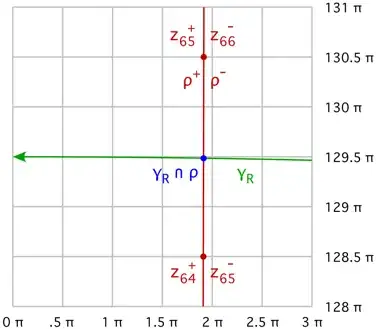
$$ \hspace{-1cm}\small \begin{array}{} z_{64}^+=5.99292081954932666 + 403.67969492855003099 i\\ z_{65}^-=6.00848352082933166 + 403.67988772309602824 i\\ z_{65}^+=6.00848352082933166 + 409.96307303027561472 i\\ z_{66}^-=6.02380774554030566 + 409.96326053797959857 i \end{array} $$ As $R\to\infty$, on $\rho^\pm$ in the upper half-plane, $(9)$ and $(10)$ imply that $\arg(z\mp\pi i)\to\frac\pi2$; thus, as indicated by $(8)$, $e^z$ and $z\mp\pi i$ cancel only when $\mathrm{Im}(z)\approx\frac\pi2\!\!\!\!\pmod{2\pi}$. Likewise, $e^z$ and $z\mp\pi i$ reinforce when $\mathrm{Im}(z)\approx\frac{3\pi}{2}\!\!\!\!\pmod{2\pi}$.

Therefore, when $R\equiv\frac{3\pi}{2}\!\!\!\!\pmod{2\pi}$ and $z\in\overset{\frown}{\gamma}_R\cap\rho^\pm$, we have that $|e^z-z\pm\pi i|\sim2R$. As $z\in\overset{\frown}{\gamma}_R$ moves to the right, by even just $1$, $e^z$ more than doubles, and dominates $z\mp\pi i$; thus, $|e^z-z\pm\pi i|\ge2R-R$. As $z\in\overset{\frown}{\gamma}_R$ moves to the left, by even just $1$, $e^z$ decreases by more than half, and $z\mp\pi i$ dominates; thus, $|e^z-z\pm\pi i|\ge R-R/2$. Therefore, when $R\equiv\frac{3\pi}{2}\!\!\!\!\pmod{2\pi}$, $|e^z-z\pm\pi i|\ge R/2$, and $|(e^z-z)^2+\pi^2|\ge R^2/4$. This guarantees that, as $R\to\infty$, the integral over $\overset{\frown}{\gamma}_R$ vanishes.

Thus, the integral along the real axis is $2\pi i$ times the sum of the residues in the upper half-plane.

The Residues

Let $z_k^\pm=-W_{-k}(1)\pm\pi i$. We will use the fact that $e^{z_k^\pm}-z_k^\pm=\mp\pi i$.

The residue of $\displaystyle\frac1{(e^z-z)^2+\pi^2}$ at $z_k^\pm=-W_{-k}(1)\pm\pi i$ is $$ \begin{align} \lim_{z\to z_k^\pm}\frac{z-z_k^\pm}{(e^z-z)^2+\pi^2} &=\frac1{2(\mp\pi i)(e^{z_k^\pm}-1)}\\ &=\frac1{2\pi i}\frac1{\mp(z_k^\pm-1\mp\pi i)}\\ &=\frac1{2\pi i}\frac1{\pm(W_{-k}(1)+1)}\\ \end{align} $$ Thus, the residues at the pairs of singularities cancel each other, leaving us with the residue at $z_0^+$ which is $\dfrac1{2\pi i}\dfrac1{W_0(1)+1}$. Thus, the integral is $$ \int_{-\infty}^\infty\frac{\mathrm{d}x}{(e^x-x)^2+\pi^2}=\frac1{W_0(1)+1} $$

robjohn
  • 353,833
  • 2
    Thanks for the fantastic answer! – Argon Oct 08 '12 at 17:33
  • 5
    @Argon: This is a marvelous question! It's nice to see LambertW appear as the result an integral (or a rational function thereof). – robjohn Oct 08 '12 at 17:41
  • @ robjohn: Good lesson to learn (+1) – user 1591719 Oct 09 '12 at 09:51
  • Why do you analyse the bounds of the integrand only on $\gamma\cap\rho^{\pm}$? – FShrike Apr 21 '22 at 22:21
  • I don't. I show that $|(e^z-z)^2+\pi^2|\ge R^2/4$ on $\gamma_R$. I look at where $\gamma_R\cap p^{\pm}$ because that is where $|e^z-z|$ is small. Away from that point, it is at least $|z|/2$. – robjohn Apr 21 '22 at 23:10
  • Sorry to bother you about this again, I've come back to this because it is such a lovely integral. Did you show the asymptotic horizontal/vertical intersections of $\gamma$ and $\rho$ for geometric pleasure, or did it have a significant effect on the analysis that I overlooked? – FShrike Jun 01 '22 at 10:06
  • It was to show the relation of $\gamma_R$ to the singularities since that bears on the size of the integral along $\gamma_R$. – robjohn Jun 01 '22 at 10:14
9

While this is by no means rigorous, but it gives the correct solution. Any corrections to this are welcome!

Let

$$f(z) := \frac{1}{(e^z-z)^2+\pi^2}$$

Let $C$ be the canonical positively-oriented semicircular contour that traverses the real line from $-R$ to $R$ and all around $Re^{i \theta}$ for $0 \le \theta \le \pi$ (let this semicircular arc be called $C_R$), so

$$\oint_C f(z)\, dz = \int_{-R}^R f(z)\,dz + \int_{C_R}f(z)\, dz$$

To evaluate the latter integral, we see

$$ \left| \int_{C_R} \frac{1}{(e^z-z)^2+\pi^2}\, dz \right| = \int_{C_R} \left| \frac{1}{(e^z-z)^2+\pi^2}\right| \, dz \le \int_{C_R} \frac{1}{(|e^z-z|)^2-\pi^2} \, dz \le \int_{C_R} \frac{1}{(e^R-R)^2-\pi^2} \, dz $$

and letting $R \to \infty$, the outer integral disappears.

Looking at the denominator of $f$ for singularities:

$$(e^z-z)^2 + \pi^2 = 0 \implies e^z-z = \pm i \pi \implies z = -W (1)\pm i\pi$$

using this.

We now use the root with the positive $i\pi$ because when the sign is negative, the pole does not fall within the contour because $\Im (-W (1)- i\pi)<0$.

$$z_0 := -W (1)+i\pi$$

We calculate the beautiful residue at $b_0$ at $z=z_0$:

$$ b_0= \operatorname*{Res}_{z \to z_0} f(z) = \lim_{z\to z_0} \frac{(z-z_0)}{(e^z-z)^2+\pi^2} = \lim_{z\to z_0} \frac{1}{2(e^z-1)(e^z-z)} = \frac{1}{2(-W(1) -1)(-W(1)+W(1)-i\pi)} = \frac{1}{-2\pi i(-W(1) -1)} = \frac{1}{2\pi i(W(1)+1)} $$

using L'Hopital's rule to compute the limit.

And finally, with residue theorem

$$ \oint_C f(z)\, dz = \int_{-\infty}^\infty f(z)\,dz = 2 \pi i b_0 = \frac{2 \pi i}{2\pi i(W(1)+1)} = \frac{1}{W(1)+1} $$


An evaluation of this integral with real methods would also be intriguing.

Argon
  • 25,971
  • 1
    Just as there are infinitely many solutions to $w\exp(w)=1$, there are infinitely many singularities in the upper half plane. Let $z_k=-W_k(1)\mp i\pi$, where $W_k(1)$ are the solutions to $W_k(1)\exp(W_k(1))=1$, then $e^z-z=\pm i\pi$. All but one of these singularities seem to be ignored in the contour integration. – robjohn Oct 05 '12 at 07:17
  • Here are the first seven singularities $$ \begin{align} -W_0(1)+i\pi&=-0.5671432904097838730 + 3.1415926535897932385\ i\ -W_{-1}(1)-i\pi&=+1.5339133197935745079 + 1.2335924994721051470\ i\ -W_{-1}(1)+i\pi&=+1.5339133197935745079 + 7.5167778066516916239\ i\ -W_{-2}(1)-i\pi&=+2.4015851048680028842 + 7.6347068625252776600\ i\ -W_{-2}(1)+i\pi&=+2.4015851048680028842 + 13.917892169704864137\ i\ -W_{-3}(1)-i\pi&=+2.8535817554090378070 + 13.971942885822352674\ i\ -W_{-3}(1)+i\pi&=+2.8535817554090378070 + 20.255128193001939151\ i\ &\vdots \end{align} $$ – robjohn Oct 05 '12 at 07:18
  • What do you consider rigorous? Other than not catching all of the singularities, your proof looks like a pretty standard application of contour integration. – robjohn Oct 05 '12 at 09:25
  • I have finally updated my answer so that the contour misses the singularities. – robjohn Oct 08 '12 at 09:23
1

Beautiful Integral!

Because \begin{align} \frac{1}{{\left( e^z - z \right)^2 + \pi^2}} &= \frac{1}{\left( e^z - z - i\pi \right)\left( e^z - z + i\pi \right)} \\ &= \frac{1}{2\pi i}\left( \frac{1}{e^z - z - i\pi} - \frac{1}{e^z - z + i\pi} \right), \end{align}

we will have: \begin{align} \int_{-\infty}^{+\infty} \frac{1}{\left( e^z - z \right)^2 + \pi^2} dz &= \frac{1}{2\pi i} \left( \int_{-\infty}^{+\infty} \frac{1}{e^z - z - i\pi} dz - \int_{-\infty}^{+\infty} \frac{1}{e^z - z + i\pi} dz \right) \\ &= \frac{1}{2\pi i} \left( \int_{-\infty}^{+\infty} \frac{1}{-(e^{z + i\pi}) - (z + i\pi)} dz - \int_{-\infty}^{+\infty} \frac{1}{-(e^{z - i\pi}) - (z - i\pi)} dz \right) \\ &= \frac{1}{2\pi i} \left( \int_{-\infty + i\pi}^{+\infty + i\pi} \frac{1}{-(e^w) - w} dw - \int_{-\infty - i\pi}^{+\infty - i\pi} \frac{1}{-(e^w) - w} dw \right) \\ &= \frac{1}{2\pi i} \left( \int_{-\infty - i\pi}^{+\infty - i\pi} \frac{1}{e^w + w} dw - \int_{-\infty + i\pi}^{+\infty + i\pi} \frac{1}{e^w + w} dw \right) \\ &= \frac{1}{2\pi i} \left( \int_{-\infty - i\pi}^{+\infty - i\pi} \frac{1}{e^w + w} dw + \int_{+\infty + i\pi}^{-\infty + i\pi} \frac{1}{e^w + w} dw \right). \end{align}

But $$\displaystyle{\left| {\frac{1}{{{e^w} + w}}} \right| \geqslant \frac{1}{{\left| {{e^w}} \right| + \left| w \right|}}\xrightarrow{{w \to \infty }}0}$$ then $$\displaystyle{\int\limits_c {\frac{1}{{{e^w} + w}}dw} = \int\limits_{ - \infty - i\pi }^{ + \infty - i\pi } {\frac{1}{{{e^w} + w}}dw} + \int\limits_{ + \infty + i\pi }^{ - \infty + i\pi } {\frac{1}{ {{e^w} + w}}dw} }$$

where $\displaystyle{c:}$ the rectangle with vertices $$\displaystyle{A\left( { - M, - \pi } \right),\;B\left( {M, - \pi } \right),\;C\left( {M,\pi } \right )\;\& \;D\left( { - M,\pi } \right)}$$ with $\displaystyle{M \to + \infty }$ and with right direction of rotation.

The function $\displaystyle{f\left( w \right) = \frac{1}{{{e^w} + w}}}$ is monomorphic inside the rectangle $\displaystyle{c}$ (analytic with some poles).

We are looking for its poles $\displaystyle{f\left( w \right) = \frac{1}{{{e^w} + w}}}$ inside it $\displaystyle{c}$, therefore the roots of the equation $\displaystyle{{e^w} + w = ​​0}.$

$$\displaystyle{{e^w} + w = ​​0 \Rightarrow {e^{x + iy}} + x + iy = 0 \Rightarrow \left\{ {\begin{array}{*{20}{c}} \begin{gathered} {e^x}\cos y + x = 0 \hfill \\ \hfill \\ \end{gathered} \\ {{e^x}\sin y + y = 0} \\ \end {array} } \right.}$$ For $\displaystyle{y = 0}$ we have a root the unique root of the real equation $\displaystyle{{e^x} + x = 0}$.

For $\displaystyle{y \ne 0}$we have $\displaystyle{{e^x} = - \frac{y}{{\sin y}}}$ which is impossible for $\displaystyle{y \in \left[ { - \pi ,\;\pi } \right]}$ (within the rectangle $\displaystyle{c}).$ So if $\displaystyle{\rho :}$ the root of the equation $\displaystyle{{e^x} + x = 0}$, we will have

\begin{align} \int_C \frac{1}{e^w + w} dw &= 2\pi i \cdot \text{Res}\left( \frac{1}{e^w + w}, w = \rho \right) \\ &= 2\pi i \cdot \lim_{w \to \rho} \frac{w - \rho}{e^w + w} \\ &= \frac{2\pi i}{e^\rho + 1}. \end{align}

so \begin{align} \int_{-\infty}^{+\infty} \frac{1}{\left( e^z - z \right)^2 + \pi^2} dz &= \frac{1}{2\pi i} \left( \int_{-\infty - i\pi}^{+\infty - i\pi} \frac{1}{e^w + w} dw + \int_{+\infty + i\pi}^{-\infty + i\pi} \frac{1}{e^w + w} dw \right) \\ &= \frac{1}{2\pi i} \int_C \frac{1}{e^w + w} dw \\ &= \frac{1}{e^\rho + 1}. \end{align}

But $$\displaystyle{{e^\rho } + \rho = 0 \Rightarrow {e^\rho } = \left( { - \rho } \right) \Rightarrow \left( { - \rho } \right){e^ {\left( { - \rho } \right)}} = 1}$$, ie $\displaystyle{ - \rho = \Omega }$ where $\displaystyle{\Omega :}$ the root of the equation $\displaystyle{x{e^x} = 1}.$

And finally \begin{align} \int_{-\infty}^{+\infty} \frac{1}{\left( e^z - z \right)^2 + \pi^2} dz &= \frac{1}{e^\rho + 1} \\ &= \frac{1}{-\rho + 1} \\ &= \frac{1}{1 + \Omega}. \end{align}