24

I've thought about the following question for a month, but I'm facing difficulty.

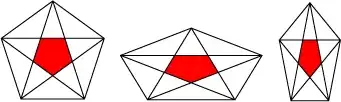
Question : Letting $S{^\prime}$ be the area of the inner pentagon made by the five diagonals of a convex pentagon whose area is $S$, then find the max of $\frac{S^{\prime}}{S}$.

$\ \ \ \ \ \ \ \ \ \ \ \ \ \ \ \ \ \ \ \ \ $enter image description here

It seems that a regular pentagon and its affine images would give the max. However, I don't have any good idea without tedious calculations. Can anyone help?

Update : I crossposted to MO.

mathlove
  • 151,597
  • Have you used similar triangles to compare the side-length ratios, and in particular, the perimeter ratios? If you can get a perimeter ratio, I believe a good start would be to consider that the area ratio would be some degree-2 form of the perimeter ratio. – abiessu Sep 23 '13 at 14:55
  • Except that in a non-regular pentagon $S$, $S'$ is often a different shape (i.e., non-similar to $S$). Hmmm... – abiessu Sep 23 '13 at 15:03
  • @abiessu: Well, I can't get what you mean, sorry. – mathlove Sep 23 '13 at 15:22
  • No worries, I drew my own non-regular pentagon and began to realize some of the difficulty you are having. If it is possible to know the perimeter $p$ of $S$ and the perimeter $p'$ of $S'$, then I would expect that $S'\over S$ is similar to (or the same as) $p'^2\over p^2$. – abiessu Sep 23 '13 at 15:24
  • 1
    I'm reminded of "Feynman's Triangle" or the " 1/7 th triangle theorem. Construct Cevians from vertices of a triangle to points on the opposite sides which are in the ratio of one third the distance to a neighbor vertex. Take it in a clockwise or anticlockwise but consistent sense. The ratio of the area of the inner to outer triangle is 1/7,Feynman worked on the problem during a dinner conversation, I suppose he got the right answer. – Alan Sep 30 '13 at 19:32
  • Computations are made a bit less tedious by considering that affine maps preserve the ratio between areas, hence we may assume without loss of generality that vertices $A,C,D$ form an equilateral triangle, or that four vertices lie on the same circle. – Jack D'Aurizio Oct 02 '15 at 17:29

5 Answers5

1

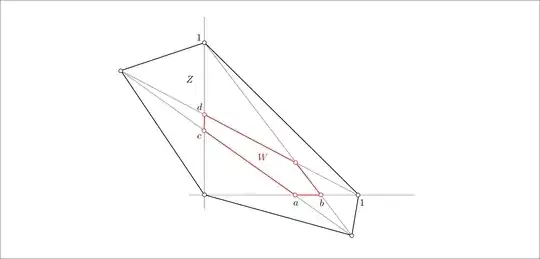
Denote by $z_i$ $(0\leq i\leq 4)$ the vertices of the large pentagon $Z$ and by $w_i$ the vertices of the small pentagon $W$. WLOG we may assume $$z_0=(0,0), \quad z_2=(1,0),\quad z_3=(0,1)$$ and $$w_3=(a,0), \quad w_4=(b,0),\quad w_1=(0,d),\quad w_2=(0,c)$$ with $$0<a<b<1,\quad 0<c<d<1,\quad d<{c\over a}<{1\over b}\ .$$
enter image description here

One then obtains $$z_1=\left({ba(1-c)\over a-bc}, {c(a-b)\over a-bc}\right),\quad z_4=\left({a(c-d)\over c-ad}, {dc(1-a)\over c-ad}\right),\quad w_0=\left({b(1-d)\over 1-bd}, {d(1-b)\over 1-bd}\right)\ .$$ This means that the moduli space ${\cal M}$ of such configurations up to affinity has dimension $4$. The values $a=c={3-\sqrt{5}\over2}\doteq0.381966$ and $b=d={\sqrt{5}-1\over2}\doteq0.618034$ correspond to regular pentagons $Z$ and $W$.

Further computation then gives $$2\>{\rm area}(Z)=1+{(b-a)c\over a- bc}-{a(d-c)\over ad-c}\>,\quad 2\>{\rm area}(W)={bd(2-b-d)-ac(1-bd)\over 1-bd}\ ,\tag{1}$$ and we are interested in the quantity $$t(a,b,c,d):={{\rm area}(W)\over {\rm area}(Z)}\ .$$ For regular pentagons $Z$ and $W$ one has $t={7-3\sqrt{5}\over2}\doteq0.145898$.

The expressions $(1)$ are complicated enough to forbid calculating partial derivatives of $t$. On the other hand it is easy to see that $\inf_{\cal M} t(a,b,c,d)=0$. As for the maximum of $t$ I simulated $10^7$ random such configurations with Mathematica and obtained the following optimal quintuple $(a,b,c,d,t)$: $$(0.383542, 0.619248, 0.381882, 0.618277, 0.14589)\ .$$ This supports the conjecture that $t$ is maximal for regular pentagons.
1

A complete solution is available at https://arxiv.org/abs/1812.07682

On the polygon determined by the short diagonals of a convex polygon, Jacqueline Cho, Dan Ismailescu, Yiwon Kim, Andrew Woojong Lee

user84909
  • 412
0

Not a complete answer, and surely not elegant, but here's an approach. The idea is to consider "polygonal conics" in the following sense. Take the cone $K$ given by \begin{equation} K:\qquad x^2+y^2=z^2 \end{equation} and slice it with the plane $z=1$. We get a circle $\gamma$, and let's inscribe in this circle a regular pentagon, $P$ (The idea actually works with a regular $n$-gon with $n=2k+1$... should it be called $n$-oddgon?). The diagonals of this pentagon define a smaller pentagon $P'$. Let also $\gamma'$ be the circle in which $P'$ is itself inscribed in.

Let also $C,C',S,S'$ be the areas of $\gamma,\gamma',P,P'$ respectively. We have \begin{equation} \frac{C'}{C}=\frac{S'}{S} \end{equation} since all these areas depend only on the radiuses of $\gamma$ and $\gamma'$.

Let's now slice the initial cone and the cone $K'$ generated by the circle $\gamma'$ with a general plane \begin{equation} (x-x_0)\cos\theta+(z-z_0)\sin\theta=0 \end{equation} (Informally, it's the plane passing through $(x_0,0,z_0)$ and its normal vector lies in the plane $y=0$ and makes an angle $\theta$ with the $x$-axis).

We get two nested conics. Considering only the cases when these conics are ellipses, we can compute the ratio of their areas (area of the inner ellipse over area of the outer one) and one finds that the maximum of this value occurs when both are circles.

When only the inner conic is an ellipse, the ratio is zero.

Considering now the "pentagonal cones" obtained by extruding the original nested pentagons along the two cones $K$ and $K'$ and reasoning in a similar way as before, we have that the ratio between the areas of the nested "pentagonal conics" has a maximum when the pentagons are regular.

A problem with this approach is that I don't have a clue of what class of pentagons we are dealing with, as it may be too narrow to be of any real interest for the problem.

UPDATE: in the case of a pentagon, since five points in general position determine a conic, I guess we have covered all the possible cases.

marco trevi
  • 3,358
0

Here is a partial answer.

Say point C of the large pentagon ABCDE is free to move, so long as the area does not change. We are curious what happens to the red area.

So C can move parallel to BD. As it does so, the red area increases on one side and decreases on the other side, due to CA and CE moving.

Consider CE, and the change in red area due only to CE as C moves by $\epsilon$ (parallel to BD). The point where CE crosses BD moves by $k \epsilon$, where $k$ is the constant ratio $m/n$ of the altitude $m$ from E to BD to the altitude $n$ from E to C's locus line. Indeed, the change in area is monotonic in the distance $s$ from B$'$ (the intersection of AD and CE) to BD, which itself is monotonic in the position of C.

The area of the red pentagon is affected in this way both by the change in area due to CE and by that due to CA, and therefore it is maximized when C is somewhere in the middle, and it is strictly concave in C's position.

Due to the symmetry of the regular pentagon, we can see the red area is at a local maximum in this case.

The question asks us to prove this is the global maximum, but I would guess an even stronger result, that this is the only local maximum, and even that the red area is strictly concave in the positions of the vertices (subject to constant area of the large pentagon).

If we could show that single-vertex area-preserving moves can transform any pentagon into any "nearby" one, with no vertex ever traveling far from its original position, then that would probably finish the proof of total strict concavity. It seems to be true, requiring $O(1/\epsilon)$ moves.

Matt
  • 9,693
0

The area ratio $S’/S$ is always $k^2$ where $$k = {1-\sin(\pi/10) \over 1 + \cos(\pi/5)}.$$ $k$ is the ratio of the perimeter of the inner pentagon to the outer pentagon.

To see this, note that the inner pentagon appears to to be similar the outer pentagon but rotated by 180 degrees. Assume the outer pentagon is inscribed in a unit circle. Label the outer regular pentagon vertices as ABCDE with A at the top. Label the inner pentagon vertices as abcde but starting with a at the bottom. The triangles ACD and Acd are similar. It’s easily seen that the altitude of the Acd triangle is $1-\sin(\pi/10)$ and that of the ACD triangle is $1 + \cos(\pi/5)$. Thus, the ratio of cd to CD is $k$. Since cd and CD are sides of regular pentagons, the perimeter ratio must be $k$ and the area ratio must be $k^2$.

I leave the proof to others, but I assert that the following are invariant under any affine transformation:

  • parallel lines remain parallel;
  • the ratio of line sub-segments (P,X) and (X,Q) is constant if line segment (P,Q) is intersected at X by another line segment (p,q);
  • similar polygons remain similar; and, as a result,
  • the perimeter and area ratios of similar polygons are constant.

The results have been checked with a MATLAB script that generates random affine transformations. Might add that these results should hold for other regular polygons except for the value of $k$. For example, $k = 1/3$ for a hexagon.

T L Davis
  • 468
  • 1
    This is wrong. The ratio is irrational if the large pentagon is regular, and is rational if the vertices of the large pentagon have integer coordinates. – Christian Blatter May 28 '17 at 13:18
  • @ChristianBlatter: I guess I misread the question. My answer only applies to affine transformations of a regular pentagon. But, a quick check with MATLAB doesn't seem to bear out your claim about integer coordinates. – T L Davis May 29 '17 at 16:28
  • It is obvious that the "small pentagon" of a pentagon with integer coordinates has rational coordinates, and that a pentagon whose vertices have rational coordinates has rational area. – Christian Blatter May 29 '17 at 18:00