The paper Dividing a polygon into two similar polygons provides that there are only three families of polygons that are irrep-2-tiles (can be subdivided into similar copies of the original).
- Right angled triangles
- $1:\sqrt{2}$ parallelograms
- The Golden Bee
I wish to find examples of polyhedra that are irrep-2-tiles. The only example I have been able to find is:
- The $1:2^\frac{1}{3}:2^\frac{2}{3}$ parallelopipeds.
Are there further examples? I would like to find as many as possible.
I have now posted this question on MathOverflow also.
Edit: A diagram of the Golden Bee from the linked paper. It seems plausible that there could be a $3d$ analogue. 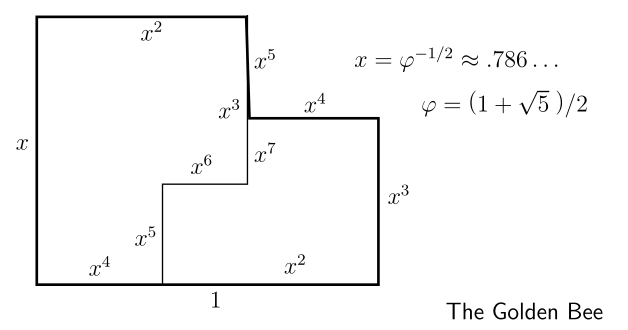
Addressing Jaap Scherphuis' comment, such a polyhedron would be able to tile $\mathbb{R}^3$, provided you used copies of different sizes. An analogue of the Pinwheel tiling would work.
However, I can't think of a way to guarantee that we only use a finite amount of different sizes of the tile. The "natural" tiling, adjoining copies of the polyhedron again and again to cover the entire plane will need arbitrarily large polyhedra. We can subdivide these to reduce their size, but unless we have some lucky scaling factors we'll end up with infinitely many different sizes of tile.
