3

Consider the braid group $$B_3=\langle x,y:xyx=yxy\rangle.$$ It has a proper subgroup $N$, defined as follows: $g$ is in $N$ if and only if the sum of all exponents in $$g=\prod u_i^{\varepsilon_i},\ u_i\in\{x,y\},\ \varepsilon_i\in\{-1,1\}$$ is divisible by $5$; i.e. $g\in N\iff\sum\varepsilon_i\equiv0\pmod5$.

I was asked to prove that $N$ is isomorphic to $B_3$ itself.

I think the first thing to do is to get a finite set of generators and relations to generate $N$, and then reduce the relations to the form $ghg=hgh$ (or $k^2=l^3$, as they're equivalent by $k=ghg$, $l=gh$), but I failed at this step.

Shaun
  • 47,747
atzlt
  • 574
  • 1
    Maybe try showing $N=\langle u,v\mid uvu=vuv\rangle,$ where $u=x^{-1}y,v=xy^{-1}.$ – suckling pig Apr 15 '24 at 06:59
  • @calcll I thought of that but 1. $N$ cannot be generated from $u$ and $v$ alone: at least there should be something like $x^5$ or otherwise $\sum\varepsilon_i$ will always be $0$ in $N$; 2. $uvu=vuv$ in fact implies $x^4=y^4$, which is again generally false. – atzlt Apr 15 '24 at 07:16
  • 1
    Maybe $x^2y^3,x^3y^2.$ – suckling pig Apr 15 '24 at 07:24
  • @calcII How do you prove 1. $u=x^2y^3$ and $v=x^3y^2$ actually generate the whole $N$, and 2. $uvu=vuv$ then? – atzlt Apr 15 '24 at 07:33
  • 1
    I can do this easily on a computer, since $N$ has finite index $5$ in $B_3$. We have $N = \langle a^2bab, a^4b \rangle$, with the two generators of $N$ satisfying the braid relations. I guess I could turn this into a hand computation, but I will wait to see if anyone comes up with a clever proof. – Derek Holt Apr 15 '24 at 08:08
  • 2
    Covering space arguments can be used in place of a computer, although fundamentally they are the same thing. The question is asking about the kernel of the map $B_3\to\mathbb{Z}_5$ given by $x\mapsto1, y\mapsto1$, so do the "usual" covering space arguments to find a presentation for this kernel (see e.g.), and then use the relators to reduce down to two generators. – user1729 Apr 15 '24 at 13:58
  • @user1729 I have a little knowledge about covering spaces and fundamental group, but not much. Could you please elaborate on how to use them to solve this particular problem? I would like to see it if you can post it as an answer. – atzlt Apr 18 '24 at 08:12
  • @atzlt I've done this now. I hope it is helpful, and I'm happy to clarify anything :-). – user1729 Apr 18 '24 at 16:16

2 Answers2

3

Anyway I managed to find out a solution: $N$ is generated by $xyxyx$ and $yxyxy$. This is found by somewhat "brute force" search by hand. I expect some more elegant explanation though.

atzlt
  • 574
3

The covering-space argument is described in the following picture:
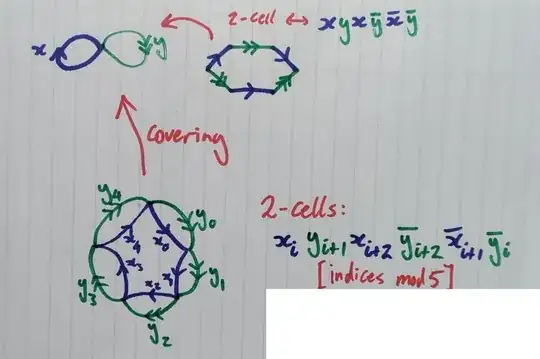
five-sheeted covering of the braid group

At the top we have a 2-complex, with fundamental group $B_3$. It is precisely the presentation complex of the presentation $\langle x, y\mid xyx=yxy\rangle$, so has $1$-skeleton as drawn on the left, and then we glue a $2$-cell on in the hopefully obvious way.

The subgroup defined in the question corresponds to the kernel of the map $B_3\to\mathbb{Z}_5$ defined by $\phi:x\mapsto 1, y\mapsto 1$, and hence clearly to an index-5 subgroup. This corresponds to a $5$-sheeted covering of our presentation complex. To draw this covering space, I first drew the Cayley graph of $\mathbb{Z}_5$, and for each of the $5$ vertices $0, \ldots, 4$ I added edges $x_i, y_i$ corresponding to the image of $\phi(x), \phi(y)$ at this point - in this case, $x_i$ and $y_i$ move to the next vertex, but for example the map $\psi:x\mapsto 1, y\mapsto0$ would have $x$-edges as here, but loop edges for each $y_i$. This gives us our $1$-skeleton. Then $2$-cells are then the lift of the $2$-cell of the presentation complex at of the $5$ vertices - that is, for each vertex $0, \ldots, 4$, read $xyxy^{-1}x^{-1}y^{-1}$ to get a $2$-cell. This gives: $$\begin{align*} x_0y_1x_2y_2^{-1}&x_1^{-1}y_0^{-1}\\ x_1y_2x_3y_3^{-1}&x_2^{-1}y_1^{-1}\\ &\vdots \end{align*} $$ To get the fundamental group of this covering space, which is what we are after, we take the presentation with the $1$-cells as generators, and then the $2$-cells and a then $1$-cells forming a spanning tree as relations; I suggest $y_1=1,y_2=1,y_3=1,y_4=1$ as the spanning tree. This gives a presentation as follows: $$ \begin{align*} \langle x_i, y_i, i\in\{0, \ldots, 4\}\mid x_iy_{i+1}x_{i+2}y_{i+2}^{-1}&x_{i+1}^{-1}y_i^{-1}\:(i \mod 5), y_1, \ldots, y_4 \rangle \end{align*} $$ Now write this out in full, remove the generators $y_1, \ldots, y_4$ from the presentation, and then carefully use Tietse transformations to reduce down to two generators. The result is the Braid group. [I can do this in full if needed, I'm just out of time now :-)]

user1729
  • 32,369
  • 1
    That's a nice explanation! Thanks for writing this answer and drawing the nice-looking diagram :D – atzlt Apr 19 '24 at 10:59