4

The dodecahedral numbers, 0, 1, 20, 84, 220, 455, 816, 1330, 2024, 2925, 4060, ... numbers of the form ${3 n \choose 3}$ (A006566).

Does anyone have a good visualization of these? In particular, I'd like to see 2024 as a dodecahedral number.

Here's the corresponding tetrahedral number 2024:

2024 spheres

Ed Pegg
  • 21,868
  • 1
    In case others fall into the same error I initially did: Googling 'dodecahedral numbers' does give some image examples, but these are for the rhombic dodecahedral numbers (A005917). – Semiclassical Jan 03 '24 at 22:05
  • 1
    As for ways to visualize this, I can think of two routes. The first is what was presumably done for the above image: find some way to systematically enumerate where all the spheres should be centered, and use these to create the image in Mathematica. But this seems substantially harder for the dodecahedral numbers than for tetragonal numbers. The second approach I could see is to use Zometool (or vZome) to create the figure directly. The disadvantage is that this would require some manual effort, but the advantage is that the dodecahedral directions are naturally incorporated. – Semiclassical Jan 03 '24 at 22:14
  • 1
    You hopefully know this interesting site, unfortunately labelled "non secure" by McAfee anti-virus... – Jean Marie Jan 04 '24 at 00:21

4 Answers4

7

Visualization

(based on Oscar's and Ed's answers)

Tetrahedral and cubic numbers are much easier to grasp than dodecahedral numbers.

So, let’s build up 5 visualizations in parallel:

  • Tetrahedral numbers
  • Cubic numbers
  • Dodecahedral numbers
  • Dodecahedral' numbers (arranged halfway between a dodecahedron and tetrahedron)
  • Dodecahedral'' numbers (arranged as a tetrahedron)

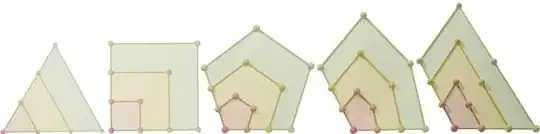
Here are the 2D equivalents. Each layer is drawn with a unique color. Notice how all layers share the red vertex: enter image description here
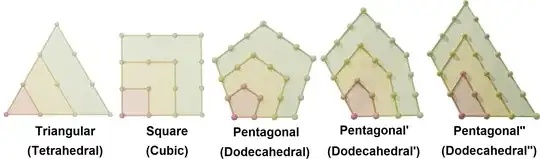
Remove the intermediate points: enter image description here

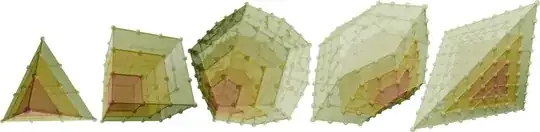
And extend to 3D. Again, each layer is a separate color. Note that 3 copies of the previous step share the red vertex. The rest of the faces are not shared among layers: enter image description here
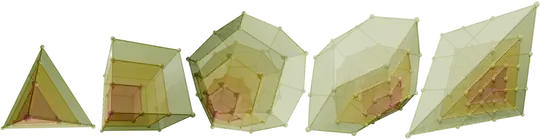
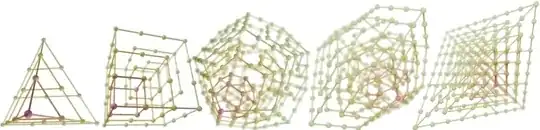
Add the intermediate points back in: enter image description here

Remove the faces: enter image description here

Here's the dodecahedral form with N=8 (2024 points): enter image description here
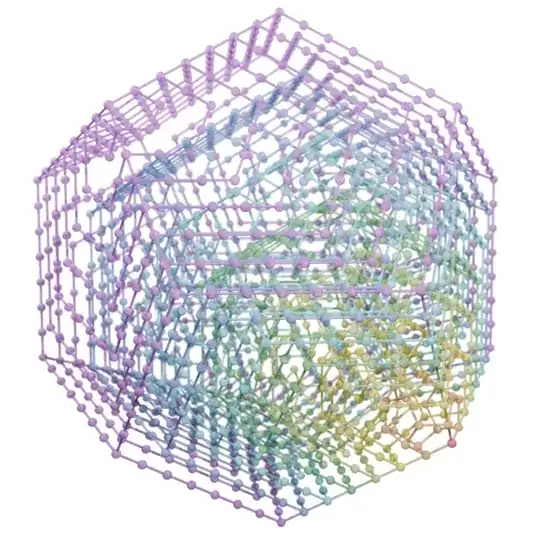
And the dodecahedral'' form, again with N=8 (2024 points): enter image description here

Justification of dodecahedral numbers using tetrahedral form

(from Oscar)

The idea is to divide each trapezoid into 3 triangles, and warp those triangles to form a pentagon. This works well for pentagonal numbers:

enter image description here

As with other figurate numbers, we may regard the array as being built from layers, or gnomons, surrounding one vertex of the figure, which we take to be the "origin". To understand how smaller dodecahedral numbers are embedded in larger ones, we first identify the proper gnomon. With the dodecahedral form at the end of this animation series, the gnomon is identified by selecting one vertex as the origin and the gnomon then consists of all the faces not touching this vertex, therefore nine dodecahedral faces. These faces have $18$ interior edges and ten interior vertices. Since the tetrahedral form has three dodecahedral faces for each tetrahedral face, the gnomon in the tetrahedral form becomes three tetrahedral faces with the origin now in the center of the fourth tetrahedral face. The face center will always have a ball on it when the tetrahedral-number argument is $3n+1$, which is the appropriate tetrahedral argument for a dodecahedral number.

In both forms we can calculate that the outer gnomon for $2024$ will have $694$ balls, which is what we would need for the eighth dodecahedral number ($2024$) to embed the next lower one ($1330$). With the dodecahedral form, the dodecahedral-number argument is $8$ and we count the number of balls in the gnomon as follows:

$(9×92)-(18×8)+10=694$

The first term is the eighth pentagonal number ($92$) on each of the nine gnomonic faces; but this double-counts the $18$ interior edges and triple-counts the ten interior vertices in the gnomon. Thus the second term removes the double-counted edges while the third term restores the triple-counted interior vertices (we think of the multiple-countings as a toggle switch).

In the tetrahedral form, the three-faced gnomon has $22$ balls on each edge, as the tetrahedral-number argument is $22$; and the calculation analogous to the one above gives

$(3×253)-(3×22)+1=694,$

where $253$ is the 22nd triangular number. With the proper number of balls in the outer gnomon thus verified ($2024-1330=694$ for this case), the dodecahedral numbers embed their predecessors in the same way as more familiar figurate numbers.

Old stuff

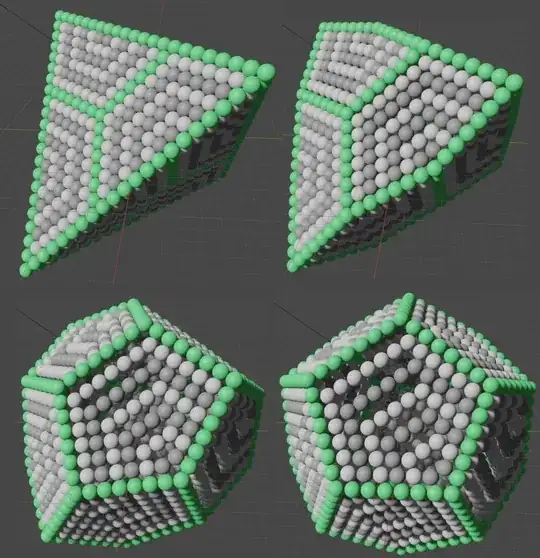
Here's an animation sequence based on Oscar's and Ed's answers: enter image description here
Tom Sirgedas
  • 1,268
  • 1
    We actually get the same problem with pentagonal numbers. Removing the outer shell of a pentagonal number array gives a remainder that isn't a pentaonal number unless we extend the formula to negative arguments. In the dodecahedral case we get a remaainder in whch we have to change both the sign of the argument and the sign of the resulting product; e.g. $1140 = –Dodecahedral(–6)$. – Oscar Lanzi Jan 05 '24 at 10:13
  • 3
    To step down from one "positive" pentagonal number to the next we have to remove only three sides of the pentagon; in the dodecahedral case we have to remove just an appropriate set of nine faces of the dodecahedron which corresponds to three faces of the tetrahedron. Doing this with 2024 leaves 1330, which is in fact the 19th tetrahedral number and seventh dodecahedral one. – Oscar Lanzi Jan 05 '24 at 10:23
  • 1
    Oh, thanks, that clears things up! So the "origin" is at the center of one of the tetrahedral faces. I'll make some new visuals and update my answer. – Tom Sirgedas Jan 05 '24 at 15:07
  • 1
    I've edited in the proper rendering; have a look. – Oscar Lanzi Jan 05 '24 at 17:31
  • Does this use my tetartoid solution, or did you derive the same thing on your own independently? It's one of those things simple enough that few believe, including myself, that I was the first to find it. – Ed Pegg Jan 06 '24 at 04:20
  • 1
    "Does this use my tetartoid solution...?" -- are you referring to the tetrahedron -> dodecahedron morphing? I just linearly interpolated the vertices between those two shapes. – Tom Sirgedas Jan 06 '24 at 07:10
  • 2
    The graphical connection between the tetrahedron and the dodecahedron (on this question) was my idea. I first applied it to this question, using a trigonal bipyramid, to identulify a (unique modulo mirror imaging) pentagonal 18-hedron. – Oscar Lanzi Jan 06 '24 at 12:12
3

The tetrahedral representation actually is also a dodecahedral one.

Imagine an equilateral triangle. You mark off the centroid and select one of two mirror-image ways to draw three rays parallel to the sides that divide the triangle into trapezoids. Now do this on each face of a regular tetrahedron, choosing the same mirror image as you look at each face from the exterior. Then the dividers on each face bisect the long sides of the trapezoids on the adjacent faces, making the twelve trapezoids graphically pentagonal.

And there is more. Each edge of the tetrahedron has 22 balls for 2024, so there are 21 intervening segments. You find that each side of the graphical pentagons defined above has a whole number of segments, 21/3=7, thus eight balls counting both ends includively. Thereby the 22nd tetrahedral number is also the eighth dodecahedral number, or more generally the $3n+1$ tetrahedral number is also the $n+1$ dodecahedral number.

Below I have drawn the dividers into the tetrahedral picture.

enter image description here

Oscar Lanzi
  • 48,208
3

Oscar seems to be right. Here's a better picture. Code. dodecahedral 2024

Ed Pegg
  • 21,868
  • 1
    Yeah, I should leave drawing to the experts :-) +1. I did slightly improve my picture, which I made using Powerpoint on a mobile device! – Oscar Lanzi Jan 04 '24 at 17:50
  • I put this property of dodecahedral numbers into Wikipedia. You may want to replace my illustration with your better one, thank you. – Oscar Lanzi Jan 07 '24 at 11:30
3

Here's an animation of the construction of the first eight (non-zero) dodecahedral numbers. (My apologies for the poor image quality. I had to shrink it and "optimize" it to get it under the maximum file size limit. I'll make a full-quality version available eventually, but I want to tweak the design a bit.)

enter image description here

As described in @Tom's answer, the layers are built up as with pentagonal numbers, with all iterated dodecahedra sharing a vertex and three edge(-lines). Effectively, each dodecahedron wears the next layer of spheres like a helmet.

Note that each pentagonal face illustrates a pentagonal number; the iterated pentagons on a given face share a vertex. To get the helmet effect for the full dodecahedron, three faces are arranged so that their shared vertices coincide with the dodecahedra's (purple) shared vertex.

It's hard to tell in the animation, but I arranged the other nine faces in triads like this, too, so that there's a total of four coincident vertices, which together determine a regular tetrahedron. (But only the purple shared vertex has the iterated dodecahedra attached.) That's something I want to highlight in my design tweak.

Blue
  • 83,939
  • 1
    Nice animation! The GIF plays in-place just fine for me on desktop and phone – Tom Sirgedas Jan 05 '24 at 23:31
  • @TomSirgedas: Thanks! :) .... Oh, and it looks like the animation plays for me now, too. Maybe my browser just had to clear its cache or something. I'll remove my pre(r)amble. – Blue Jan 05 '24 at 23:49