1

This is to be proven an incorrect triangulation of the torus:

Incorrect triangulation of the torus

And this is to be proven an incorrect triangulation of the projective plane: Incorrect triangulation of the projective plane

I would like to know what part of the definition of triangulation is missing in these examples. The definition I was given is the following:

A triangulation of X is a finite set of triangules $\mathcal{T}=\{T_1,\dots,T_n\}$ satisfying the following 4 properties:

  1. The union of the triangles is exactly X

  2. The intersection of two different triangles is either the empty set, a single common vertex or a single common side

  3. Every side is side of exactly 2 triangles

  4. Given any vertex, the triangles containing it form a closed chain of triangles

As I said, I can't figure which one of these 4 properties is not satisfied by the triangulations shown in the pictures.

I have found similar questions in the forum for the torus, but the answers didn't appeal to any definition, but to geometric intuition. I hope I could explain the question clearly enough.

Jyrki Lahtonen
  • 140,891

1 Answers1

6

A problem with the torus triangulation is the following.

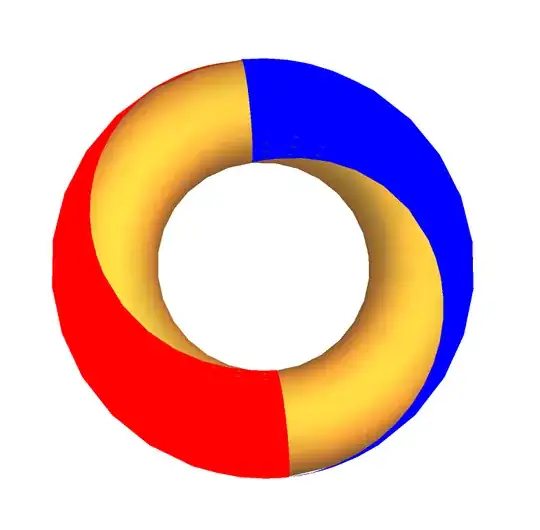
Look at the two triangles with an edge at the top. Those two triangles intersect at two isolated points, namely those marked 0 and 2. Therefore their intesection cannot be a single vertex. But the two edges from the central 2 to the corner 0s are not identified, so the intersection cannot be a common edge either.

I don't know if the situation becomes any clearer, but below there is a picture of how those two triangles, one red, the other blue, look like on the surface of a donut. I used a parametrization mapping the horizontal lines at the top/bottom to the outer "equator" of the donut. Hence the top half of your square is in the front in the image. You see how the blue and red triangles meet at two points, one at the top and the other at the bottom.


A problem with the proposed triangulation of the projective plane is that there are two distinct triangles sharing all three vertices: 0, 1 and 4. Those two triangles also share two edges, which is not allowed. No picture here, as I have trouble embedding the projective plane into 3-space :-).

Jyrki Lahtonen
  • 140,891