Here is a crazy and over-the-top method using contour integration.
$$
\bbox[15px,#FFFAFD,border:6px groove #0712FF ]{\int_0^2 x \Biggl\lceil{\frac{1}{x}-\frac{1}{2}\Biggl\rceil}dx = \frac{\pi^2}{4}}
$$
PROOF. Let the integral equal $\mathcal{I}$. Using the transformation $\displaystyle \frac{1}{x}+\frac{1}{2} \mapsto x$, we get
$$
\begin{align}
\mathcal{I} &= \int_0^2 x \Biggl\lceil{\frac{1}{x}-\frac{1}{2}\Biggl\rceil}dx \\
&= \int_0^2 x \Biggl\lfloor{\frac{1}{x}+\frac{1}{2}\Biggl\rfloor}dx \\
&\overset{\frac{1}{x}+\frac{1}{2} \mapsto x}= 8\int_{1}^{\infty}\frac{\lfloor{x\rfloor}}{\left(2x-1\right)^{3}}dx \\
&= 8\sum_{k \in \mathbb{Z}^+} k\int_{k}^{k+1}\frac{dx}{\left(2x-1\right)^{3}} \\
&= 16\sum_{k \in \mathbb{Z}^+}\frac{k^{2}}{\left(4k^{2}-1\right)^{2}} \\
&= 8\sum_{k \in \mathbb{Z}}\frac{k^{2}}{\left(4k^{2}-1\right)^{2}}\,. \\
\end{align}
$$
In that last equality, note that the sequence of terms $\displaystyle \frac{k^2}{(4k^2-1)^2}$ for negative $k$ equals that of positive $k$.
We define a function $\displaystyle f: \mathbb{C} \,\backslash \left(\mathbb{Z}^+ \cup \mathbb{Z}^- \cup \left\{-\frac{1}{2},\frac{1}{2}\right\}\right) \to \mathbb{C}$ such that $\displaystyle z \mapsto \frac{z^2 \cot(\pi z)}{(4z^2-1)^2}$. We also construct a counterclockwise circular contour and a set of poles
$$
\begin{align}
C_n &:= \left\{t \in [0,2\pi]\,:\,\left(n+\frac{1}{2}\right)e^{it}\right\} \\
\mathcal{P}_n &:= \overbrace{\left(\left\{-n,-n+1,\ldots,n-1,n\right\}\,\backslash \left\{0\right\}\right) \cup \left\{-\frac{1}{2},\frac{1}{2}\right\}}^\text{set of simple poles}
\end{align}
$$
where $n \in \mathbb{Z}^+$. The visual above depicts the contour $C_n$ enclosing $\mathcal{P}_n$ over the rainbow phase plot of $f$ with shading.
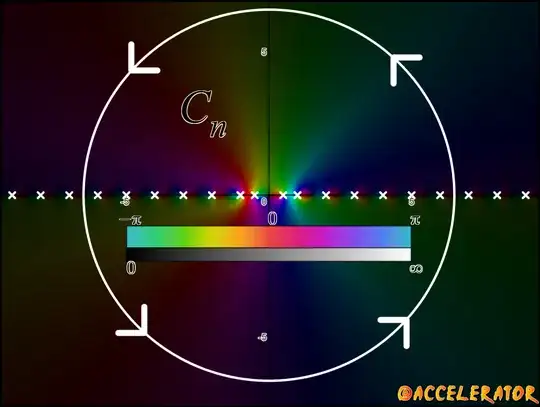
Notice that $z=0$ is a removable singularity. Writing $\displaystyle \frac{z}{e^{\pi iz}-1}$ as an asymptotic Taylor expansion centered at $z=0$, we get
$$
\begin{align}
f(z) &= \frac{z^2\cot(\pi z)}{(4z^2-1)^2} \\
&= \frac{iz\left(1+e^{2\pi iz}\right)}{\left(4z^{2}-1\right)^{2}\left(e^{\pi iz}+1\right)}\cdot\frac{z}{e^{\pi iz}-1} \\
&= \frac{iz\left(1+e^{2\pi iz}\right)}{\left(4z^{2}-1\right)^{2}\left(e^{\pi iz}+1\right)}\cdot\left(-\frac{i}{\pi}-\frac{1}{2}z+\frac{i\pi}{12}z^{2}+\mathcal{O}\left(z^{4}\right)\right)\,.
\end{align}
$$
This expansion makes it possible to redefine $f$ such that it's analytic in a neighborhood of $0$ and remove $z=0$ as a singularity.
Employing Cauchy's Residue Theorem, we get
$$
\oint_{C_n}f(z)dz = 2\pi i\sum_{k \,\in\, P_n}\mathop{\mathrm{Res}}_{z\,=\,k}f(z) = 2\pi i \left(\sum_{k\,=\,-n}^{n}\mathop{\mathrm{Res}}_{z\,=\,k} f(z) +\mathop{\mathrm{Res}}_{z\,=\,-\frac{1}{2}}f(z) + \mathop{\mathrm{Res}}_{z\,=\,\frac{1}{2}}f(z)\right)
$$
Evaluating the residue at $\displaystyle z=-\frac{1}{2}$ of $f(z)dz$, we get
$$
\begin{align}
2\pi i\mathop{\mathrm{Res}}_{z\,=\,-\frac{1}{2}}f(z) &= 2\pi i \lim_{z\,\to\,-\frac{1}{2}}\left(z+\frac{1}{2}\right)\cdot\frac{iz^{2}\left(1+e^{2\pi iz}\right)}{16\left(z-\frac{1}{2}\right)^{2}\left(z+\frac{1}{2}\right)^{2}\left(e^{2\pi iz}-1\right)} \\
&= -\frac{\pi}{8}\lim_{z\,\to\,-\frac{1}{2}}\frac{z^{2}}{\left(z-\frac{1}{2}\right)^{2}\left(e^{2\pi iz}-1\right)} \lim_{z\,\to\,-\frac{1}{2}}\frac{1+e^{2\pi iz}}{z+\frac{1}{2}} \\
&= -\frac{\pi}{8}\cdot\frac{\left(-\frac{1}{2}\right)^{2}}{\left(-\frac{1}{2}-\frac{1}{2}\right)^{2}\left(e^{2\pi i\left(-\frac{1}{2}\right)}-1\right)}\cdot \lim_{z\,\to\,-\frac{1}{2}}\frac{\frac{d}{dz}\left(1+e^{2\pi iz}\right)}{\frac{d}{dz}\left(z+\frac{1}{2}\right)} \\
&= \frac{\pi}{64}\lim_{z\,\to\,-\frac{1}{2}}\frac{2\pi ie^{2\pi iz}}{1} \\
&= \frac{\pi}{64}\cdot2\pi ie^{2\pi i\left(-\frac{1}{2}\right)} \\
&= -\frac{i\pi^{2}}{32}\,. \\
\end{align}
$$
The same process should apply for calculating the residue at $\displaystyle z=\frac{1}{2}$. It should be
$$
2\pi i\mathop{\mathrm{Res}}_{z\,=\,\frac{1}{2}}f(z) = -\frac{i\pi^2}{32}\,.
$$
Calculating the rest of the residues, we get
$$
\begin{align}
2\pi i \sum_{k\,=\,-n}^{n}\mathop{\mathrm{Res}}_{z\,=\,k} f(z) &= 2\pi i \lim_{z\,\to\,k} \frac{iz^{2}\left(1+e^{2\pi iz}\right)}{\frac{d}{dz}\left(4z^{2}-1\right)^{2}\left(e^{2\pi iz}-1\right)}\\
&= -2\pi\sum_{k\,=\,-n}^{n}\lim_{z\,\to\,k}\frac{z^{2}\left(1+e^{2\pi iz}\right)}{2\left(4z^{2}-1\right)\left(4\pi iz^{2}e^{2\pi iz}+8ze^{2\pi iz}-8z-i\pi e^{2\pi iz}\right)}\\
&=-2\pi\sum_{k=-n}^{n}\frac{k^{2}\left(1+e^{2\pi ik}\right)}{2\left(4k^{2}-1\right)\left(4\pi ik^{2}e^{2\pi ik}+8ke^{2\pi ik}-8k-i\pi e^{2\pi ik}\right)} \tag{1}\\
&= 2i\sum_{k=-n}^{n}\frac{k^{2}}{\left(4k^{2}-1\right)^{2}}\,. \\
\end{align}
$$
In $(1)$, we use the piecewise equality
$$
e^{k\pi i} =
\begin{cases}
1 & k \equiv 0 \pmod{2} \\
-1 & k \equiv 1 \pmod{2}\,. \\
\end{cases}
$$
Equating the imaginary part on both sides of the equality that resulted from Cauchy's Residue Theorem and applying $n \to \infty$, we recover the infinite series we want as follows:
$$
\lim_{n\,\to\,\infty}\Im\oint_{C_n}\frac{z^{2}\cot\left(\pi z\right)}{\left(4z^{2}-1\right)^{2}} = \sum_{k\,\in\,\mathbb{Z}}\frac{2k^{2}}{\left(4k^{2}-1\right)^{2}} - \frac{\pi^{2}}{16}
$$
$$
\implies \sum_{k\,\in\,\mathbb{Z}}\frac{k^{2}}{\left(4k^{2}-1\right)^{2}} = \frac{1}{2}\lim_{n\,\to\,\infty}\Im\oint_{C_n}\frac{z^{2}\cot\left(\pi z\right)}{\left(4z^{2}-1\right)^{2}}+\frac{\pi^2}{32}\,.
$$
All that's left is to evaluate the limit of that contour integral and multiply both sides by $8$ to get the desired answer.
We construct a sequence of contour integrals $\displaystyle \oint_{C_n}f$ such that $\displaystyle \oint_{C_n}f$ converges as $n \to \infty$. As the contour grows bigger, none of the integer poles touch it because we judiciously constructed $C_n$ such that $\displaystyle \Re\left(n+\frac{1}{2}\right)e^{it}$ always lies in between two poles. A visual I made on Desmos can be found here and playing with the $n$ slider.
Letting $z \in C_n$, we use the parameterization $\displaystyle z = \left(n+\frac{1}{2}\right)e^{it}$ on $[0,2\pi]$. We bound the contour integral's modulus and have the following chain of inequalities below:
$$
\begin{align}
0 &\leq \left|\Im \oint_{C_n}f(z)dz\right| \\
&\leq \left|\oint_{C_n}f(z)dz\right| \\
&= \underbrace{\left|\operatorname{\Large\int_{0}^{2\pi}}\frac{\left(n+\frac{1}{2}\right)^{2}e^{2it}\cot\left(\pi\left(n+\frac{1}{2}\right)e^{it}\right)}{\left(4\left(n+\frac{1}{2}\right)^{2}e^{2it}-1\right)^{2}}\left(n+\frac{1}{2}\right)ie^{it}dt\right|}_{z \, \in\, C_n} \\
&\leq \operatorname{\Large\int_{0}^{2\pi}}\left|\frac{\left(n+\frac{1}{2}\right)^{2}e^{2it}\cot\left(\pi\left(n+\frac{1}{2}\right)e^{it}\right)}{\left(4\left(n+\frac{1}{2}\right)^{2}e^{2it}-1\right)^{2}}\left(n+\frac{1}{2}\right)ie^{it}\right|dt \\
&= \operatorname{\Large\int_{0}^{2\pi}}\frac{\left(n+\frac{1}{2}\right)^{3}\left|\cot\left(\pi\left(n+\frac{1}{2}\right)e^{it}\right)\right|}{\left|4\left(n+\frac{1}{2}\right)^{2}e^{2it}-1\right|^{2}}dt \\
&\leq \frac{\left(n+\frac{1}{2}\right)^{3}}{\left(4\left(n+\frac{1}{2}\right)^{2}-1\right)^{2}}\int_{0}^{2\pi}\left|\cot\left(\pi\left(n+\frac{1}{2}\right)e^{it}\right)\right|dt \\
&= \frac{\left(n+\frac{1}{2}\right)^{3}}{\left(4\left(n+\frac{1}{2}\right)^{2}-1\right)^{2}}\operatorname{\large\int_{0}^{2\pi}}\left|i+\frac{2i}{\exp\left(2\pi\left(n+\frac{1}{2}\right)ie^{it}\right)-1}\right|dt \\
&\leq \frac{\left(n+\frac{1}{2}\right)^{3}}{\left(4\left(n+\frac{1}{2}\right)^{2}-1\right)^{2}}\operatorname{\large\int_{0}^{2\pi}}\left(1+\frac{2}{\left|\exp\left(2\pi\left(n+\frac{1}{2}\right)ie^{it}\right)-1\right|}\right)dt \\
&\leq \frac{\left(n+\frac{1}{2}\right)^{3}}{\left(4\left(n+\frac{1}{2}\right)^{2}-1\right)^{2}}\operatorname{\large\int_{0}^{2\pi}}\mathop{\mathrm{sup}}_{t \in [0,2\pi]}\left(1+\frac{2}{\left|\exp\left(2\pi\left(n+\frac{1}{2}\right)ie^{it}\right)-1\right|}\right)dt \\
&= \frac{2\pi\left(n+\frac{1}{2}\right)^{3}}{\left(4\left(n+\frac{1}{2}\right)^{2}-1\right)^{2}}\mathop{\mathrm{sup}}_{t \in [0,2\pi]}\left(1+\frac{2}{\left|\exp\left(2\pi\left(n+\frac{1}{2}\right)ie^{it}\right)-1\right|}\right)\,.
\end{align}
$$
Here, we bound the integral by its supremum because the graph of $\displaystyle 1+\frac{2}{\left|\exp\left(2\pi\left(n+\frac{1}{2}\right)ie^{it}\right)-1\right|}$ is a square-looking wave for large $n$ periodic on $2\pi$.
Applying $n \to \infty$, we get
$$
\lim_{n \to \infty} 0 \leq \lim_{n\to\infty}\left|\Im \oint_{C_n}f(z)dz\right| \leq \frac{2\pi\left(n+\frac{1}{2}\right)^{3}}{\left(4\left(n+\frac{1}{2}\right)^{2}-1\right)^{2}}\mathop{\mathrm{sup}}_{t \in [0,2\pi]}\left(1+\frac{2}{\left|\exp\left(2\pi\left(n+\frac{1}{2}\right)ie^{it}\right)-1\right|}\right)\,.
$$
Since the supremum is fixed and the numerator grows slower than the denominator, we can use the Squeeze Theorem for sequences to get
$$
\begin{align}
&\lim_{n\to\infty}\left|\Im \oint_{C_n}f(z)dz\right| = 0 \\
\implies
&\bbox[15px,#DBFFEA]{\lim_{n\to\infty}\Im \oint_{C_n}f(z)dz = 0\,.} \\
\end{align}
$$
Wrapping things up,
$$
\require{cancel}{\sum_{k\,\in\,\mathbb{Z}}\frac{k^{2}}{\left(4k^{2}-1\right)^{2}} = \frac{1}{2}\cancelto{0}{\lim_{n\,\to\,\infty}\Im\oint_{C_n}\frac{z^{2}\cot\left(\pi z\right)}{\left(4z^{2}-1\right)^{2}}}+\frac{\pi^2}{32}\,.}
$$
Then we just multiply both sides by $8$. Finally, we conclude that
$$
\bbox[15px,#E7FCFF,border:6px groove #51008C ]{\int_0^2 x \Biggl\lceil{\frac{1}{x}-\frac{1}{2}\Biggl\rceil}dx = \frac{\pi^2}{4}}
$$
and we're finally done! $\blacksquare$
Happy New Year :)


roundseems to be$$\left[\frac1x\right]:=\left\lceil\frac1x-\frac12\right\rceil=\left\lfloor\frac1x+\frac12\right\rfloor$$ – user170231 Mar 02 '23 at 16:38