25

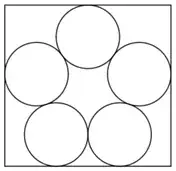
Five unit circles are in a rectangle. In the beginning, their centres are the vertices of a regular pentagon, and each circle is tangent to two other circles and one edge of the rectangle.

Image of five unit circles in a rectangle

Can the circles move without overlapping?

I will post my answer below. I hope to get a more intuitive answer.

Cesareo
  • 36,341
Dan
  • 35,053

5 Answers5

13

Yes, they can move.

enter image description here

Suppose the top circle moves right a small distance $t$, and each circle remains tangent to its corresponding side of the rectangle and its neighboring circles, except the top circle and its lower-left neighbor might lose contact or overlap.

We will show that the circles can move, by applying Pythagorus' theorem around the ring of circles.

$p=2\left(1+\sin{\frac{\pi}{5}}+\sin{\frac{2\pi}{5}}\right)$
$q=4\left(1+\cos{\frac{2\pi}{5}}\right)$
$a=2\cos{\frac{\pi}{5}}-t$
$b=\sqrt{4-a^2}$
$c=p-2-b$
$d=\sqrt{4-c^2}$
$e=q-4-d$
$f=\sqrt{4-e^2}$
$g=p-2-f$
$h=q-2-a$

$\sqrt{g^2+h^2}$ is an increasing function of $t$ (Edit: I used a computer to show this), and $\sqrt{g^2+h^2}=2$ when $t=0$.

$\therefore \sqrt{g^2+h^2}>2$ when $t>0$.

This means that when the top circle moves right, it can separate from its lower-left neighbor. So the circles can move without overlapping.

Five coints moving

(Here you can adjust the speed of the animation.)

Dan
  • 35,053
  • 1
    Just "thinking out loud" ... Consider the two circles along the bottom, moving as a unit. It's not too hard to believe that, as they move, say, to the right, the left-most circle above them moves downward a bit more quickly than the right-most one moves upward, freeing-up space for the top circle. – Blue Jan 04 '23 at 10:55
  • 1
    @Blue I've surveyed a few dozen high school students and teachers about this question, asking them to guess the answer, and most of them guess that the circles cannot move. So apparently the fact that the circles can move, is somewhat counter-intuitive. – Dan Jan 04 '23 at 11:17
  • 2
    [+1] in particular for the nice Desmos animation. – Jean Marie Jan 04 '23 at 21:42
  • 1
    "Yes, they can move" strongly reminds Galileo's "eppur si muove"... – Jean Marie Jan 04 '23 at 21:47
  • 1
    @Dan: How do you know that $\sqrt{g^2+h^2}$ is an increasing function of $t$? (I believe it is, but verifying it seems non-obvious. The derivative is a bit of a monster.) We know that $h$ increases, but $g$ decreases, so that conceivably the hypotenuse of the $gh$ triangle could decrease somewhere. (Eg, if the long leg barely grows while the short leg rapidly shrinks, the hypotenuse could get smaller.) – Blue Jan 05 '23 at 20:44
  • 1
    @Blue I cheated and used a computer to show that $\sqrt{g^2+h^2}$ is an increasing function of $t$. But in principle it can be shown with paper and pencil that when $t=0$, the first derivative is $0$ and the second derivative is positive. (This is why I hope to get a more intuitive answer.) – Dan Jan 06 '23 at 04:32
5

For unit circle, the length of the rectangle is the pentagon diagonal + $2$, that is $$2\cdot \frac{1+\sqrt 5}{2}+2=3+\sqrt 5=5.2361$$The height of the rectangle is$$2\cdot \sqrt{\left(\frac{1+\sqrt 5}{2}\right)^2-\left(\frac{1}{2}\right)^2}+2=5.0777$$as in the Geogebra image below, since$$\frac{5.2361}{5.0777}=\frac{14.33}{13.90}=1.031$$ 5 circles in a rectangle I made a wooden frame of this shape, sized just to hold a regular pentagon array of five U.S. quarters, and was easily able to rotate them into the position shown in the next figure. circles in a square If the rectangle were changed to a square with side $13.96$, the quarters would fit symmetrically about the diagonal and be more compact than in the original arrangement, since$$13.96^2<14.33\times13.90$$

But even without altering the rectangle, the circles have room to move into the second position. Apart from physical experiment, it is prima facie a more economical use of space—the arrangement is more compact—with three circles crowded into a corner (second position) than with only two along one side and the corners unoccupied (first position).

  • 1
    The circles cannot necessarily move from a less economical arrangement into a more economical arrangement. For example, an "X" formation is the most economical use of space, but the circles cannot move from a locked ring with one circle in a corner, to an X formation. – Dan Jan 06 '23 at 09:20
  • That’s true, the “X” formation is more compact, and we can’t move there either from the original position or from my second, more economical, position. But the “X” formation does not meet the original condition of each circle being tangent to two other circles. If we keep to that condition, my ability to economize is limited, since I can’t unpack and repack my quarters but only slide them? – Edward Porcella Jan 06 '23 at 16:34
  • I have written another answer as a long comment on your answer. – Dan Jan 10 '23 at 04:39
4

Here's an attempt at a more intuitive explanation that makes things feel pretty clear to me.

Let the circles be $A,B,C,D,E,$ read from top to bottom and left to right. We're going to move $A$ righwards, $B$ upwards, $C$ downwards, and $D$ and $E$ leftwards, all at a constant rate (though not the same for every circle). We'll argue that this never causes the circles to intersect, so we can continue it until one of them hits a side of the rectangle.

First, let's assert that $D$ and $E$ move left at unit speed. We'll try to work out how fast everything else should move.

Consider the half-plane bounded by the tangent between $B$ and $D$ that contains $B$. If we move this half-plane left at the same rate that $D$ is traveling, this is equivalent to moving it up at some other rate related to the slope of the line. So if $B$ moves upwards at that rate, it'll stay within a half-plane that doesn't overlap $D$ at any point.
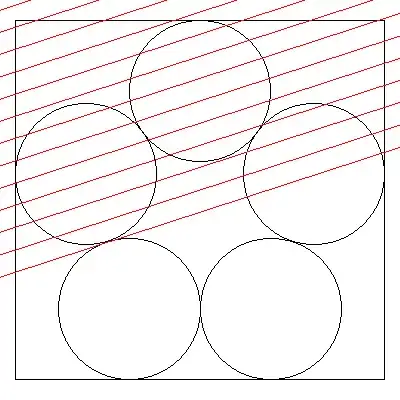
enter image description here

Likewise, we can take the half-plane bounded by the $C-E$ tangent which contains $C$, and note that moving it left is equivalent to moving it down, at the same rate as in the previous paragraph by symmetry. So we can also move $C$ downwards at the same speed $B$ is moving upwards.
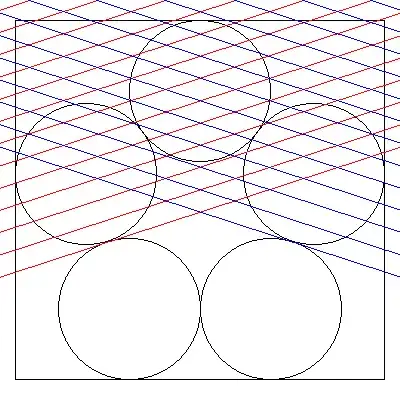
enter image description here

Now consider the half-plane containing $B$ and bounded by the $A-B$ tangent, and the one containing $C$ and bounded by the $A-C$ tangent. These will move up and down, respectively, at the same rate, which means that they can be thought of as moving left and right, respectively, at some other rate (but still the same one between the two of them, because they meet $A$ at identical slopes). So, by the same logic, the void between these half-planes will keep having space for $A$ as it shifts rightwards at some third constant speed.
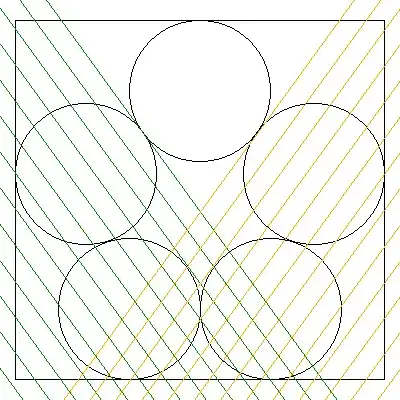
enter image description here

Here's a gif of all five circles moving at a constant speed from one end of the square to the other, with a single line for each relevant half-plane. Note that every line touches the corresponding two circles at all times, and all that changes is the relative position of those tangent points.
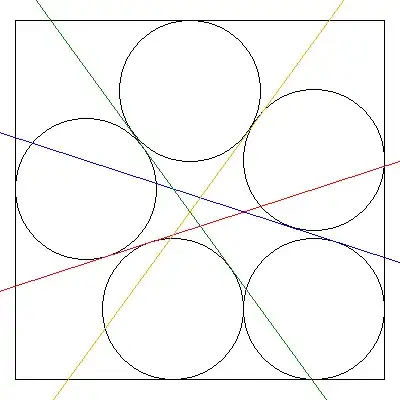
enter image description here

2

This is a long comment on @Edward Porcella's answer.

It is not always the case that circles can move from a less economical arrangement to a more economical arrangement, even with the condition that each circle is tangent to two other circles. Here is an example.

Consider packing three equal circles into the region bounded by $y=x^2$ and $y=2-x^2$.

Arrangement $A$:

Arrangement A

Arrangement $B$:

Arrangement B

In this desmos graph, by sliding $G$ (green circle), $R$ (red circle), and $B$ (blue circle), you can see that:

  • In Arrangement $A$, the circles cannot move without overlapping.
  • Arrangement $B$ is more economical than Arrangement $A$.
Dan
  • 35,053
  • Yes, this keeps the condition that each circle is tangent to two others, but if we allow conics for containers it becomes a different game. Besides the tangency arrangement I guess I assumed a rectilineal right-angled container—five circles in a rectangle, or (i would expect) four in a right triangle. – Edward Porcella Jan 10 '23 at 16:19
  • I think arrangement $B$ is not more economical or compact, since it requires a container of the same size and shape as arrangement $A$. There is no way for three tangent circles to recede from one of the walls by drawing nearer to one another, so there indeed seems no room for “economizing” when it’s three circles in a two-sided container. – Edward Porcella Jan 24 '23 at 01:04
  • 1
    @EdwardPorcella In arrangement $B$, there are small gaps between the circles (not obvious in the image above, but you can see this if you open the desmos graph and zoom in). The blue circle can move a little to the right, and the green and red circles can move a little to the left. – Dan Jan 24 '23 at 01:22
  • Yes, I see the gaps now in arrangement $B$, and it seems you can’t get there from arrangement $A$. So this counters my conjecture, that you can always move from a less to a more economical use of space. – Edward Porcella Jan 27 '23 at 19:44
0

Imagine we have $p_1 = -d\sin\theta\hat j$ and $p_2 = d\cos\theta\hat i$ and we have $\|p_1-p_2\|^2 = d^2$ As $ \frac{d}{dt}\|p_1-p_2\|^2 = 2(p_1-p_2)\cdot (\dot p_1-\dot p_2) = 0$. Here we have $\dot p_1 = -d\cos\theta\dot\theta\hat j$ and $\dot p_2 = -d\sin\theta\dot\theta\hat i$ and as can be verified, $(p_1-p_2)\cdot (\dot p_1-\dot p_2) = 0$ so a virtual displacement is possible.

enter image description here

Resuming:

Considering the pentagon formed by the circles centers, and with $l$ the regular pentagon side, according to the attached figure we have

$$ \cases{ u = l\cos a\\ v = l\cos b\\ x = l\cos c\\ y = l\cos d } $$

and

$$ \cases{ v = l\sin a\\ x = l\sin b\\ y = l\sin c\\ z = l\sin d} $$

so for virtual displacements we have

$$ \cases{ \delta u = -\tan a\delta v\\ \delta v = -\tan b\delta x\\ \delta x = -\tan c\delta y\\ \delta y = -\tan d\delta z } $$

For compatibility we need

$$ \delta x = \tan a\tan b\tan c\tan d\delta x $$

or as a consequence

$$ \tan a\tan b\tan c\tan d = 1 $$

but in our setup we have $d = \frac{\pi}{2}-a$ and $c = \frac{\pi}{2}-b$ hence in this setup, the displacement is possible because we have

$$ \tan a\cot a\tan c\cot c = 1 $$

Cesareo
  • 36,341
  • I'm not sure where your $p_1$, $p_2$, $d$ and $\theta$ are in the diagram in the OP. – Dan Jan 06 '23 at 14:37
  • $p_1$ and $p_2$ are any two sequential circle centers, excluded the two at the bottom. $d$ is their distance. – Cesareo Jan 06 '23 at 14:55