Consider a regular $n$-gon of side length $1$ with its diagonals. Here is an example with $n=11$ (from geogebra applet).
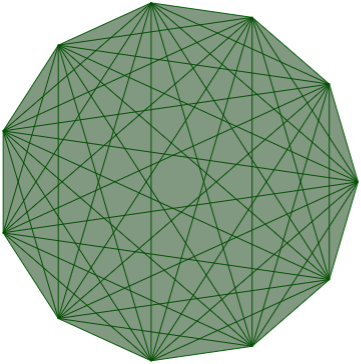
Excluding the centre cell when $n$ is odd, I've been trying to find bounds on the area of the largest cell, in terms of $n$.
It seems that, for every value of $n$, the largest non-centre cell has roughly similar area as the outermost cell, whose area is $\frac{1}{4}\tan{\frac{\pi}{n}}\approx\frac{\pi}{4n}$.
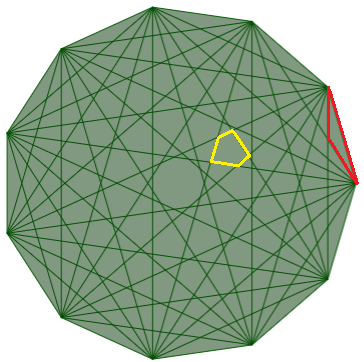
That is, $(\text{area of largest non-centre cell})\approx\frac{\pi}{4n}$. (This claim has strong numerical evidence.)
My question is:
In a regular $n$-gon of side length $1$ with diagonals, what is the infimum and supremum of $n\times(\text{area of largest non-centre cell})$ ?
(The number of cells is approximately $\frac{1}{24}n^4$ for large $n$.)
