23

Let $G$ be a group and $H$ be a subgroup of $G$ with finite index. I want to show that there exists a normal subgroup $N$ of $G$ with finite index and $N \subset H$. The hint for this exercise is to find a homomorphism $G \to S_n$ for $n := [G:H]$ with kernel contained in $H$.

The standard solution suggests to choose $\varphi$ as the homomorphism induced by left-multiplication $\varphi: G \to S(G/H) \cong S_n$. I'm not 100% sure if I understand this correctly. What exactly does $\varphi$ do? We take $g \in G$ and send it to a bijection $\varphi_g: G/H \to G/H, xH \mapsto gxH$? If so, how can I see that its kernel is contained in $H$? Also, the standard solution claims its image is isomorphic to $G/N$ and thus $N$ has a finite index in $G$, how can I see that the image is isomorphic to $G/N$?

Thanks in advance for any help.

Huy
  • 6,867

2 Answers2

5

Your definition of $\varphi$ looks fine. Anything in the kernel must in particular fix $H$, and $gH = H$ is equivalent to $g \in H$. On the other hand I think $N = \ker \varphi$ can be a proper subgroup of $H$. As an example, which is silly because the group is finite, if you take $G = S_3$ and $H = \{1, (12)\}$ then this process produces $N = \{1\}$.

For the second question, this is just the "first" isomorphism theorem.

TTS
  • 1,101
  • For the third statement of the first isomorphism theorem, am I correct that this just follows from the universal property of factor groups? – Huy Jun 24 '13 at 14:09
  • @Huy I certainly think it's part of that circle of ideas. For me the universal property of $G/H$, where $H$ is a normal subgroup of $G$, is that any homomorphism $f\colon G \to G'$ with $H \subset \ker f$ factors uniquely through it. It seems like it's an extra step to say that if $H = \ker f$ then you get an embedding. – TTS Jun 24 '13 at 14:25
  • how do you show it is homomorphism? – user2993422 Sep 14 '15 at 09:52
  • and also i don't understand why N is in H? I think that from your solution we can assume N in xH – user2993422 Sep 14 '15 at 09:59
  • How can we show $S(G/H) \cong S_n$? – 1ENİGMA1 Jan 17 '18 at 09:30
  • Thanks. This post is very helpful but what exactly do we mean by $S(G/H)$? Are we saying that the cosets are permuted amongst themselves? Is that correct? – PythonSage Feb 20 '20 at 20:53
  • @user2993422 $\varphi: G \to S(G/H), a \mapsto [bH \mapsto abH]$ is a homomorphism because for $a, b \in G$ and $c \in G$ we have that $\varphi(ab)(cH) = abcH = a(bcH) = \varphi(a)(bcH) = \varphi(a)(\varphi(b)(cH))$. This shows that $\varphi(ab) = \varphi(a) \circ \varphi(b)$. – Smiley1000 Nov 13 '24 at 08:30
  • @user2993422 We want to show that $N \leq H$. Take $a \in N$. Then we have $\varphi(a) = \operatorname{id}$. In particular, $aH = \varphi(a)(H) = \operatorname{id}(H) = H$. Hence there are $h_1, h_2 \in H$ with $a h_1 = h_2$. But then $a = h_2 {h_1}^{-1} \in H$. – Smiley1000 Nov 13 '24 at 08:33
  • @1EniGMA1 If $G/H$ is a set of size $n$, we have $S(G/H) \cong S_n$. – Smiley1000 Nov 13 '24 at 08:35
  • @PythonSage $S(G/H) = {f: G/H \to G/H \mid f \text{ is bijective}}$. This is the set of all permutations of the cosets, yes. – Smiley1000 Nov 13 '24 at 08:36
3

I have come up with a simple, non-constructive proof, inspired by this post.

Let $ X = \{ gH \ | \ g \in G \}$ be the set of left cosets of $H$ in $G$.

Define $\varphi : G \to S_X$, where $S_X$ is the symmetric group of $X$, by $$\varphi(g)(xH) = gxH$$

It is trivial to show that $\varphi$ is well defined and indeed is a homomorphism:

$$\varphi(ab)(xH) = abxH = \varphi(a)(\varphi(b)(xH)) = (\varphi(a)\circ\varphi(b))(xH) $$

Note that:

  1. $\ker\varphi$ is normal in $G$. This is obvious, because kernel of any homomorphism is normal.

  2. $\ker\varphi \subseteq H$. If $a \in \ker\varphi$, then $\varphi(a)=id$, so $xH=\varphi(a)(xH)=axH$ for all $x\in G$. This implies $x^{-1}ax\in H$ (cosets $aH$ and $bH$ coincide iff $a^{-1}b\in H$). This is true for $x\in H$ in particular, so $a\in H$.

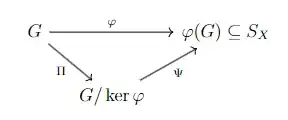
  3. $[G:\ker\varphi]<\infty$, because by isomorphism theorem, we obtain: $$[G:\ker\varphi] = \left| G / \ker\varphi \right| \stackrel{\text{iso}}{=} \left| \varphi(G) \right| < |S_X| < \infty.$$

isomorphism theorem visualisation:

This ends the proof, because $\ker\varphi$ is normal in $G$, subset of $H$ and has finite index in $G$.

Please note that this proof does not specify the exact value of $\ker\varphi$, although it is relatively simple to show that $\ker\varphi = \bigcap_{x\in G} xHx^{-1}$.

311411
  • 3,576
Wiktor
  • 131