0

Consider the following problem asked in a masters exam for which I am self studying.

Write V for the space of $3 \times 3$ skew - symmetric real matrices.

(A) Show that for $A\in SO_3(\mathbb{R})$ and $M\in V$ , $AMA^t \in V$.

(B) Show that there does not exists $M \in V$ , $M \neq 0$ such that for every $A\in SO_3(\mathbb{R})$ , A . M belongs to span of M.

(Note that $SO_3(\mathbb{R})$ is a subgroup of $GL_3 (\mathbb{R})$ such that any element $x\in SO_3(\mathbb{R})$ consists of all orthogonal matrices with Determinant =1).

I have done (A) part, but I am struck on (B). I thought I should assume that let there exists such a matrix $M \in V$ but I am unable to think of any contradiction.

So, Can you please outline a proof for part (b)?

  • In part (b) do you mean to say $AMA^T$ belongs to span of $M$? –  Sep 09 '21 at 18:57
  • @MatthewPilling No , I mean AM belongs to span of M –  Sep 09 '21 at 19:03
  • Suppose there is some non$-$zero $M\in V$ such that $AM\in \text{span}(M)$ for all $A\in SO_3(\mathbb{R})$. Since $M$ is a $3\times 3$ skew symmetric matrix, its column space must be contained in two$-$dimensional plane $W$. If you take $A\in SO_3(\mathbb{R})$ as a $90^{\circ}$ proper rotation in $W$, could $AM$ belong to the span of $M$? –  Sep 09 '21 at 20:04
  • There are some linguistic problems here. Since $M$ lives in vector space $V$ the span of $M$ $\iff$ $\big{\alpha M\big}$ i.e. span of a vector. An easy solution comes from writing $M$ in Polar Form. Since $M$ is singular, this may be useful https://math.stackexchange.com/questions/3834754/how-to-show-that-the-unitary-matrix-in-a-polar-value-decomposition-a-up-is-uni/ . It may be the case that column space of M was meant but the question posed asks for span of a single vector, $M$. – user8675309 Sep 09 '21 at 22:28
  • @user8675309 My perspective on this problem assumes $\text{span}(M)$ is meant to represent ${cM}_{c\in \mathbb{R}}$. If we assume the first column of $M$ (call it $v$) is a non$-$zero vector in $W,$ then the first column of $AM$ is $Av$ which, by construction, is a rotation of $v$ by $\pi/2$ radians around $W^{\perp}.$ There is no way $Av$ can be a constant multiple of $v$. –  Sep 10 '21 at 04:02
  • @MatthewPilling I am bit busy. I will get back to it as soon as I can –  Sep 10 '21 at 04:03
  • @MatthewPilling so we are in agreement. I like polar form as it gives an easy way to get to a matrix with positive trace, and skew matrices are traceless but it depends on what people want to emphasize – user8675309 Sep 10 '21 at 04:20
  • @MatthewPilling For your 2nd comment I am unable to understand how the question in last line is related to my question. ( I understood the rest) –  Sep 18 '21 at 09:09
  • Did you read my second comment directed to @user8675309? I proceeded with a proof by contradiction. –  Sep 18 '21 at 13:55
  • @MatthewPilling I am really sorry but I am unable to understand it. The problem is that what rotation is wasn't covered in my course? So, I have no clue what a rotation is.So, I am not able to understand how it is a rotation of v by $\pi /2$ radians around $W$ prependicular. –  Sep 18 '21 at 15:45

1 Answers1

1

The matrix $M$ is skew symmetric if $M^T=-M$. A general skew symmetric 3x3 matrix has only 3 independent entries.

$$M=\left( \begin{array}{ccc} 0 & m_{12} & m_{13} \\ -m_{12} & 0 & m_{23} \\ -m_{13} & -m_{23} & 0 \\ \end{array} \right) $$

You can use the Rule of Sarrus to make sure $\det(M)=0$.

In a more general setting, the determinant of the skew symmetric $nxn$ matrix is $$\det(M)=\det(M^T)=\det(-M)=(-1)^n\det(M)$$ where we have used some basic properties of determinants. For odd $n$ this means $\det(M)=-\det(M)$ so $\det(M)=0$. This is sometimes called Jacobi's theorem after Carl Gustav Jacobi.

When $\det(M)=0$ the matrix is singular and the dimension of the column space must be less than $n$.

Further, if the 3x3 matrix $M$ above is $\neq \mathbf{0}$ at least one of $(m_{12},m_{13}, m_{23})$ must be nonzero. But as the entries come in pairs over the diagonal, setting one of them to a nonzero value means at least two columns are linearly independent (convince yourself by setting for example $m_{12}=1$ and notice that column 1 and column 2 are now linearly independent). Armed with this knowledge of 3x3 skew symmetric matrices we are ready to continue our adventure

Since $M$ is an odd dimension skew symmetric matrix the determinant is zero and the dimension of its column space $W$ is at most 2 (Jacobi's theorem). But since $M\neq 0$ and skew symmetric the dimension of $W$ must be at least 2. Hence the dimension of $W$ is exactly 2. This also means that at least two of the columns are $\neq \mathbf{0}$. We say that the columns of $M$, lets call them $(M_1,M_2,M_3)$, spans $W$.

The subgroup of orthogonal matrices with determinant +1 is called the special orthogonal group, denoted SO(3). Every rotation can be represented uniquely by an orthogonal matrix with unit determinant. We are free to pick ANY $A\in \text{SO(3)}$. Let $A$ be a proper $\frac{\pi}{2}$ rotation ($\det\,A=1)$ around a vector in the plane perpendicular to one of the nonzero columns $M_i=v$. The rotated vector $Av$ is clearly not in $W$.
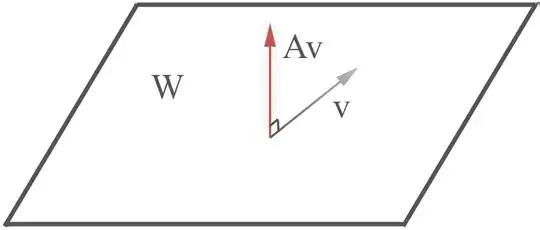
One the columns v and the rotated vector Av

Hence, with our chosen rotation matrix $A$, at least one of the columns of the product $AM=[AM_1\,AM_2\,AM_3]$ has left $W$ completely. It is impossible for $AM$ to equal $cM$ where $c$ is a constant for this specific choice of $A$.

ContraKinta
  • 1,622
  • Can you please prove that how" the dimension of its column space W is at most 2"? Jacobi's Theorem wasn't covered in my course and I could not find the result "the dimension of its column space W is at most 2" on browser. –  Sep 19 '21 at 05:33
  • @James "Since M $\neq 0$ is skew symmetric the dimension of column space must be at least 2".Why can't dimension be 1,0? How does being skew symmetric affects it? –  Sep 19 '21 at 05:37
  • "Let A be a proper π/2 rotation (detA=1) around a vector in the plane perpendicular to one of the nonzero columns $M_i=v$" How you are sure that such a rotation always exists? –  Sep 19 '21 at 05:43
  • I have elaborated on why the dimension of the column space $W$ is exactly two for a non-zero skew symmetric $(3x3)$-matrix above. According to the problem statement we are free to pick any member of the group SO(3) since the statement needs to be valid for ALL members of SO(3). – ContraKinta Sep 19 '21 at 12:17
  • I am unwell and I will not be able to check it now. So, I am awarding you bounty. –  Sep 23 '21 at 06:00