3

This post is sort of followup of Prove or disprove that the function is convex, a question coined up by Erik Satie.
Define $f_n(x)=\sum_{k=1}^{2n}x^{k^2}$ where $n\ge 1$ a natural number and $-1 \leq x \leq 1$.
From the picture below the fact seems evident but I have no idea how to prove it (otherwise).
So, prove or disprove that $f_n(x) \gt -1/2$.

enter image description here

Some easy to prove facts about the function behaviour are noticed: $$ \begin{cases} f_n(-1) = 0 & ; & f_n'(-1) = \sum_{k=1}^{2n} (-1)^{k-1} k^2 = -2n^2-n \lt 0 \\ f_n(0)=0 & ; & f_n'(0) = 1 \\ f_n(+1)=2n & ; & f_n'(+1) = \sum_{k=1}^{2n} k^2 = 2n(2n+1)(4n+1)/6 \end{cases} $$ Numerically:

n =  1 ; minimum = -4.72466351692463E-0001 at x = -6.31262525050100E-0001
n =  2 ; minimum = -4.98653787376657E-0001 at x = -7.51503006012024E-0001
n =  3 ; minimum = -4.99936871867468E-0001 at x = -8.11623246492986E-0001
n =  4 ; minimum = -4.99997098383334E-0001 at x = -8.47695390781563E-0001
n =  5 ; minimum = -4.99999866659599E-0001 at x = -8.71743486973948E-0001
n =  6 ; minimum = -4.99999993940378E-0001 at x = -8.91783567134269E-0001
n =  7 ; minimum = -4.99999999732976E-0001 at x = -9.03807615230461E-0001
n =  8 ; minimum = -4.99999999987309E-0001 at x = -9.15831663326653E-0001
n =  9 ; minimum = -4.99999999999449E-0001 at x = -9.23847695390782E-0001
n = 10 ; minimum = -4.99999999999967E-0001 at x = -9.31863727454910E-0001
n = 11 ; minimum = -4.99999999999999E-0001 at x = -9.35871743486974E-0001
n = 12 ; minimum = -5.00000000000000E-0001 at x = -9.39879759519038E-0001
Han de Bruijn
  • 17,475
  • From the answer by River Li: If $0\le x \le 1$, we have $f_n(x) \ge 0$. If $-1 \lt x \lt 0$, we have $f_n(x) \gt f_{n + 1}(x)$ for all $n\ge 1$. I should have augmented my easy to prove facts with these. – Han de Bruijn Jul 19 '21 at 20:51

1 Answers1

3

If $0 \le x \le 1$, we have $f_n(x) \ge 0$. True.

If $x = -1$, we have $f_n(-1) = 0$. True.

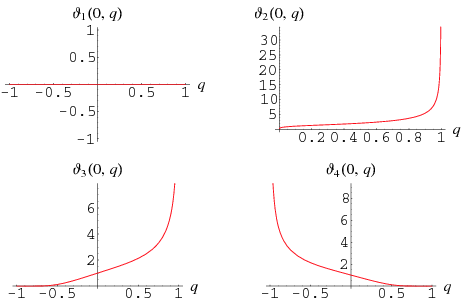
If $-1 < x < 0$, we have $f_n(x) > f_{n + 1}(x)$ for all $n\ge 1$. Also, $\sum_{k=1}^\infty x^{k^2} = \frac{1}{2}\vartheta_3(0, x) - \frac{1}{2} > -\frac{1}{2}$ where $\vartheta_3(z, q) = 1 + 2 \sum_{k=1}^\infty q^{k^2}\cos (2k z)$ is the Jacobi theta function, and we have used the property $\vartheta_3(0, q)= \prod_{n=1}^\infty (1-q^{2n})(1+q^{2n-1})^2$. Thus, $f_n(x) > -\frac12$. True.

We are done.

River Li
  • 49,125
  • 1
    That is it. (I had just found https://math.stackexchange.com/a/1589581 and was about to assemble a similar answer :) – Martin R Jul 19 '21 at 11:21
  • 1
    I wonder if the same method can be used to reduce https://math.stackexchange.com/q/4196614/42969 to the question whether $\vartheta_3(0, x)$ is convex. – Martin R Jul 19 '21 at 11:33
  • @MartinR Yes, thanks for the link. – River Li Jul 19 '21 at 11:36
  • Indeed, the limit of my function graph for $n\to\infty$ is very similar to this picture of $\vartheta_3$ at Wolfram MathWorld. – Han de Bruijn Jul 19 '21 at 21:00
  • 1
    And the formula $\vartheta_3(0, q)= \prod_{n=1}^\infty (1-q^{2n})(1+q^{2n-1})^2$ is a special case of equation (92) at the same Wolfram MathWorld page for $z=0$. Right? But I am not done until I know how to derive that equality $\sum_{n=1}^\infty x^{n^2} = \prod_{n=1}^\infty (1-x^{2n})(1+x^{2n-1})^2$ from first principles. – Han de Bruijn Jul 19 '21 at 21:09
  • @HandeBruijn What is first principles here? – River Li Jul 20 '21 at 00:48
  • Sorry, after several attempts I still cannot understand why $1+2\sum_{n=1}^\infty q^{n^2}=\prod_{n=1}^\infty (1-q^{2n})(1+q^{2n-1})^2$, with $-1\lt q\lt 0$ real-valued, would be true. That's the reason why I upvoted your answer as a whole but issued an unaccept for the last step. – Han de Bruijn Jul 20 '21 at 19:39
  • 1
    @HandeBruijn There is a proof in Page 462, Whittaker, E. T. and Watson, G. N. A Course in Modern Analysis, 2nd Eds., 1915. – River Li Jul 21 '21 at 01:03
  • @RiverLi: Found it on the internet and going to absorb some of it. Thanks. – Han de Bruijn Jul 21 '21 at 08:31