9

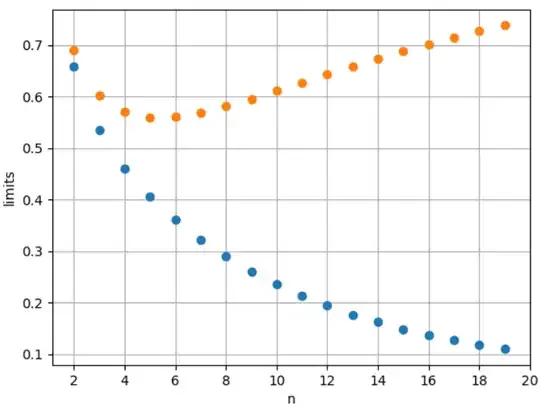
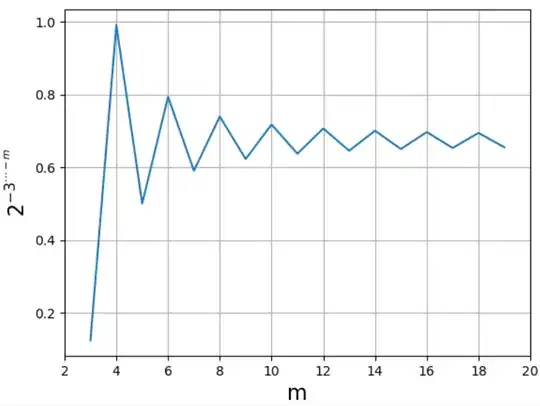
Consider the following: $$n \uparrow -\Bigl((n+1) \uparrow -\bigl((n+2) \uparrow \cdots \uparrow -m \bigr)\Bigr)= n^{{{-(n+1)}^{-(n+2)}}^{\cdots^{-m}}}$$ It doesn't converge for $m \to \infty$, but eventually alternates between two values where the larger one occurs at even numbers of exponents because for $x \to \infty : n^{-x^{-x}} \approx n^0 > n^{-(n+1)^{-x^{-x}}} \approx n^{-1}$.
$\qquad$

For $2^{-3^{-4^{-5^\cdots}}}$ the limits are for example about $0.6903471$ and $0.6583656$.

Is there a closed form for the two limits of the power tower? Are the limits always irrational?

Thanks in advance.

Christian
  • 2,185
  • 3
  • The infinite tetration of x is$ x^{x^{x^{x{^…}}}}$=$-\frac {W(-ln(x)}{ln(x)}$:Source. This has the product logarithm or W-Lambert Function. – Тyma Gaidash Apr 26 '21 at 21:21
  • 1
    Instead of discrete 'n', you can extend this to all real x>0. If you limit the height of the tower to infinity, you get two limits; one for even height towers and one for odd height towers. I plotted towers of height 30 and 29 here: https://i.imgur.com/URkMO2h.png. The height 30 is in red, other one is in blue. – Jade Vanadium Apr 29 '21 at 23:43

1 Answers1

1

This will be an attempt at a semi closed form by using logarithm properties. The fraction MathJax will not be used for better viewing let this number, odd or even limit, be called $C$ for constant: \begin{align} C&=(1/2)^{{1/3}^{{\ldots}^{1/n}}}\\&=\exp\biggr(\ln\biggr((1/2)^{{1/3}^{{\ldots}^{1/n}}}\biggr)\biggr)\\&= \exp\bigr({{1/3}^{{\ldots}^{1/n}}}\times -\ln(2)\bigr)\\&= \exp\bigr(\exp\bigr({1/4}^{{\ldots}^{1/n}}\times-\ln(3)\bigr)\times-\ln(2)\bigr)\\&=\exp(\exp(\ldots(-\ln(n))\times-\ln(n-1))\ldots\times-\ln(3))\times-\ln(2))\end{align}

This means our final answer is: $$C=\lim_{n\to \infty} \exp(\exp(\ldots(-\ln(n))\times-\ln(n-1))\ldots\times-\ln(3))\times-\ln(2)).$$

These $e^y$ can also be expressed in terms of a power infinite summation series for the simplest sum. You can also turn the $\exp(y)$ into $e^y$ to see the full conventional shape of the number. I am not too sure how to proceed from here. Maybe I will think of something else. Please give me feedback and correct me!

Rócherz
  • 4,241
Тyma Gaidash
  • 13,576
  • I found something interesting, the continued fraction of the A242760 constant has the “term numbers” as the sequence: 1,2,4,2,1,4,1,2,2,1,4,1,... which does not reach 10 only until the 15th index or so. What I mean. The other constant seems to have slightly larger numbers maybe meaning it “irrational measure” is different. – Тyma Gaidash May 07 '21 at 12:18
  • This is an old answer – Тyma Gaidash Nov 19 '23 at 03:28