Motivation
I have been thinking about this thing for quite a while now. I have tried many ways but couldn't really figure it out.
I am pretty sure that this kind of expressions don't really have a closed form, so I am asking for other representation for example maybe in terms of an infinite sum or product or something.
Creating A New Notation
Just like there is a notation for a sum $\textstyle\displaystyle{\sum_{n=a}^{b}s_n=s_a+\cdots+s_b}$ and also for a product $\textstyle\displaystyle{\prod_{n=a}^{b}s_n=s_a\cdots s_b}$, I was quite surprised that there wasn't any notation for exponentiation.
I would agree that there wouldn't be any use for this notation but still, why would no mathematician ever would create such a notation just for the sake of curiosity. That is why I would request readers to give me any references if there are any. I haven't found any, so I am creating my own. Let $$\boxed{\textstyle\displaystyle{{\huge\varepsilon\normalsize}_{k=a}^{b}s_k=s_a^{\unicode{x22F0}^{s_b}}}}$$ where $b>a$. If $a>b$ then $\textstyle\displaystyle{{\huge\varepsilon\normalsize}_{k=a}^{b}s_k=1}$ and $\textstyle\displaystyle{{\huge\varepsilon\normalsize}_{k=a}^{b}x=^{b-a+1}x}$. Obviously $a,b\in\mathbb{Z}$.
Unlike product and sum, exponentiation isn't commutative so we have to be careful when using the notation. Maybe we can modify it a little bit to include the ordering.
By the way we are defining $\textstyle\displaystyle{{\huge\varepsilon\normalsize}_{k=a}^{\infty}s_k:= \lim_{n\rightarrow\infty}\left({\huge\varepsilon\normalsize}_{k=a}^{n}s_k\right)}.$
Some Natural Questions
When written out in the form of this notation, some natural curious questions arrive or at least some arrived in my mind, for example $\textstyle\displaystyle{{\huge\varepsilon\normalsize}_{k=2}^{\infty}\frac{1}{k^s}}$ and $\textstyle\displaystyle{{\huge\varepsilon\normalsize}_{k=2}^{\infty}\frac{1}{n}}$.
My Curiosity
My initial curiosity was $H=\textstyle\displaystyle{{\huge\varepsilon\normalsize}_{k=2}^{\infty}\frac{1}{k}=\left(\frac{1}{2}\right)^{\left(\frac{1}{3}\right)^{\left(\frac{1}{4}\right)^{\unicode{x22F0}}}}}$.
As pointed out by Tavish in the comments, this can be written as a recurrence relation given by $$\textstyle\displaystyle{a_{n+1}=-\frac{\ln(a_n)}{\ln(n)}}$$ where $\textstyle\displaystyle{a_n=\left(\frac{1}{n}\right)^{\left(\frac{1}{n+1}\right)^{\unicode{x22F0}}}}$. Solving this will help us derive $H$.
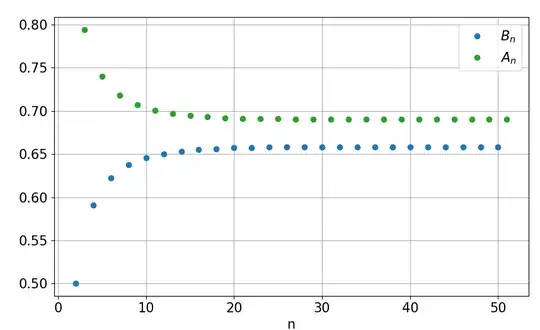
But as pointed out in the comments and in this question (Note that this question focuses on the convergence of $H$, while my question focuses on something different), $H$ doesn't really make much sense by the definition of infinite power tower above because it seems that $$\textstyle\displaystyle{\lim_{n\rightarrow\infty}\left({\huge\varepsilon\normalsize}_{k=2}^{2n}\frac{1}{k}\right)\neq\lim_{n\rightarrow\infty}\left({\huge\varepsilon\normalsize}_{k=2}^{2n+1}\frac{1}{k}\right)}.$$ In particular, we have
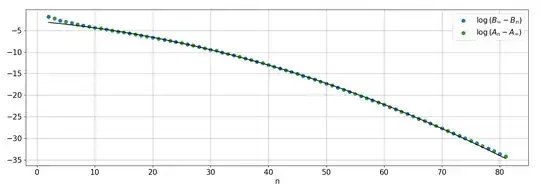
\begin{align}H_O&=\lim_{n\rightarrow\infty}\left({\huge\varepsilon\normalsize}_{k=2}^{2n+1}\frac{1}{k}\right)=0.6903471261\cdots\\H_E&=\lim_{n\rightarrow\infty}\left({\huge\varepsilon\normalsize}_{k=2}^{2n}\frac{1}{k}\right)=0.6583655992\cdots\end{align}
Let $E_n=\textstyle\displaystyle{{\huge\varepsilon\normalsize}_{k=2}^{2n}\frac{1}{k}}$ and $O_n=\textstyle\displaystyle{{\huge\varepsilon\normalsize}_{k=2}^{2n+1}\frac{1}{k}}$. I tried constructing a recurrence relation for $E_n$ and $O_n$, but couldn't, except \begin{align}E_{n+1}&=\left(\log_{\frac{1}{2n-1}}(\cdots\log_{\frac{1}{2}}(E_n))\right)^{\left(\frac{1}{2n+1}\right)^{\left(\frac{1}{2n+2}\right)}}\\O_{n+1}&=\left(\log_{\frac{1}{2n}}(\cdots\log_{\frac{1}{2}}(O_n))\right)^{\left(\frac{1}{2n+2}\right)^{\left(\frac{1}{2n+3}\right)}}\end{align} which is not really workable. If there is a way to simplify it then please do tell me or write a partial answer about it, because it would help us a lot in finding the values of $H_E$ and $H_O$.
My Question
I am pretty sure that there really isn't closed form of $H_E$ and $H_O$.
So I am asking for a different representation for those constants, maybe as a sum or an integral possibly?




https://oeis.org/A102575
– mick Nov 20 '23 at 22:09