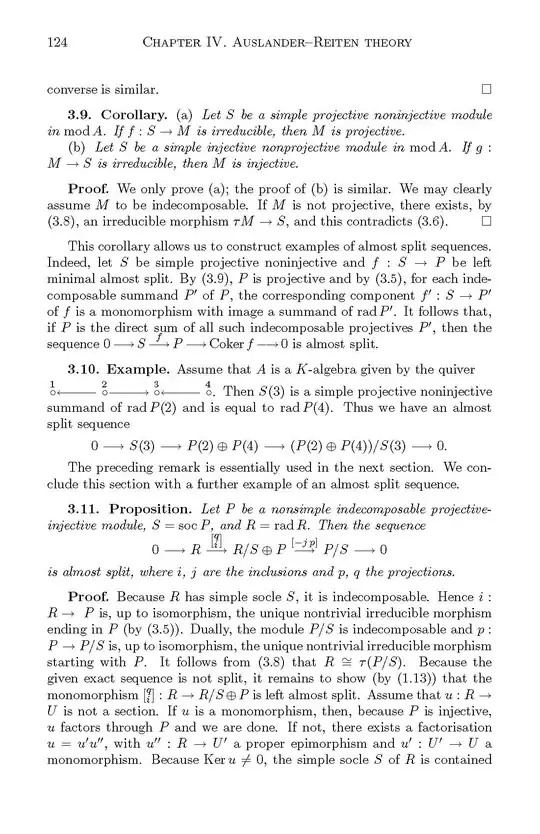
On page 124 of the book Elements of representation theory of associative algebras, volume 1, Example 3.10, I computed the modules in this example.
$$ S(3)=0\leftarrow 0 \rightarrow K \leftarrow 0, \\ P(2) = K\overset{1}{\leftarrow} K \overset{1}{\rightarrow} K \leftarrow 0,\\ P(4) = 0\overset{}{\leftarrow} 0 \overset{}{\rightarrow} K \overset{1}{\leftarrow} K,\\ P(2) \oplus P(4) = K\overset{1}{\leftarrow} K \overset{\left(\begin{matrix} 0 \\ 1 \end{matrix}\right)}{\rightarrow} K^{2} \overset{\left(\begin{matrix} 1 \\ 0 \end{matrix}\right)}{\leftarrow} K. $$
Let $f_1: S(3) \to P(2)$ be the embedding and $f_2: S(3) \to P(4)$ be the embedding. Let $f=\left(\begin{matrix} f_1 \\ f_2 \end{matrix}\right): S(3) \to P(2) \oplus P(4)$. Then $f$ is injective. Is $f: S(3) \to P(2) \oplus P(4)$ the map in the sequence $$ 0 \to S(3) \overset{f}{\to} P(2) \oplus P(4) \to (P(2) \oplus P(4))/S(3) \to 0 \quad (1) $$ in Example 3.10?
I think that $$ (P(2) \oplus P(4))/(Im(S(3))) = (P(2) \oplus P(4))/(Im f) = K\overset{1}{\leftarrow} K \overset{0}{\rightarrow} 0 \overset{0}{\leftarrow} K, (2) \\ (P(2) \oplus P(4))/S(3) = K\overset{1}{\leftarrow} K \overset{1}{\rightarrow} K \overset{0}{\leftarrow} K. (3) $$ I am not sure about the maps in (3). Should $(P(2) \oplus P(4))/S(3)$ the sequence (1) in Example 3.10 be $(P(2) \oplus P(4))/(Im(S(3)))$? I think that the direct sum of $S(3)$ and (3) is $P(2) \oplus P(4)$ which contradicts the fact the (1) is non-split. Thank you very much.