$\color{green}{\textbf{Version of 01.04.24. Common way.}}$
$\color{brown}{\;\textbf{1. Cubic in the specific form.}}$
The equation
$$\dfrac{3t}{4t^3+d}=c^2,\qquad c>0,\quad c^3d\in[0,1]\tag{1.1}$$
can be solved via the trigonometric form:
$$\dfrac{3ct}{4(ct)^3+c^3d}=1,\quad 3ct-4(ct)^3=c^3d,\quad
\sin(3\arcsin(ct))=c^3d,$$
$$\mathbf{t_k=\dfrac1c\,sin\;\dfrac{2\pi k+\arcsin(c^3d)}3},\qquad k=0,1,2.\tag{1.2}$$
Since $\;c^3d\in[0,1],\;$ then $\;\arcsin(c^3d)\in\left[0,\dfrac\pi2\right],\;$
$$t_0=\dfrac1c\,\sin\;\dfrac{\arcsin(c^3d)}3\in\left[0,\dfrac1{2c}\right];\tag{1.3}$$
$$t_1=\dfrac1c\,\sin\;\dfrac{2\pi+\arcsin(c^3d)}3
=\dfrac1c\,\sin\;\dfrac{\pi-\arcsin(c^3d)}3\in\left[\dfrac1{2c},\dfrac{\sqrt3}{2c}\right];\tag{1.4}$$
$$t_2=\dfrac1c\,\sin\;\dfrac{4\pi+\arcsin(c^3d)}3=-\dfrac1c\,\sin\;\dfrac{\pi+\arcsin(c^3d)}3\in\left[-\dfrac{\sqrt3}{2c}, -\dfrac1{c},\right].\tag{1.5}$$
$\color{brown}{\textbf{2. The main areas.}}$
Taking in account the rotational symmetry of the given inequality
$$\dfrac{x^4}{133x^3+81y^3}+\dfrac{y^4}{133y^3+81z^3}+\dfrac{z^4}{133z^3+81x^3}\ge\dfrac{x+y+z}{214},\tag{2.1}$$
we can WLOG assume $\;x\;$ the greatest one of the unknowns $\;\{x, y, z\}.\;$
Then it suffices to consider two main cases (areas):
$A. \quad 0\le z\le y\le x.$
$B. \quad 0\le y\le z\le x.$
$\color{brown}{\textbf{3. Edges.}}$
$\color{teal}{\textbf{3a. Edges, case A.}}$
Let $\;\color{teal}{\mathbf{\;z=0,\; 0<y\le x.\;}}$
Then inequality ($1.1$) takes a form of
$$\dfrac{x^4}{133x^3+81y^3} +\dfrac{y^4}{133y^3}\ge\dfrac{x+y}{214}.$$
Substitution $u=\dfrac yx\in[0,1]$ presents it in the form of $L(u)\ge0,$
where
$$L(u)=\dfrac1{133+81u^3}+\dfrac1{133}u-\dfrac{1+u}{214}
=\dfrac{133\cdot214+214u(133+81u^3)-133(1+u)(133+81u^3)}{133\cdot214(133+81u^3)}$$
$$=\dfrac{81(81u^4-133u^3+133u+133)}{133\cdot214(133+81u^3)}
=\dfrac{81(81u^4+133u(1-u^2)+133)}{133\cdot214(133+81u^3)}\ge 0.$$
The case is proven.
$\color{teal}{\textbf{3b. Edges, case B.}}$
Let $\color{teal}{\mathbf{\;y=0,\;0<z\le x.\;}}$
Then inequality ($1.1$) takes a form of
$$\dfrac{x^4}{133x^3}+\dfrac{z^4}{133z^3+81x^3}\ge\dfrac{x+z}{214}.$$
Substitution $u=\dfrac zx\in[0,1]$ presents it in the form of $L(u)\ge0,$
where
$$L(u)=\dfrac1{133}+\dfrac{u^4}{81+133u^3}-\dfrac{1+u}{214}
=\dfrac{214(81+133u^3)+133\cdot214u^4-133(1+u)(81+133u^3)}{81\cdot214(81+133u^3)}$$
$$=\dfrac{133u^4+133u^3-133u+81}{214(81+133u^3)}
=\dfrac{532u^4+532u^3-532u+324}{4\cdot214(81+133u^3)}
=\dfrac{(14-23u^2)^2+3u^4+532u^3+(644u^2-532u+128)}{856(81+133u^3)}\ge0,$$
The case is proven.
Therefore, inequality ($2.1$) $\color{green}{\textbf{is proven at the bounds of the given area.}}$
$\color{brown}{\textbf{4. Substitutions.}}$
In the case "A", $\quad \color{teal}{\mathbf{0<z\le y\le x.}}$
Substitutions
$$u=\dfrac yx\in[0,1],\quad v=\dfrac zy\in[0,1],\quad w=\dfrac xz=\dfrac1{uv}\in[1,\infty),\tag{4.1}$$
lead to presentation of the given inequality in the form of
$$\dfrac{1}{133+81u^3}-\dfrac1{214}+u\left(\dfrac{1}{133+81v^3}-\dfrac1{214}\right)+uv\left(\dfrac1{133+81w^3}-\dfrac1{214}\right) \ge 0.\tag{4.2}$$
In the case "B", $\quad \color{teal}{\mathbf{0<y\le z\le x.}}$
Substitutions
$$u=\dfrac zy\in[1,\infty],\quad v=\dfrac xz\in[1,\infty],\quad w=\dfrac yx=\dfrac1{uv}\in[0,1],\tag{4.3}$$
lead to presentation of the given inequality in the form of
$$\dfrac{1}{133+81w^3}-\dfrac1{214}+\dfrac1{uv}\left(\dfrac{1}{133+81u^3}-\dfrac1{214}\right)+\dfrac1v\,\left(\dfrac1{133+81v^3}-\dfrac1{214}\right) \ge 0.\tag{4.4}$$
Both ($\text{4.2}$) and ($\text{4.4}$) can be written in the form of
$$\dfrac1{uv}\,\dfrac{1-u^3}{133+81u^3}+\dfrac1v\,\dfrac{1-v^3}{133+81v^3}+\dfrac{1-w^3}{133+81w^3}\ge 0.\tag{4.5}$$
At the same time, the constraints ($\text{4.1}$) and ($\text{4.3}$) are specific ones.
Let
$$\begin{cases}
P(t)=\dfrac{1-t^3}{133+81t^3},\\[4pt]
Q(t)=-P'(t)=\dfrac{642t^2}{(133+81t^3)^2},\\[4pt]
R(t)= P(t)+tQ(t)=\dfrac{-81t^6+590t^3+133}{(81t^3 + 133)^2},
\tag{4.6}\end{cases}$$
then (${4.5}$) takes the form of $\;f(u,v)\ge0,\;$ where
$$f(u,v)=P\left(\dfrac1{uv}\right)+\dfrac1v\left(P(v)+\dfrac1u\, P(u)\right).\tag{4.7}$$
$\color{brown}{\textbf{5. Inner stationary points.}}$
$\color{teal}{\textbf{5.1. Algebraic system.}}$
Stationary points can be defined from the system $\;f'_u=f'_v=0,\;$ or
$$\begin{cases}
P'\left(\dfrac1{uv}\right)\left(-\dfrac1{u^2v}\right)+\dfrac1v\left(-\dfrac1{u^2}\right)P(u)+\dfrac1{uv}\,P'(u)=0\\[4pt]
P'\left(\dfrac1{uv}\right)\left(-\dfrac1{uv^2}\right)-\dfrac1{v^2}\left(P(v)+\dfrac1uP(u)\right)+\dfrac1vP'(v)=0,
\end{cases}$$
$$\begin{cases}
Q(w)-P(u)-uQ(u)=0\\[4pt]
Q(w)-P(u)-uP(v)-uvQ(v)=0\\[4pt]
uvw=1
\end{cases}\Rightarrow
\begin{cases}
R(u)=Q(w)\\[4pt]
R(v)=Q(u)\\[4pt]
uvw=1
\end{cases}\tag{5.1}$$
$\color{teal}{\textbf{5.2. The inequality transformation.}}$
Taking in account the equalities $(4.6),(4.7),(5.1)$ in the form of
$$P(t)=R(t)-tQ(t),\quad R(u)=Q(w),\quad R(v)=Q(u),\quad uvw=1,$$
the inequality
$$wf(u,v,w)=P(w)+w(P(u)+uP(v))\ge0$$
can be presented in a form of
$$R(w)-wQ(w)+w\big(R(u)-uQ(u)+uR(v)-uvQ(v)\big)\ge0,$$
$$R(w)+w\big(R(u)-Q(w)\big)+uw\big(R(v)-Q(u)\big)-uvwQ(v)\ge0,$$
or
$$R(w)-Q(v)\ge0.\tag{5.2}$$
$\color{brown}{\textbf{6. Explicit form of the inverse functions.}}$
$\color{teal}{\textbf{6.1. Inversion of $Q(t).$}}$
Function $Q(t)$ can be presented in the form of
$$Q(t)=\dfrac{642t^2}{(133+81t^3)^2}=\dfrac{3424}{19683}\left(\dfrac{3t}{\dfrac{532}{81}+4t^3}\right)^2.\tag{6.1}$$
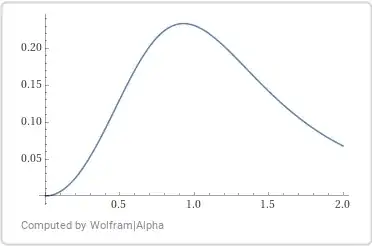
Then
- $Q(0)=0;$
- $\;\lim\limits_{t\to\infty}Q(t)=0;$
- $\;\dfrac{\text d}{\text dt}\dfrac{t}{133+81t^3}=\dfrac{133-162t^3}{(133+81t^3)^2},\\$
- $\max Q(t)=Q_m=\dfrac{428}{3591}\,\sqrt[\large3]{\dfrac2{1197}}\approx0.014142960\;$ at $\;t_m=\sqrt[\large3]{\dfrac{133}{162}}\approx0.936365798.$
- $Q(t)\;$ increases at $\;t\in[0,t_m];$
- $Q(t)\;$ decreases at $\;t\in[t_m,\infty].$
Taking in account $(1.1)-(1.2),$ inverse function $\;Q^{-1}(q)\;$ finally is
$$\theta(k,q)=\sqrt[\large4]{\dfrac{3424}{3^9q}} \sin\left(\dfrac13\left(2\pi k+\arcsin\left(4788\left(\dfrac{3q}{3424}\right)^{\large\frac34}\right)\right)\right),\quad k=0,1.\tag{6.2}$$
Note that, in accordance with $(1.5),\quad\theta(2,q)<0.$
Therefore, there are two branches of the inverse function $Q^{-1}(q):$
- "zero" branch $\;\theta(0,q),\quad q\in\left(0,Q_m\right],\quad\theta(0,q)\in[0,\tau_m],\;$ and
- "first" branch $\;\theta(1,q),\quad q\in\left(0,Q_m\right],\quad \theta(1,q)\in[\tau_m,\infty].$
Easily to check, that
- $Q(\theta(k,q))=q,\quad q\in(0,\infty);$
- $\theta(0,Q(t))=t,\quad t
t\in[0,t_m];$
- $\theta(1,Q(t))=t,\quad t\in[t_m,\infty].$
$\color{teal}{\textbf{6.2. Inversion of $R(t).$}}$
Function $R(t)$ can be presented in the form of
$$R(t)=\dfrac{133+590t^3-81t^6}{(133+81t^3)^2}=\dfrac{457}{32319}-\dfrac1{6916266}\left(\dfrac{85386}{133+81t^3}-428\right)^2.\tag{6.3}$$
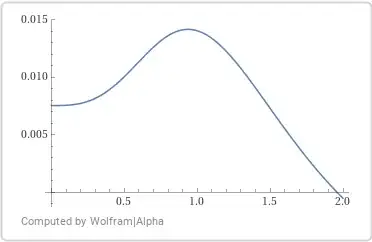
Easily to see, that
- $R(0)=\dfrac1{133}\approx0.007518797;$
- the positive root of $R(t)$ is
$\;t_h=\sqrt[\large3]{\dfrac{295+\sqrt{97798}}{81}} \approx1.957677294;$
- $\dfrac{\text dR}{\text dt}=\dfrac{1284t^2(133-162t^3)}{(133+81t^3)^3};$
- $\max R(t)=R_m=\dfrac{457}{32319}\approx0.014140289\;$ at $\;t_m=\sqrt[\large3]{\dfrac{133}{162}}\approx0.906083691;$
- $R(t)\;$ increases at $\;t\in[0,t_m];$
- $R(t)\;$ decreases at $\;t\in[t_m,t_h];$
- $R(t)\;$ is negative at $\;t\in(t_h,\infty).$
Finally, the inverse function is
$$\rho(s,r)=\left(\dfrac{133}{81}\left(\dfrac{3}{2+s\sqrt{\dfrac{457-32319r}{214}}}-1\right)\right)^{\large\frac13},\tag{6.4}$$
where $\;s=\pm1.$
Accordingly, there are two branches of the inverse function $R^{-1}(r):$
- "plus"-branch $\;\rho(1,r),\quad r\in\left[\dfrac1{133},\dfrac{457}{32319}\right], \quad\rho(1,r)\in[0,t_m],\;$ and
- "minus"-branch $\;\rho(-1,r),\quad r\in\left[0,\dfrac{457}{32319}\right], \quad\rho(-1,r)\in[t_m,t_h].$
Easily to check, that
- $R(\rho(\pm1,r))=r,\quad r\in[0,\infty);$
- $\rho(1,R(t))=t,\quad t\in[0,t_m];$
- $\rho(-1,R(t))=t,\quad t\in[t_m,t_h].$
$\color{teal}{\textbf{6.3. Explicit expressions for superpositions.}}$
Since
$$Q(t)\in(0,Q_m),\quad R(t)\in(0,R_m),\quad R_m=\dfrac{457}{32319}<Q_m,$$
then from $(5.1)$ should
$$Q(t)\in\left(0,\dfrac{457}{32319}\right],\quad t\in\left((0,t_0]\cup[t_1,t_h]\right),\tag{6.5}$$
where
$$\begin{cases}
t_0=\theta\left(0,\dfrac{457}{32319}\right]\approx0.927295634,\\[4pt]
t_m=\sqrt[\large3]{\dfrac{133}{162}}\approx0.936365798,\\[4pt]
t_1=\theta\left(1,\dfrac{457}{32319}\right]\approx0.945494916,\\[4pt] t_h=\rho(-1,0)\approx1.957677294.
\end{cases}\tag{6.6}$$
From $\;(5.1)\;R(u)=Q(w)\;$ should $\;u=\rho(s,Q(w))=g(s,w),\;$ where
$$g(s,t)=\left(\dfrac{133}{81}\;\left(\dfrac{3}{2+s\sqrt{\dfrac{457}{214}-\dfrac{96957t^2}{(133+81t^3)^2}}}-1\right)\right)^{\large\frac13},\quad s=-1,1.\tag{6.7}$$
Also, from $\;(5.1)\;R(v)=Q(u)\;$ should $v=g(s,u).$
On the other hand, from $\;(5.1)\;R(u)=Q(w)\;$ should $w=\theta(k,R(u))=h(k,u),\;$ where
$$h(k,t)=\sqrt[\large4]{\dfrac{3424}{19683R(t)}} \sin\left(\dfrac13\left(2\pi k+\arcsin\left(4788\left(\dfrac{3R(t)}{3424}\right)^{\large\frac34}\right)\right)\right),\quad k=0,1.\tag{6.8}$$
Also, from $\;(5.1)\;R(v)=Q(u)\;$ should $u=h(k,v).$
At the same time, in accordance with $(5.1)$ should
$$ug(s,u)h(k,u)=1.\tag{6.9}$$
$\color{brown}{\textbf{7. Proof, case A.}}$
In accordance with $(4.1),\quad u,v\in(0,1],\quad w\in[1,t_h],\quad $ and then should
$$\;R(u)\in\left(\dfrac1{133},\dfrac{457}{32319}\right],\tag{7.1}$$
$$u w>1.\tag{7.2}$$
$\color{teal}{\textbf{7.1. Case A,$\;u\in[0,t_0].$}}$
Taking in account $(1.3),(7.1),(7.2),$ easily to get
$h(0,u)<1,$ so
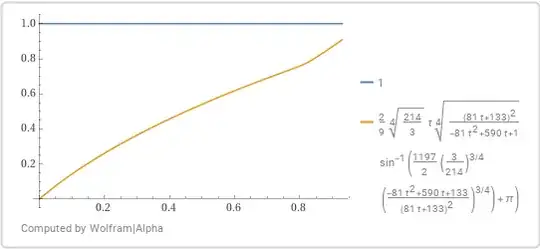
$$\begin{align}
&w=h(1,u)=\sqrt[\large4]{\dfrac{3424(133+81u^3)^2}{19683(133+590u^3-81u^6)}}\\[4pt]
&\times\sin\left(\dfrac13\left(\pi-\arcsin\left(4788\left(\dfrac{3}{3424}\dfrac{133+590u^3-81u^6}{(133+81u^3)^2}\right)^{\large\frac34}\right)\right)\right),
\end{align}\tag{7.3}$$
wherein $\;h(1,u)\;$ is decreasing function,
Let $H(t)=\dfrac1{h(1,t)},$ then
- for $\;u\in[0, H(0)]\quad u h(1,u) \le 1,\qquad H(0)\approx 0.621782171,$
- for $\;u\in[H(0), H(H(0))]\quad u h(1,u) \le 1,\qquad H(H(0))\approx 0.789031022,$
- for $\;u\in[H(H(0)),H(H(H(0))))]\quad u h(1,u) \le 1,\qquad H(H(H(0)))\approx 0.920622140,$
- for $\;u\in[H(H(H(0))),t_0]\quad u h(1,u) \le 1,\qquad t_0\approx 0.927295634.$
Therefore, $\text{for}\,u\in[0,t_0]\quad uh(1,u)\le1,$
and this contradicts with $(7.2).$
The plot of $\;uh(1,u)\;$ is shown below.
$\color{teal}{\textbf{7.2. Case A,$\;u\in(t_0,t_1).$}}$
In accordance with $(6.6),$
$$Q(t_0)=Q(t_1)=\dfrac{457}{32319}\approx0.014149289,\quad
Q(t_m)=\dfrac{428}{3591}\sqrt[\large3]{\dfrac{2}{1197}}\approx0.014142960.$$
If $\;t\in(t_0,t_1),\;$ then $\;Q(t)\in\left(\dfrac{457}{32319},\dfrac{428}{3591}\sqrt[\large3]{\dfrac{2}{1197}}\right)\approx(0.014140289, 0.014142960).$
On the other hand,
$$R(t)\le R_m=\dfrac{457}{32319}\approx0.014140289.$$
Therefore, the equation
$$Q(u)=R(v)$$
has not real solutions in the described interval.
$\color{teal}{\textbf{7.3. Case A,$\;u\in[t_1,1].$}}$
Since $\;R(u)\in\left(\dfrac1{133}, \dfrac{457}{32319}\right)\equiv\left(\dfrac{243}{32319},\dfrac{457}{32319}\right),\;$ then
$\;w_0=h(0,u)\in[0.860147050,0.917509715],\; w_0<1,\;$
in contradiction with the conditions $(4.1).$
$\;(w_1=h(1,u)\in[0.943496443,1])\wedge(w_1\in[1,\infty)),$
$\mathbf{\{u,v,w\}=\{1,1,1\},\quad R(w)=Q(v)},\;$
and this corresponds with the inequality $(5.2).$
Therefore, the inequality $(2.1)\;\color{green}{\textbf{is proven in the case A}}.$
$\color{brown}{\textbf{8. Proof, case B,$\;u\in[1,t_h]$.}}$
$\color{teal}{\textbf{8.1. Preliminary notes.}}$
Taking in account $(4.3),$ should $\;u\in(1,t_h),\quad v\in(1,\infty),\quad w\in(0,1),\quad t_h=\rho(-1,0).$
Then
$$\color{teal}{\mathbf{v=g(-1,u),\quad w=h(0,u)}}.\tag{8.1}$$
Graphic analysis of the functions $\;h(0,u)\;$ (orange line) and $\;u g(-1,u)\;$ (green line)
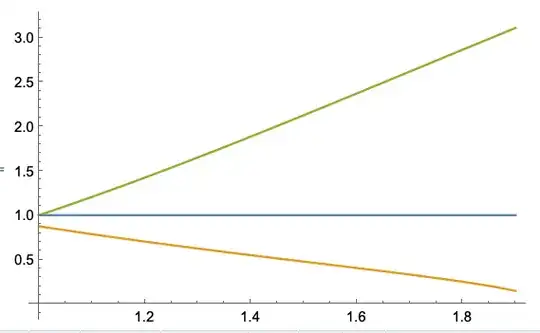
show, that both of them allow accurate linear approximations at the interval $\;u\in(1, t_h):$
$$h(0,u)\approx 0.8755-0.795(u-1)\pm 0.0135,\quad
ug(-1,u)\approx 1+2.296(u-1)\pm 0.039.$$
So their product can be accurately approximated via quadratic function.
Therefore, the function
$B(u)= u g(-1,u) h(0,u)$ is unimodal one in the interval $u\in(1,t_h).$
$\color{teal}{\textbf{8.2. Proof.}}$
From $(8.1),(6.7),(6.8)$ should that
$$B(u)=ug(-1,u)h(0,u)=1\tag{8.2}$$
in the stationary points of the $f(u,v).$
Since $B(u)$ has the single maximum at $u\in(1,t_h),$ then equation $(8.2)$ can not have more than two roots in this interval.
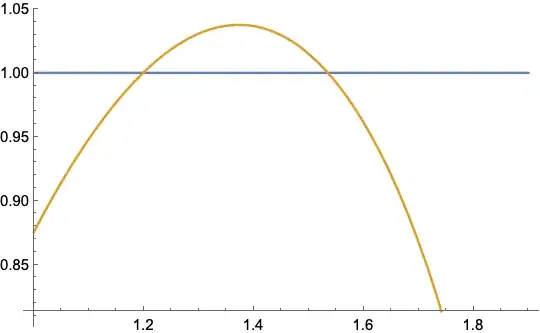
Let us calculate the table
$$\hspace{-32mu}\begin{vmatrix}
u &\! v=g(-1,u) &\! w=h(0,u) & uvw & R(w) & Q(v)\\
1.19 & \!1.177155295 &\! 0.711272982 &\! 0.996361720 &\! 0.012734730 &\! 0.012353493\\
1.20 & \!1.185845698 &\! 0.703171746 &\! 1.000623827 &\! 0.012641505 & \!0.012221669\\
{\small 1.535129}&\!1.440476091 &\! 0.452219322 &\! 1.000000101 &\! 0.009467695 &\! 0.009467650\\
{\small1.535130}&\!1.440476742 &\! 0.452218605 &\! 0.999999621 &\! 0.009467687 &\! 0.009467642
\end{vmatrix}\tag{8.3}$$
Easily to see that there are two solutions of $(8.2)$,which are situated at the intervals $(1.19,1.20)$ and $(1.535129,1.535130)$ accordingly.
At the same time, the functions $R(w)$ and $Q(v)$ are monotonic in these intervals. In particular, in the interval $(1.19,1.20)\quad R(w)>0.01264\;$ and $\;Q(v)<0.01236.$ This means that the inequality $(7.2)$ is satisfied at the interval $\;u\in(1.19,1.20),$ including the stationary point.
Similarly, at the interval $(1.535129,1.535130)$ easily to get $\;R(w)>0.009467686>0.009467651>Q(w).$ This means that the inequality $(7.2)$ is satisfied at the interval $\;u\in(1.535129,1.535130),$ including the stationary point.
Plot of the equality $uvw=1$ see below.
Therefore, the inequality $(4.5)$ $\color{green}{\textbf{is satisfied in the case B}}.$
$\color{green}{\textbf{Proved!!!}}$


