Let's rewrite the system of ODEs as a second order ODE:
$$
U''=V'=-\frac{c}{D}V-\frac{\mu}{D}U(1-U)=-\frac{c}{D}U'-\frac{\mu}{D}U(1-U). \tag{1}
$$
It follows from $(1)$ that
$$
\frac{d}{dt}\left[\frac{1}{2}(U')^2+\frac{\mu}{D}\left(\frac{1}{2}U^2-\frac{1}{3}U^3\right)\right]=-\frac{c}{D}(U')^2\leq 0. \tag{2}
$$
If we interpret $(1)$ as the Newtonian equation of motion of a particle subject to the force $F=-\frac{c}{D}U'-\frac{\mu}{D}U(1-U)$, then Eq. $(2)$ expresses the dissipation of mechanical energy $E=\frac{1}{2}(U')^2+\frac{\mu}{D}\left(\frac{1}{2}U^2-\frac{1}{3}U^3\right)$ due to the viscous frictional force $-\frac{c}{D}U'$.
Let's now show that there is a trajectory that satisfies $\lim_{t\to-\infty}(U(t),U'(t))=(1,0)$ and $\lim_{t\to+\infty}(U(t),U'(t))=(0,0)$. When $|U(t)-1|\ll 1$, we can linearize $(1)$ as
$$
U''+\frac{c}{D}U'-\frac{\mu}{D}U\approx -\frac{\mu}{D}. \tag{3}
$$
Equation $(3)$ has a solution that satisfies $\lim_{t\to-\infty}(U(t),U'(t))=(1,0)$, given by
$$
U(t)=1+Ae^{\lambda t},\quad\text{where}\quad
\lambda:=\frac{-c+\sqrt{c^2+4\mu D}}{2D}>0. \tag{4}
$$
If $A<0$, the particle initially moves to the left. Because of $(2)$, $E(t)<E(-\infty)=\frac{\mu}{6D}$ for any finite $t$, so the particle gets trapped in the potential well $\mathcal{V}(U):=\frac{\mu}{D}\left(\frac{1}{2}U^2-\frac{1}{3}U^3\right)$ to the left of $U=1$ (see figure below).
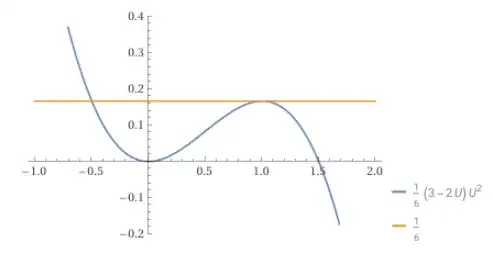
Although the solution $(4)$ is valid only for times $t$ such that $|Ae^{\lambda t}|\ll 1$, we can base the rest of our argument on the inequality $(2)$, which is valid for all $t$. Since $E(t)$ is a non-increasing function of $t$ and is bounded below (once the particle is trapped in the potential well), $E(t)$ tends to a finite limit as $t\to\infty$. Since this limit is a constant, it follows from $(2)$ that $\lim_{t\to\infty}U'(t)=0$, hence $\lim_{t\to\infty}U''(t)=0$ too. Equation $(1)$ then implies $\lim_{t\to\infty}U(t)[1-U(t)]=0$; since $U(t)<1$ for $t>-\infty$, it follows that $\lim_{t\to\infty}U(t)=0$. This completes the proof of existence of an heteroclinic orbit between the equilibrium points $(1,0)$ and $(0,0)$.


