4

I'm having difficulty with this problem here:

Let $f\in L^1(X,\mathcal{M},\mu)$ with $||f||_1 \neq 0$.

Prove that there exists a unique $\alpha$ so that $ \mu(\lbrace|f|\geq \alpha\rbrace) = \frac{1}{\alpha} ||f||_1$.

My first thought was to use the Hardy LittleWood Maximal Theorem which says that there exists $C$ so that

$\mu(\lbrace Hf(x) >\alpha\rbrace) \leq \frac{C}{\alpha} ||f||_1$

Unfortunately this theorem does not take me very far in this approach.

Any help is appreciated.

Edit: It seems the question was asking to show that there is at most one such $\alpha$

  • 1
    you may want to check Chebyshev's inequality: https://en.wikipedia.org/wiki/Chebyshev%27s_inequality#Measure-theoretic_statement – daw Feb 14 '19 at 16:07
  • 1
    @daw I don't think that will be useful because the proof of Markov's and Chebyshev's inequality follows from "truncation" argument. You may visualise it as chopping a rectangular piece of ginger from raw. The chopped piece will always be strictly smaller than the raw ginger, unless there's nothing to chop (i.e. $f$ is an indicator function). – GNUSupporter 8964民主女神 地下教會 Feb 14 '19 at 16:15
  • 2
    Just to let you know the generally accepted policy here: If you ask a question that you didn't mean to ask, but end up with correct answers to the question you did ask, it is considered polite to ask your actual question in a new question instead of editing your first question. See here for more discussion on the policy. – K.Power Feb 14 '19 at 16:20
  • 1
    To respond to the edit, one has to show that the given eqaulity holds iff $f$ is (up to a multiplicative constant) an indicator function of a measurable set (i.e. $1_A(x) = 1$ if $x \in A$, $0$ if $x \notin A$, $A \in \cal{M}$). The if-part is trivial. The only-if-part can be shown by assuming that $f$ is not a scalar multiple of an indicator function. Therefore, for all $k \in \Bbb{R}$, $A \in \cal{M}$, $f \ne 1_A$. Note that ${|f|\ge a} \in \cal{M}$, so once we've shown that a strict inequality, we're almost done, and the rest is trivial. – GNUSupporter 8964民主女神 地下教會 Feb 14 '19 at 16:49

3 Answers3

6

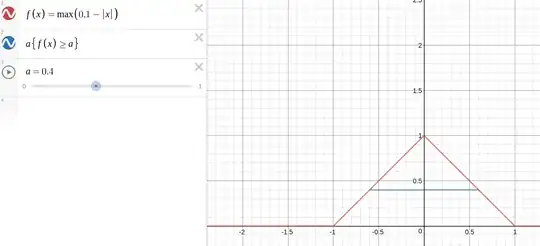
The conclusion doesn't hold for $f(x) = (1-|x|)_+ = \max(1-|x|,0)$ and if $\mu$ is the Lebesgue measure. The shape of piecewise linear fucntion $f$ is a centred peak, so $||f||_1 = 1$. so that $\mu(|f| \ge a) = 2(1-a) \ne \dfrac1a = \dfrac{||f||_1}{a}$.

graph


By AM-GM inequality, $$2 \, a(1-a) \le 2 \left(\frac{a+(1-a)}{2}\right)^2 \le 2 \cdot \frac14 = \frac12 < 1,$$ so the last inequality holds.

2

Let $X:=[0,1]$ and $\mu$ the Lebesgue measure. Let $f:X\to\mathbb{R}$ be as $f(x):=2$ for $x\in[0,1/2]$ and $f(x):=1$ for $x\in(1/2,1]$. Furthermore let $\alpha:=2$

Then $$2\mu([0,1/2]) =1 < 1 +1/4 = \int_0^1 f(x) d\mu(x)$$ which is a counterexample of your equality.

However the proposition is true when you substitute $'='$ by $'\le'$:

$ \mu(\lbrace|f|\geq \alpha\rbrace) \le \frac{1}{\alpha} ||f||_1$.

Maksim
  • 1,725
2

As others have said this is not necessarily true, but it is true that we are always guaranteed a $\alpha>0$ s.t $\mu\{|f|\geq\alpha\}\leq \frac{\|f\|_1}{\alpha}.$ Regardless of the measure space we know that $\mu\{|f|\geq \|f\|_1\}\leq 1$, so if we choose $\alpha=\|f\|_1$ the inequality will hold.

K.Power
  • 7,111