-2

If

α
,
β
,
γ

are the roots of equation $x^3 -x -1 =0$ then

$$ \frac{1+\alpha}{1-\alpha} + \frac{1+\beta}{1-\beta} + \frac{1+\gamma}{1-\gamma} $$

My attempt is in the attachment My attempt
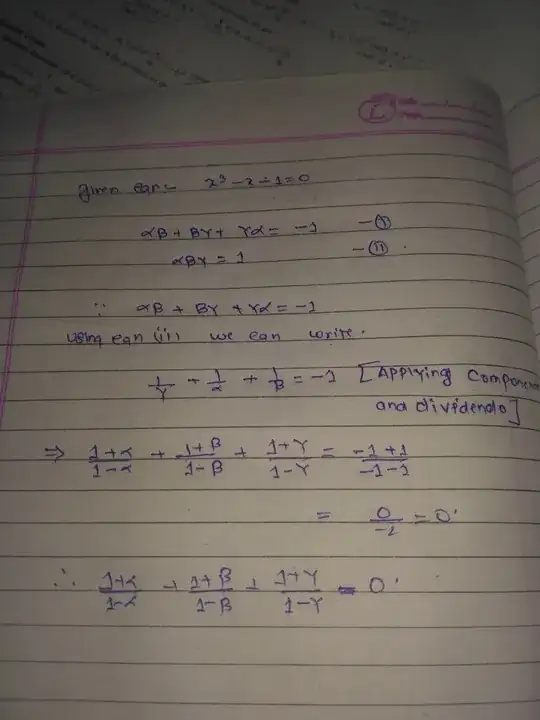
I got answer $=0$ but in book answer is given as $-7$ . Where I do mistake by solving the question ?

Tips
  • 420

2 Answers2

2

hint...write $$y=\frac{1+x}{1-x}\implies x=\frac{y-1}{y+1}$$ and substitute into the polynomial. Simplify the polynomial in $y$ and find the sum of the roots.

Alternatively,$$\Sigma\frac{1+\alpha}{1-\alpha}=-3+2\Sigma\frac{1}{1-\alpha}$$ $$=-3+2\frac{3+\Sigma\alpha\beta-2\Sigma\alpha}{1-\Sigma\alpha+\Sigma\alpha\beta-\alpha\beta\gamma}$$ $$=-3+2\frac{3-1-0}{1-0-1-1}=-7$$

David Quinn
  • 35,087
1

$$\sum \frac{1+\alpha}{1-\alpha}=2\sum\frac{1}{1-\alpha}-3\cdots (1)$$

Where $$\sum\frac{1+\alpha}{1-\alpha}=\frac{1+\alpha}{1-\alpha}+\frac{1+\beta}{1-\beta}+\frac{1-\gamma}{1-\gamma}.$$

Now adding $1$ in each term and

subtracting $-3$,We get equation no $(1)$

Now $$x^3-x-1=(x-\alpha)(x-\beta)(x-\gamma)$$

Taking $\ln$ and Differentiate both side and put $x=1$

$$\frac{3(1)^2-1}{(1)^3-(1)-1}=\frac{1}{1-\alpha}+\frac{1}{1-\beta}+\frac{1}{1-\gamma}$$

So we get $\displaystyle \sum \frac{1}{1-\alpha}=-2$

put into $(1)$, we have $$\displaystyle \frac{1+\alpha}{1-\alpha}=-4-3=-7.$$

DXT
  • 12,047
  • Can you explain the first step.. – Tips Feb 26 '19 at 13:44
  • $\displaystyle \sum \frac{1+\alpha}{1-\alpha}=\sum\bigg(\frac{1+\alpha}{1-\alpha}+1\bigg)-3=2\sum\frac{1}{1-\alpha}-3$ – DXT Feb 26 '19 at 13:46
  • Sir , why you have added 1 then also subtracted 3 ?? – Tips Feb 26 '19 at 13:53
  • because $\displaystyle \sum \frac{1+\alpha}{1-\alpha}=\bigg(\frac{1+\alpha}{1-\alpha}+1\bigg)+\bigg(\frac{1+\beta}{1-\beta}+1\bigg)+\bigg(\frac{1+\gamma}{1-\gamma}+1\bigg)-3$ – DXT Feb 26 '19 at 13:55