Munkres Topology

I understand:
- why $C \cap X^0$ is closed in $C$ ($X^0$ is closed in $X$ by coherence)
- why $C \cap X^0$ has no limit points (no limit points if and only if all isolated points if and only if discrete, which is concluded)
- why $C \cap X^0$ is finite (compactness implies limit point compactness)
I don't understand why $C \cap X^0$ is discrete.
I have deduced $C \cap X^0$ is a union of vertices of edges (arcs). To show each of these vertices is open in $C \cap X^0$, I must find a open set of a superset of $C \cap X^0$, such as an open set of $X$, to show that the vertex is equal to the intersection of such open set and $C \cap X^0$. Without loss of generality, assume the vertices correspond to $\{0\}$ in $[0,1]$, the interval to which each of the edges (arcs) is homeomorphic. Denote such vertices $\{p_{\beta}\}_{\beta \in K \subseteq J}$. We must find an open set $B$ in $X$ to have $\{p_{\beta}\} = B \cap C \cap X^0$. I tried to select $B = A_{\beta} \setminus \{q_{\beta}\}$, but I am not sure if this is open in $X$. Under coherence, $A_{\beta} \setminus \{q_{\beta}\}$ is open in $X$ if $\forall \alpha \in J$, $A_{\alpha} \cap [A_{\beta} \setminus \{q_{\beta}\}]$ is open in $A_{\alpha}$.
$A_{\alpha} \cap [A_{\beta} \setminus \{q_{\beta}\}]$ is either:
- $\emptyset$ - Clopen
- $A_{\beta} \setminus \{q_{\beta}\}$ - Open because $[0,1)$ is open in $[0,1]$
- $\{p_{\beta}\}$ - We don't know yet if open!
What other open set can you suggest?
On intuition, I this like picking $0$ from a $K$ copies of $[0,1]$. Instead of $[0,1]$, we can choose different closed intervals of $\mathbb R$.
Here are some facts that might be related:
- $C \cap X^0$ is compact because it is closed in a compact space $C$
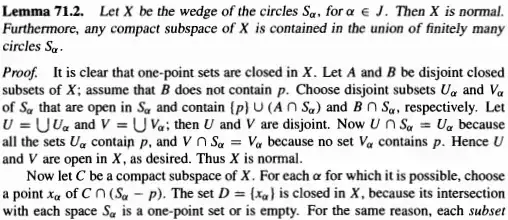
- This lemma, Lemma 83.2 is kind of an analog of a previous lemma, Lemma 71.2.