To derive a probability generating function, let $x$ track the total number of steps and let $y$ track the number of times the lamp at the origin has been toggled. First, we repeatedly do one of two things at the origin – with probability $\frac13$, toggle the lamp, and otherwise, go for a walk until we return. The probability generating function for one such action is
\begin{eqnarray*}
&&
\frac13xy+\frac13x^2\sum_{n=0}^\infty C_n\left(\frac x2\right)^{2n}\left(\frac23\left(1+\frac x3+\left(\frac x3\right)^2+\cdots\right)\right)^{2n+1}
\\
&=&
\frac13xy+\frac13x^2\sum_{n=0}^\infty C_n\left(\frac x2\right)^{2n}\left(\frac{\frac23}{1-\frac x3}\right)^{2n+1}
\\
&=&
\frac13xy+\frac23\frac{x^2}{3-x}\sum_{n=0}^\infty C_n\left(\frac x2\right)^{2n}\left(\frac2{3-x}\right)^{2n}
\\
&=&
\frac13xy+\frac23\frac{x^2}{3-x}\sum_{n=0}^\infty C_n\left(\frac x{3-x}\right)^{2n}
\\
&=&
\frac13xy+\frac23\frac{x^2}{3-x}C\left(\left(\frac x{3-x}\right)^2\right)
\\
&=&
\frac13xy+\frac23\frac{x^2}{3-x}\frac{1-\sqrt{1-4\left(\frac x{3-x}\right)^2}}{2\left(\frac x{3-x}\right)^2}
\\
&=&
\frac13\left(xy + 3-x-\sqrt{(3-x)^2-4x^2}\right)\;,
\end{eqnarray*}
where the $C_n$ are the Catalan numbers and
$$
C(x)=\sum_{n=0}^\infty C_nx^n=\frac{1-\sqrt{1-4x}}{2x}
$$
is their generating function.
We can take any number of these actions, so we need to form the geometric series, yielding
$$
\frac1{1-\frac13\left(xy + 3-x-\sqrt{(3-x)^2-4x^2}\right)}\\=\frac3{-xy+x+\sqrt{(3-x)^2-4x^2}}\;.
$$
After taking any number of these actions at the origin, we can optionally go for a walk without returning to the origin, optionally toggling non-origin lamps along the way. Ignoring for now the toggling of lamps, we can find the probability generating function $g(z)$ for simple symmetric random walks that never return to the origin by writing the probability generating function $(1-z)^{-1}$ for all walks as the product of g(z) with a geometric series for walks that return to the origin:
\begin{eqnarray*}
\frac1{1-z}
&=&
g(z)\cdot\frac1{1-\frac{z^2}2\sum_{n=0}^\infty C_n\left(\frac z2\right)^{2n}}
\\
&=&
g(z)\cdot\frac1{1-\frac{z^2}2C\left(\frac{z^2}4\right)}
\\
&=&
\frac{g(z)}{\sqrt{1-z^2}}\;,
\end{eqnarray*}
so
$$
g(z)=\sqrt{\frac{1+z}{1-z}}\;.
$$
To account for the fact that after each step in this random walk we can toggle the non-origin lamp we're at any number of times, we need to substitute $x\cdot\frac23\left(1+\frac x3+\left(\frac x3\right)^2+\cdots\right)=\frac{2x}{3-x}$ for $z$:
\begin{eqnarray*}
g(x)&=&\sqrt{\frac{1+\frac{2x}{3-x}}{1-\frac{2x}{3-x}}}
\\
&=&
\sqrt{\frac{1+\frac x3}{1-x}}\;.
\end{eqnarray*}
Thus, the complete probability generating function with $y$ counting the number of times the lamp at the origin is toggled and $x$ counting the number of steps is
$$
\frac{3\sqrt{\frac{1+\frac x3}{1-x}}}{-xy+x+\sqrt{(3-x)^2-4x^2}}\\
=
\frac{\sqrt{3(3+x)/(1-x)}}{-xy+x+\sqrt{3(3+x)(1-x)}}\;.
$$
But we don't actually want to know the number of times the lamp at the origin is toggled, only whether it's on or off, so we evaluate at $y=1$ and $y=-1$ and take half the difference to extract the sum of the terms with odd powers of $y$ that correspond to the lamp being on:
$$
\frac12\left(\frac{\sqrt{3(3+x)/(1-x)}}{\sqrt{3(3+x)(1-x)}}-\frac{\sqrt{3(3+x)/(1-x)}}{2x+\sqrt{3(3+x)(1-x)}}\right)\\
=
\frac12\left(\frac1{1-x}-\frac1{1-x+\frac{2x}{\sqrt{3(3+x)/(1-x)}}}\right)\;.
$$
This is the probability generating function for the probability of the lamp at the origin being on; the coefficient of $x^n$ is the probability for the lamp to be on after $n$ steps. Letting Wolfram|Alpha compute the series expansion yields
$$
\frac x3+2\cdot\left(\frac x3\right)^2+9\cdot\left(\frac x3\right)^3+24\cdot\left(\frac x3\right)^4+83\cdot\left(\frac x3\right)^5+242\cdot\left(\frac x3\right)^6+\cdots\;,
$$
and the first four terms are readily verified by a hand count.
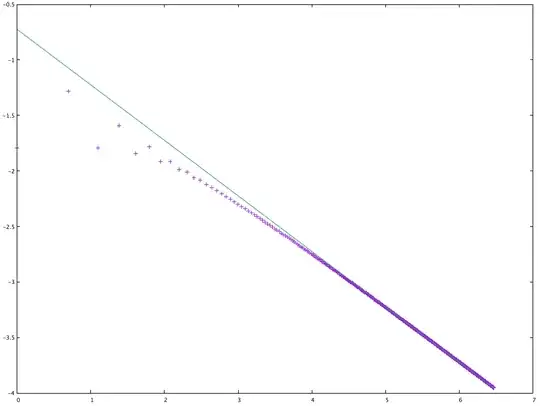
The first term, $\frac12\frac1{1-x}$, represents the long-term average probability $\frac12$, and the second term represents the deviation from that equilibrium. The singularity at $x=1$ is of the form $\frac{\sqrt3}2\frac1{\sqrt{1-x}}$, and the coefficients in the series for $\frac1{\sqrt{1-x}}$ are asymptotic to $\frac1{\sqrt{\pi n}}$, suggesting that the deviation of the probability from $\frac12$ is asymptotic to $\sqrt{\frac3{4\pi n}}$. This is confirmed by direct computation of the probabilities (using this Java code). The following diagram shows a log-log plot of the deviations of the probabilities from $\frac12$ as a function of $n$; the line shows the above asymptotic behaviour.
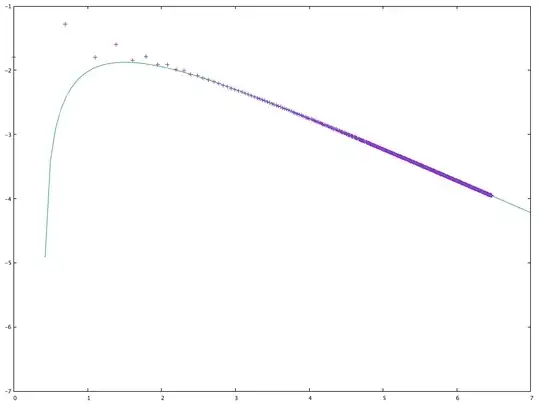
P.S.: We can expand in powers of $\sqrt{1-x}$ to generate an asymptotic series for the deviation of the probability from $\frac12$. The next singular term is $\sqrt{27/4}\sqrt{1-x}$, with coefficients asymptotic to $\sqrt{27/(4\pi n^3)}$, so the asymptotic series begins with
$$
\sqrt{\frac3{4\pi n}}-\sqrt{\frac{27}{4\pi n^3}}+O\left(n^{-5/2}\right)\;.
$$
Here's the log-log plot again, with the green line showing these first two terms:
Edit in response to the edit in the question:
You can derive this equation for $L_k^-(z)$ by reducing everything to the number $S_k$ of walks that shift by $k$ and never touch the lamp at $k$. To get to $k$, you first have to get there without touching the lamp at $k$, and then you can append any number of repetitions of toggling the lamp at $k$, going for a walk and returning. Thus (suppressing the argument $z$ to reduce the clutter)
$$
L_k=S_k\left(1+zS_0+(zS_0)^2+\cdots\right)=\frac{S_k}{1-zS_0}\;.
$$
$L_k^-$ is the even part of this series, in which the lamp is toggled an even number of times:
$$
L_k^-=S_k\left(1+(zS_0)^2+(zS_0)^4+\cdots\right)=\frac{S_k}{1-z^2S_0^2}\;.
$$
So
$$
L_k=(1+zS_0)L_k^-\;,
$$
that is, every walk to $k$ is either a walk to $k$ with the lamp at $k$ ending up off or such a walk plus a toggle at $k$ plus a return walk without toggle at $k$.
Thus your equation is equivalent to
$$
\frac{1+zL_0}{1+2zL_0}=\frac1{1+zS_0}\;,
$$
which you can verify by substituting $L_0$ in terms of $S_0$ from above.


