-1

Let's say a lake has $4$ types of fish. What is the number of possible outcomes ( number of each type of fish caught ) if a total of $10$ fish are caught ?.

We'd use the formula and find the answer like $$ ^{10+4-1}C_{4-1} = {^{13}C_3} $$

  • But the book explains how this result is obtained.
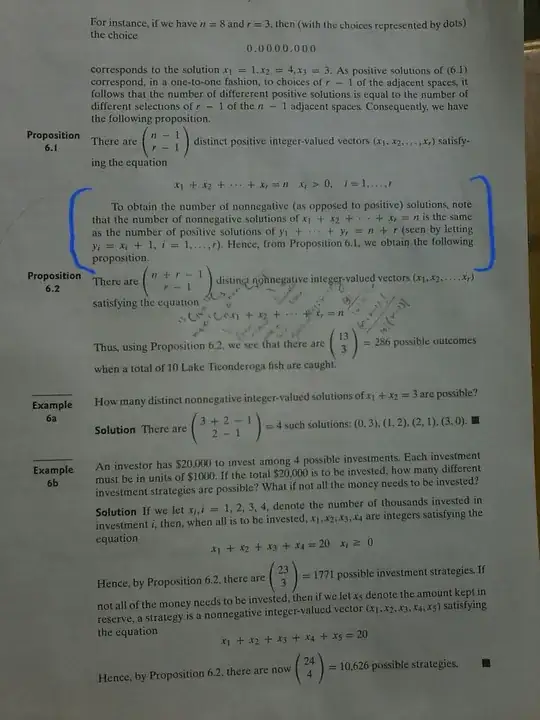
  • I do understand Proposition $\bf 6.1$ but I don't get the highlighted paragraph ( Proposition $\bf 6.2$ )... please see:

enter image description here

enter image description here

Felix Marin
  • 94,079
Isabel
  • 111

2 Answers2

1

$\newcommand{\bbx}[1]{\,\bbox[15px,border:1px groove navy]{\displaystyle{#1}}\,} \newcommand{\braces}[1]{\left\lbrace\,{#1}\,\right\rbrace} \newcommand{\bracks}[1]{\left\lbrack\,{#1}\,\right\rbrack} \newcommand{\dd}{\mathrm{d}} \newcommand{\ds}[1]{\displaystyle{#1}} \newcommand{\expo}[1]{\,\mathrm{e}^{#1}\,} \newcommand{\ic}{\mathrm{i}} \newcommand{\mc}[1]{\mathcal{#1}} \newcommand{\mrm}[1]{\mathrm{#1}} \newcommand{\pars}[1]{\left(\,{#1}\,\right)} \newcommand{\partiald}[3][]{\frac{\partial^{#1} #2}{\partial #3^{#1}}} \newcommand{\root}[2][]{\,\sqrt[#1]{\,{#2}\,}\,} \newcommand{\totald}[3][]{\frac{\mathrm{d}^{#1} #2}{\mathrm{d} #3^{#1}}} \newcommand{\verts}[1]{\left\vert\,{#1}\,\right\vert}$ \begin{align} & \color{#44f}{\sum_{f_{1} = 0}^{\infty}\sum_{f_{2} = 0}^{\infty} \sum_{f_{3} = 0}^{\infty}\sum_{f_{4} = 0}^{\infty} \bracks{z^{10}}z^{f_{1} + f_{2} + f_{3} + f_{4}}} \\[3mm] = & \ \bracks{z^{10}}\pars{\sum_{f = 0}^{\infty}z^{f}}^{4} = \bracks{z^{10}}\pars{1 - z}^{-4} = {-4 \choose 10}\pars{-1}^{10} \\[5mm] = & \ {13 \choose 10}\pars{-1}^{10} = {13 \times 12 \times 11 \over 3 \times 2} = \bbx{\color{#44f}{286}} \end{align}

Felix Marin
  • 94,079
-1

By proposition 6.1, there are $\binom{n-1}{r-1}$ distinct positive integer solutions to $\sum_{i=1}^r x_i=n$.

Then there are $\binom{n-1+r}{r-1}$ distinct positive integer solutions to $\sum_{i=1}^r y_i=n+r$.

So by sustracting $r$ from left and right, and setting $x_i=y_i-1$, we have that there are $\binom{n-1+r}{r-1}$ non-negative integer solutions to $\sum_{i=1}^r x_i=n$.   (Non-negative integers because if $y_i\in\Bbb Z^+$ then $y_i-1\in \Bbb Z^+\cup\{0\}$ )

Graham Kemp
  • 133,231
  • I dont understand this.. the new equation.. why did he add 1 to the x's.. and how will its solution give the non-negative possibilities?? – Isabel Apr 17 '18 at 03:35