8

I am very curious to what is the closed form of:

Assume where $a,b,c > 0$

$$\int_{0}^{\pi/2}{\arctan(a\tan^2x)\over b\sin^2x+c\cos^2x}\mathrm dx=f(a,b,c)\tag1$$

$$b\sin^2x+c\cos^2x$$ $$=b(1-\cos^2 x)+c\cos^2 x$$ $$=b-(b-c)\cos^2 x$$

$$\int_{0}^{\pi/2}{\arctan(a\tan^2x)\over b-(b-c)\cos^2x}\mathrm dx\tag2$$

$u=a\tan^2x\implies\mathrm du=2a\tan x\sec^2 x~\mathrm dx$

${u+a\over a}=\sec^2 x$

$${\sqrt{a}\over 2}\int_{0}^{\infty}{\arctan(u)\over \sqrt{u}(bu+ac-2ab)}\mathrm du\tag3$$

$u=y^2\implies\mathrm du=2y~\mathrm dy$

$$\sqrt{a}\int_{0}^{\infty}{\arctan(y^2)\over by^2+ac-2ab}\mathrm dy\tag4$$

$b=P$ and $ac-2ab=Q$

Take the form of: $$\int_{0}^{\infty}{\arctan(y^2)\over Py^2+Q}\mathrm dy\tag5$$

Apply $\arctan(y)$ series

$$\sum_{n=0}^{\infty}{(-1)^n\over 2n+1}\int_{0}^{\infty}{y^{4n+2}\over Py^2+Q}\mathrm dy\tag6$$

5 Answers5

11

We have

$$ f(a,b,c) = \int_{0}^{\frac{\pi}{2}} \frac{\arctan(a \tan^2\theta)}{b \sin^2\theta + c\cos\theta^2} \, d\theta = \frac{\pi}{\sqrt{bc}} \left( \arctan\left(1 + \sqrt{\frac{2ac}{b}}\right) - \frac{\pi}{4} \right). $$

Here is a sketch of computation.

Step 1. Reduction of the problem (not essential)

Consider the curve $\gamma(\theta) = (\sqrt{c}\cos\theta, \sqrt{b}\sin\theta)$ for $\theta \in [0,\pi/2]$. This is part of an ellipse in the first quadrant. By noting that $ \sqrt{bc} d\theta = x dy - y dx$, it follows that

$$ f(a,b,c) = \int_{\gamma} \omega, \quad \text{where} \quad \omega = \frac{1}{\sqrt{bc}} \arctan\left(\frac{ac}{b}\cdot\frac{y^2}{x^2}\right) \frac{x dy - y dx}{x^2 + y^2}. $$

Write $g = ac/b$ for simplicity. Then the crucial observation is that

$$ d\omega = \frac{1}{\sqrt{bc}} \left( \frac{\partial}{\partial x} \frac{x \arctan(gy^2/x^2)}{x^2 + y^2} + \frac{\partial}{\partial y} \frac{y \arctan(gy^2/x^2)}{x^2 + y^2} \right) dx \wedge dy = 0 $$

in the first quadrant. So by the Green's theorem, we can replace $\gamma$ by any piecewise $C^1$-curve in the first quadrant that joins from $P = (\sqrt{c}, 0)$ to $Q = (0, \sqrt{b})$. Since the integral of $\omega$ along any line segment on each axis is zero, we can also replace $P$ by any point on the positive $x$-axis and likewise for $Q$. Putting altogether, we can replace $\gamma$ by the circular arc $(x,y) = (\cos\theta, \sin\theta)$ to obtain

$$ f(a,b,c) = \frac{1}{\sqrt{bc}} \int_{0}^{\frac{\pi}{2}} \arctan(g\tan^2\theta) \, d\theta = \frac{1}{2\sqrt{bc}} \int_{0}^{\infty} \frac{\arctan(g u)}{\sqrt{u}(1+u)} \, du. $$

Step 2. Calculus

Now the rest of computation can be done with the aid of residue computation. Indeed, consider the last integral as a function of $g$. Then the residue computation shows that

$$ \frac{\partial f}{\partial g} = \frac{1}{2\sqrt{bc}} \int_{0}^{\infty} \frac{\sqrt{u}}{(1+u)(1+ g^2 u^2)} \, du = \frac{\pi}{2\sqrt{bc}} \cdot \frac{1}{\sqrt{2g}(1 + \sqrt{2g} + g)}. $$

Integrating both sides and using the initial value $f|_{g=0} = 0$ gives the desired answer.


Remark. I realized that we can skip Step 1 and apply techniques in Step 2 directly to

$$ f(a,b,c) = \frac{1}{2} \int_{0}^{\infty} \frac{\arctan (a u)}{\sqrt{u}(c + bu)} \, du. $$

Still, Step 1 looks pleasing to me as it sanitizes parameters and demonstrates some unusual technique.

Sangchul Lee
  • 181,930
7

We will use Fourier transformation and Parseval's identity. Say that \begin{equation*} \hat{g}(\xi) = \int_{-\infty}^{\infty}e^{-i\xi x}g(x)\, dx . \end{equation*} Then the Fourier transform of $g(x) = \arctan\dfrac{2}{x^2}$ will be \begin{equation*} \hat{g}(\xi) = 2\pi\dfrac{\sin \xi}{\xi}e^{-|\xi|}\tag{1} \end{equation*} (integration by parts followed by residue calculus). We are now prepared for the given integral. We start with the substituition $y=\tan x$. \begin{equation*} f(a,b,c) = \int_{0}^{\infty}\dfrac{\arctan(ay^2)}{by^2+c}\, dy =\left[y =\dfrac{\sqrt{2}}{z\sqrt{a}}\right] = \dfrac{1}{c\sqrt{2a}} \int_{-\infty}^{\infty}\dfrac{1}{z^2+d^2}\arctan\dfrac{2}{z^2}\, dz \tag {2} \end{equation*} where $d=\sqrt{\dfrac{2b}{ac}}$. But Parseval's identity combined with (1) give \begin{gather*} \int_{-\infty}^{\infty}\dfrac{1}{z^2+d^2}\arctan\dfrac{2}{z^2}\, dz =[\text{ Parseval ]} = \dfrac{1}{2\pi}\int_{-\infty}^{\infty}\dfrac{\pi}{d}e^{-d|\xi|}\, 2\pi\dfrac{\sin \xi}{\xi}e^{-|\xi|}\, d\xi = \\[2ex] \dfrac{2\pi}{d}\dfrac{1}{2\pi}\int_{-\infty}^{\infty}\pi e^{-(1+d)|\xi|}\, \dfrac{\sin \xi}{\xi}\, d\xi = [\text{ Parseval, H = Heaviside ]} = \\[2ex]\dfrac{2\pi}{d}\int_{-\infty}^{\infty}\dfrac{1+d}{x^2+(1+d)^2}\dfrac{1}{2}({\rm H}(\xi+1)-{\rm H}(\xi-1))\, d\xi = \dfrac{\pi}{d}\int_{-1}^{1}\dfrac{1+d}{x^2+(1+d)^2} = \\[2ex]\dfrac{2\pi}{d}\arctan\dfrac{1}{1+d}. \end{gather*} Finally this and (2) give \begin{equation*} f(a,b,c) = \dfrac{\pi}{\sqrt{bc}}\arctan\left(\dfrac{\sqrt{ac}}{\sqrt{ac}+\sqrt{2b}}\right). \end{equation*}

JanG
  • 4,872
3

Here is a real method that makes use of Feynman's trick of differentiating under the integral sign.

Let $$I(a) = \int_0^{\pi/2} \frac{\tan^{-1} (a \tan^2 x)}{b \sin^2 x + c \cos^2 x} \, dx, \quad a,b,c > 0.$$ Note that $I(0) = 0$. Now differentiating with respect to the parameter $a$ we have \begin{align*} I'(a) &= \int_0^{\pi/2} \frac{\tan^2 x}{1 + a^2 \tan^4 x} \cdot \frac{1}{b \sin^2 x + c \cos^2 x} \, dx\\ &= \frac{1}{c} \int_0^{\pi/2} \frac{\tan^2 x}{1 + a^2 \tan^4 x} \cdot \frac{\sec^2 x}{1 + \frac{b}{c} \tan^2 x} \, dx. \end{align*}

Enforcing a substitution of $u = \tan x$ yields $$I'(a) = \frac{1}{c} \int_0^\infty \frac{u^2}{1 + a^2 u^4} \cdot \frac{1}{1 + \frac{b}{c} u^2 + 1} \, du.$$ From a partial fraction decomposition, since \begin{align*} \frac{u^2}{1 + a^2 u^4} \cdot \frac{1}{1 + \frac{b}{c} u^2} &= \frac{bc}{a^2c^2 + b^2} \cdot \frac{1}{a^2 u^4 + 1} + \frac{a^2 c^2}{a^2 c^2 + b^2} \cdot \frac{u^2}{1 + a^2 u^4}\\ & \qquad - \frac{bc^2}{a^2 c^2 + b^2} \cdot \frac{1}{bu^2 + c}, \end{align*} we have \begin{align*} I'(a) &= \frac{b}{a^2 c^2 + b^2} \int_0^\infty \frac{du}{1 + a^2 u^4} + \frac{a^2 c}{a^2 c^2 + b^2} \int_0^\infty \frac{u^2}{1 + a^2 u^4} \, du\\ & \qquad - \frac{bc}{a^2 c^2 + b^2} \int_0^\infty \frac{du}{bu^2 + c}\\ &= \frac{b}{a^2 c^2 + b^2} I_1 + \frac{a^2 c}{a^2 c^2 + b^2} I_2 - \frac{bc}{a^2 c^2 + b^2} I_3. \end{align*}

Finding each of these integrals.

For the first, let $x = a^2 u^4$. Thus $$I_1 = \frac{1}{4 \sqrt{a}} \int_0^\infty \frac{x^{-3/4}}{1 + x} \, dx = \frac{1}{4 \sqrt{a}} \text{B} \left (\frac{1}{4}, \frac{3}{4} \right ) = \frac{\pi}{2 \sqrt{2} \sqrt{a}}.$$

For the second, setting $x = a^2 u^4$ yields $$I_2 = \frac{1}{4 a \sqrt{a}} \int_0^\infty \frac{x^{-1/4}}{1 + x} \, dx = \frac{1}{4 a \sqrt{a}} \text{B} \left (\frac{3}{4}, \frac{1}{4} \right ) = \frac{\pi}{2 \sqrt{2} a \sqrt{a}}.$$

And for the third $$I_3 = \frac{1}{b} \int_0^\infty \frac{du}{u^2 + \frac{c}{b}} = \frac{1}{\sqrt{bc}} \left [\tan^{-1} \left (\frac{bu}{c} \right ) \right ]_0^\infty = \frac{\pi}{2 \sqrt{bc}}.$$

Thus $$I'(a) = \frac{\pi b}{2 \sqrt{2}} \cdot \frac{1}{\sqrt{a} (a^2 c^2 + b^2)} + \frac{\pi c}{2 \sqrt{2}} \cdot \frac{\sqrt{a}}{a^2 c^2 + b^2} - \frac{\pi \sqrt{bc}}{2} \cdot \frac{1}{a^2 c^2 + b^2}.$$ On integrating up with respect to $a$ we have $$I(a) = \frac{\pi}{2 \sqrt{2}} \int \frac{b + ca}{\sqrt{a}(a^2 c^2 + b^2)} \, da - \frac{\pi \sqrt{b}}{2 c \sqrt{c}} \int \frac{da}{a^2 + b^2/c^2}.\tag1$$

The second of the integrals can be readily found. The result is $$\int \frac{da}{a^2 + b^2/c^2} = \frac{c}{b} \tan^{-1} \left (\frac{ca}{b} \right ) + K_2.$$

For the first of the integrals appearing in (1), set $ac = b \tan \theta$. Thus \begin{align*} \int \frac{b + ca}{\sqrt{a}(a^2 c^2 + b^2)} \, da &= \frac{1}{\sqrt{bc}} \int \left (\sqrt{\cot \theta} + \sqrt{\tan \theta} \right ) \, d\theta \tag2\\ &= \frac{\sqrt{2}}{\sqrt{bc}} \sin^{-1} (\sin \theta - \cos \theta) + K_1\\ &= \frac{\sqrt{2}}{\sqrt{bc}} \sin^{-1} \left (\frac{ac - b}{\sqrt{a^2 c^2 + b^2}} \right ) + K_1. \end{align*} Note an evaluation of the integral given by (2) can be found here.

On returning to (1), we have $$I(a) = \frac{\pi}{2 \sqrt{bc}} \sin^{-1} \left (\frac{ac - b}{\sqrt{a^2 c^2 + b^2}} \right ) - \frac{\pi}{2 \sqrt{bc}} \tan^{-1} \left (\frac{ca}{b} \right ) + K.$$ To find the constant $K$ we set $a = 0$. As $I(0) = 0$, we find $K = \pi^2/(4 \sqrt{bc})$. So \begin{align*} I(a) &= \frac{\pi}{2 \sqrt{bc}} \left [\sin^{-1} \left (\frac{ac - b}{\sqrt{a^2 c^2 + b^2}} \right ) + \frac{\pi}{2} - \tan^{-1} \left (\frac{ca}{b} \right ) \right ]\\ &= \frac{\pi}{2 \sqrt{bc}} \left [\sin^{-1} \left (\frac{ac - b}{\sqrt{a^2 c^2 + b^2}} \right ) + \tan^{-1} \left (\frac{b}{ca} \right ) \right ], \end{align*} since $\tan^{-1} (1/x) = \pi/2 - \tan^{-1} x$ for $x > 0$, or $$\boxed{f(a,b,c) = \frac{\pi}{2 \sqrt{bc}} \left [\sin^{-1} \left (\frac{b}{\sqrt{a^2 c^2 + b^2}} \right ) + \sin^{-1} \left (\frac{ac - b}{\sqrt{a^2 c^2 + b^2}} \right ) \right ]}$$ where use of the following inverse trigonometric identity $$\tan^{-1} x = \sin^{-1} \left (\frac{x}{\sqrt{1 + x^2}} \right ),$$ has been made.

omegadot
  • 12,364
2

OP's integral $(3)$ is a good start for contour integration since $\dfrac{ac}b>0$, although the integrand's denominator has an extra term (no $-2ab$). For $t>0$, let

$$I(t) := \int_0^\infty \frac{\arctan u}{\sqrt u\,(u+t)} \, du$$

so that

$$f(a,b,c) = \int_0^\tfrac\pi2 \frac{\arctan\left(a \tan^2x\right)}{b\sin^2x + c\cos^2x} \, dx \stackrel{u=a\tan^2x}= \frac{\sqrt a}{2b} I\left(\frac{ac}b\right)$$

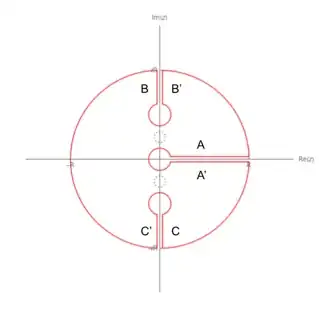
Evaluate $I(t)$ with the residue theorem. Integrate

$$F(z) = \frac{\arctan z}{\sqrt z \, (z+t)} = -\frac i2 \frac{\log \left\lvert\frac{i-z}{i+z}\right\rvert + i \arg\left(\frac{i-z}{i+z}\right)}{\sqrt{\lvert z\rvert} \, e^{\tfrac i2 \arg z} \, (z+t)}$$

along a deformed circular contour avoiding branch cuts along $\pm i [1,\infty)$ and $[0,\infty)$, so that $\arg z\in(0,2\pi)$ and $\arg\left(\dfrac{i-z}{i+z}\right)\in(-\pi,\pi)$. (I'm reusing the image of the contour from one of my older questions; ignore the dotted circles and instead imagine another centered at $z=-\dfrac{ac}b$, anywhere on the negative real axis.)
enter image description here

By the residue theorem,

$$\begin{align*} \oint_\mathcal C F(z) \, dz &= i2\pi \underset{z=-\tfrac{ac}b}{\operatorname{Res}} F(z) = -2\pi \sqrt{\frac b{ac}} \arctan \frac{ac}b \end{align*}$$

Integrals along the circular components of $\mathcal C$ (small arcs with radius $\varepsilon$ encircling branch points and the large arc of radius $R$) will vanish as $\varepsilon\to0$ and $R\to\infty$. We have $\arg z\to0$ along $A$ and $\to2\pi$ along $A'$, while $\arg\left(\dfrac{i-z}{i+z}\right)\to+\pi$ along $B',C$ and $\to-\pi$ along $B,C'$. The remaining contributions are thus

$$\begin{align*} \int_A F(z)\,dz &= \int_\varepsilon^R F(x+i\varepsilon) \, dx \to \int_0^\infty \frac{\arctan x}{\sqrt x \, e^{\tfrac i2\cdot0} \, (x+t)} \, dx = I(t) \\ \int_{A'} F &= \int_R^\varepsilon F(x-i\varepsilon) \, dx \to -\int_0^\infty \frac{\arctan x}{\sqrt x \, e^{\tfrac i2 \cdot 2\pi} \, (x+t)} \, dx = I(t) \\ \int_B F &= i \int_{1+\varepsilon}^R F(-\varepsilon+ix) \, dx \to \frac12 \int_1^\infty \frac{\log\frac{x-1}{x+1} - i \pi}{\sqrt x \, e^{\tfrac i2 \cdot \tfrac\pi2} \, (ix+t)} \, dx \\ \int_{B'} F &= i \int_R^{1+\varepsilon} F(\varepsilon+ix) \, dx \to -\frac12 \int_1^\infty \frac{\log\frac{x-1}{x+1} + i \pi}{\sqrt x \, e^{\tfrac i2 \cdot \tfrac\pi2} \, (ix+t)} \, dx \\ \int_C F &= -i \int_{1+\varepsilon}^R F(\varepsilon-ix) \, dx \to -\frac12 \int_1^\infty \frac{\log\frac{x+1}{x-1} + i \pi}{\sqrt x \, e^{\tfrac i2 \cdot \tfrac{3\pi}2} \, (-ix+t)} \, dx \\ \int_{C'} F &= -i \int_R^{1+\varepsilon} F(-\varepsilon-ix) \, dx \to \frac12 \int_1^\infty \frac{\log\frac{x+1}{x-1} - i \pi}{\sqrt x \, e^{\tfrac i2 \cdot \tfrac{3\pi}2} \, (-ix+t)} \, dx \end{align*}$$

so that upon combining, we have

$$\begin{align*} -2\pi \sqrt{\frac b{ac}} \arctan \frac{ac}b &= 2 \, I(t) + i\pi \int_1^\infty \left(\frac{e^{i\tfrac\pi4}}{t-ix} - \frac{e^{-i\tfrac\pi4}}{t+ix}\right) \, \frac{dx}{\sqrt x} \\ \implies I(t) &= -\pi \sqrt{\frac b{ac}} \arctan \frac{ac}b + \frac\pi{\sqrt2} \int_1^\infty \frac{x+t}{x^2+t^2} \, \frac{dx}{\sqrt x} \\ &\!\!\!\!\stackrel{x\to\tfrac1{x^2}}= -\pi \sqrt{\frac b{ac}} \arctan \frac{ac}b + \pi\sqrt2 \int_0^1 \frac{1+tx^2}{1+t^2x^4} \, dx \\ &= \frac\pi{\sqrt t} \arctan \frac{\sqrt{2t}}{1-t} - \pi \sqrt{\frac b{ac}} \arctan \frac{ac}b \end{align*}$$

Now we have

$$I\left(\frac{ac}b\right) = \pi \sqrt{\frac b{ac}} \left(\arctan \frac{\sqrt{2abc}}{b-ac} - \arctan \frac{ac}b\right)$$

and hence

$$\boxed{f(a,b,c) = \frac\pi{2\sqrt{bc}} \arctan \frac{a^2c^2-abc + b\sqrt{2abc}}{b^2-abc+ac\sqrt{2abc}}}$$

where we make use of $\arctan u+\arctan v=\arctan\dfrac{u+v}{1-uv}$. This result agrees with the other answers up to trigonometric identities. JanG's answer, for instance, follows upon recalling $\arctan x=2\arctan\dfrac x{1+\sqrt{1+x^2}}$.

user170231
  • 25,320
2

Split the numerator as $$ \tan^{-1}(a\tan^2x)= \tan^{-1}\left(\sqrt{\frac 2a}\cot x+1\right)- \tan^{-1}\left(\sqrt{\frac 2a}\cot x-1\right) $$ and then substitute $y =\sqrt{\frac{2}{a}} \cot x$, along with $p={\sqrt{\dfrac{2b}{ac}}}$ \begin{align} &\int_{0}^{\pi/2}{\tan^{-1}(a\tan^2x)\over b\sin^2x+c\cos^2x}dx\\ =& \ \dfrac{1}{\sqrt{2ac^2}} \int_{-\infty}^{\infty}\dfrac{\tan^{-1}(y+1)- \tan^{-1}(y-1)}{y^2+p^2}\, dy \>\>\>\>\>\>\\ =& \ \dfrac{1}{\sqrt{2ac^2}} \int_{-\infty}^{\infty}\int_{-1}^1 \dfrac{1}{(y^2+p^2)[(y+t)^2+1]}dt\, dy \\ =& \ \dfrac{\pi}{2\sqrt{bc}}\int_{-1}^{1}\dfrac{1+p}{t^2+(1+p)^2}dt= \dfrac{\pi}{\sqrt{bc}}\cot^{-1}\bigg( 1+\sqrt{\frac{2b}{ac}}\bigg) \end{align}

Quanto
  • 120,125