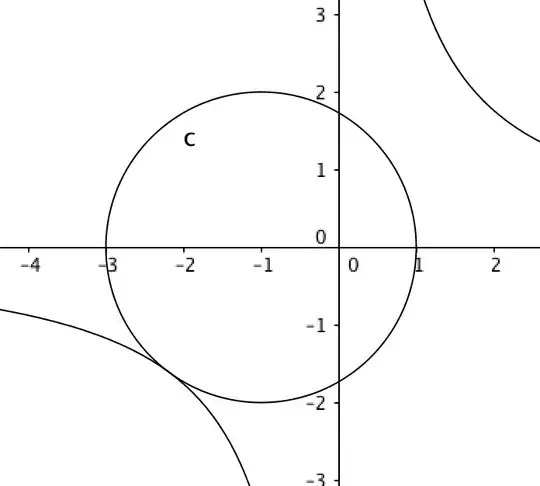
Your constraint is a circle centered at $(-1,0)$ with radius $2$. And the level curves of $xy$ with positive level are hyperbolae in the first and third quadrant. Since the circle is centered left of the origin, visualizing this it should be clear that the maximum value of $xy$ happens when both $x$ and $y$ are negative.
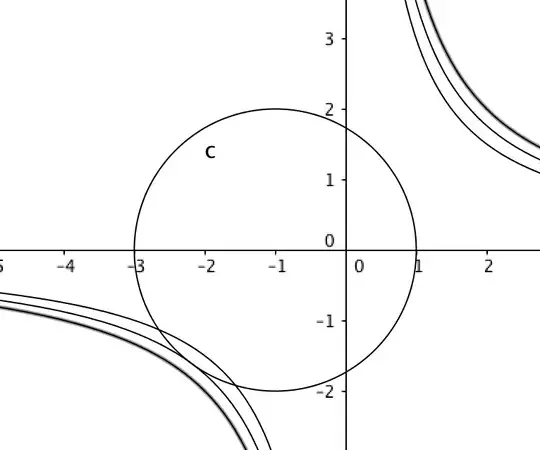
Furthermore, the curve $xy=M$ (where $M$ is the maximal value subject to the constraint) must intersect the circle in a tangency instead of at crossings, or else a slightly larger $M$ would be obtainable. For these two curves to intersect with tangency, there must be a repeated root to the equation that you get by eliminating one variable.
That is, if you eliminate $y$ to get $$(x+1)^2+\left(\frac{M}{x}\right)^2=4$$ and then expand and clear $x$ from the denominator to get $$x^4+2x^3-3x^2+M^2=0$$ we need to have a polynomial equation with a doubled root. So for some $a,b,c$:
$$\begin{align}
&x^4+2x^3-3x^2+M^2\\
&=(x-a)^2(x-b)(x-c)\\
&=(x^2-2ax+a^2)(x^2-(b+c)x+bc)\\
&=x^4-(2a+b+c)x^3+(a^2+2a(b+c)+bc)x^2-(a^2(b+c)+2abc)x+a^2bc\\
\end{align}$$
which implies the system
$$\begin{cases}
2a+b+c&=-2\\
a^2+2a(b+c)+bc&=-3\\
a^2b+a^2c+2abc&=0
\end{cases}$$
In the last equation we know $a\neq0$ so we can divide by $a$. Then we can eliminate $c$ by solving for it in the first equation and substituting it into the other two. All this gives:
$$\begin{cases}
-4a-3a^2-2b-2ab-b^2&=-3\\
-2a-2a^2-4b-4ab-2b^2&=0
\end{cases}$$
Double the top and subtract from the second to get:
$$6a+4a^2=6$$ from which we can solve for $a$ using the quadratic formula. Remember that $a$ is the doubled root, and so it is the same as the $x$-value where $xy$ is maximal. Also we know this number is negative, which helps to discern between the two quadratic solutions. We find that $x=a=-\frac14\left(3+\sqrt{33}\right)$ at the point where $xy$ is maximal.
Now we can find:
$$\begin{align}
y&=-\sqrt{4-(x+1)^2}\\
&=-\sqrt{4-\left(-\frac14\left(3+\sqrt{33}\right)+1\right)^2}\\
&=-\sqrt{4-\left(\frac14\left(1-\sqrt{33}\right)\right)^2}\\
&=-\sqrt{4-\frac1{16}\left(34-2\sqrt{33}\right)}\\
&=-\frac14\sqrt{30+2\sqrt{33}}
\end{align}$$
And so the maximal value is $$M=xy=\frac{1}{16}\left(3+\sqrt{33}\right)\sqrt{30+2\sqrt{33}}$$
I submit visual evidence that this is the maximal value. A plot of the circle and the curve $xy=M$. A larger $M$, and the two curves would not intersect.