7

(See 2025 update below.)

This is related to the post on $x^2+ny^2=z^k$. In response to my answer on,

$$x^2+47y^2 = z^k\tag1$$

for $k=3$ and where z is not of form $p^2+nq^2$, Will Jagy provided one for $k=5$,

$$ (14p^5 + 405p^4q + 3780p^3q^2 + 13410p^2q^3 + 11550pq^4 - 14647q^5)^2 + 47 ( p^5 - 270p^3q^2 - 2520p^2q^3 - 8115pq^4 - 8344q^5)^2 \\= (3p^2 + 28pq + 81q^2)^5\tag3 $$

As noticed by Elaqqad, the cubic polynomials I used for $(1)$ involve the discriminant $d=47$ and I assumed it would be same with the two quintic polynomials used by Jagy for $(3)$. Then I wondered if they were solvable in radicals as well since I knew Ramanujan played with a solvable quintic with $d=47$. It turns out both are.

This Magma calculator computes the Galois group and the command is:

Z := Integers(); P < x > := PolynomialRing(Z); f := 14x^5 + 405x^4 + 3780x^3 + 13410x^2 + 11550*x - 14647; G, R := GaloisGroup(f); G;

Testing both polynomials, it shows the group has order 20 and hence is solvable.


Q: Given $x^2+dy^2=z^k$ where $z\neq p^2+dq^2$, is it true that if $$\big(P_1(x)\big)^2+d\big(P_2(x)\big)^2=\big(P_3(x)\big)^k$$ then the equations $P_1(x) = P_2(x) = P_3(x) = 0$ are solvable in radicals?

P.S. Or is this deg-$5$ parameterization special only because the class number $h(-47) = 5$? One way to check would be to solve $x^2+47y^2 = z^\color{red}7$ analogous to $(3)$ and see if it involves solvable septics (Will, care to oblige?).


(Update 2025) I realized that I never did compare Jagy's quintics with the one solved in radicals by Ramanujan also with $d=47$, namely,

$$x^5 - x^3 - 2x^2 - 2x - 1 = 0$$

Like a lot of algebraic numbers that interested Ramanujan, its real root $x$ has a special property,

$$\pi\approx\frac{\log\big((x\sqrt2)^{24}-24\big)}{\sqrt{47}}$$

though we can tweak that for more accuracy,

$$\pi\approx\frac{\log\Big(\big((x\sqrt2)^{24}-24\big)^2-552\Big)}{2\sqrt{47}}$$

which differs by just $10^{-18}$ and $10^{-26}$, respectively. (One can replace $x$ and $\sqrt{47}$ with infinitely many other solvable radicals for arbitrary accuracy.)

However upon inspection, Ramanujan's quintic has $d=47^2$ with one real root, while Jagy's has $d=47^{10}$ with five real roots, so the latter does not factor in the field of the former.

  • 1
    And solvable septics would be... curable equations? (sorry, couldn't resist) Anyway, you may wish to ping @WillJagy. – A.P. Aug 05 '15 at 09:09
  • 1
    @A.P.: I remember a discussion in the old sci.math where one researcher commented his "sextic" files were often accessed by questionable URLs, if you know what I mean. :) – Tito Piezas III Aug 05 '15 at 12:05
  • 1
    You would enjoy Hiramatsu and Saito, An Introduction to Non-Abelian Class Field Theory, where they say Ramanujan's quintic is due to Schlafli in 1870, this being reported in Weber's 1908 book, volume 3 of Lehrbuch der Algebra. Anyway, Hiramatsu and Saito especially pages 29 to 36. – Will Jagy Jan 25 '25 at 17:56
  • also Zassenhaus and Liang 1969 https://www.ams.org/journals/mcom/1969-23-107/S0025-5718-1969-0246853-2/S0025-5718-1969-0246853-2.pdf – Will Jagy Jan 25 '25 at 18:17
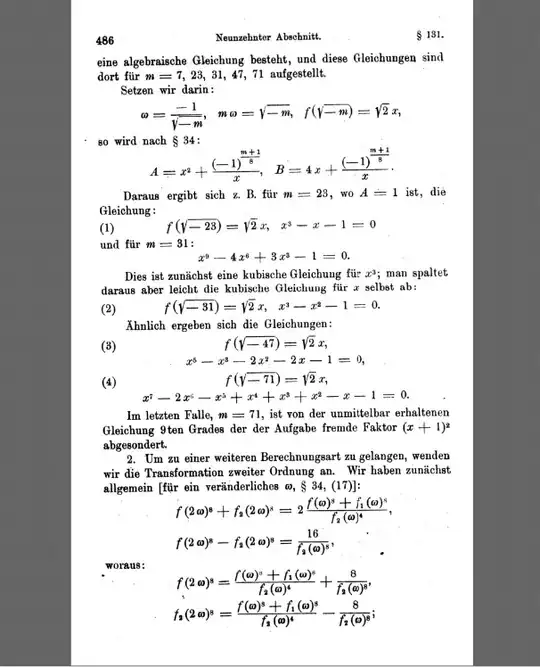
  • page 486 in Weber 1908: https://gdz.sub.uni-goettingen.de/id/PPN234736674?tify=%7B%22pages%22%3A%5B503%5D%2C%22pan%22%3A%7B%22x%22%3A0.275%2C%22y%22%3A0.772%7D%2C%22view%22%3A%22export%22%2C%22zoom%22%3A0.464%7D – Will Jagy Jan 25 '25 at 18:22
  • @WillJagy Thanks! Ramanujan's quintic has group order 10, yours has group order 20. Ramanujan had little knowledge of class field theory, but somehow he knew about the quintics for $d=47$ and $d=79$, the two smallest with class number $h(-d)=5$. Let me guess, $d=79$ also appears in Schlafli in 1870 or in Weber in 1908? – Tito Piezas III Jan 26 '25 at 01:38
  • Not so sure. The next prime mentioned is $71$ I put page 486 in Weber to my answer – Will Jagy Jan 26 '25 at 01:50
  • @WillJagy I looked at the photocopy. Ah, they wrote $m=(7,23,31,47,71)$. These are the smallest $d = 8m+7$ for class number $n=h(-d) = (1,3,3,5,7)$, respectively. And the Weber class polynomial for these only has deg $n$. In the picture below, it seems Weber didn't notice that his deg-$9$ actually *factors* as, $$(x^9 - 4x^6 + 3x^3 - 1) = (x^3 - x^2 - 1)(1 - x^2 - 2 x^3 + x^4 + x^5 + x^6) = 0$$ The cubic's real root for $d=23$ is called the "plastic ratio", while the cubic's real root for $d=31$ is called the "supergolden ratio". – Tito Piezas III Jan 26 '25 at 02:07
  • @TitoPiezasIII here is a modern treatment of 31 https://people.math.carleton.ca/~williams/papers/pdf/168.pdf Lots more items at https://people.math.carleton.ca/~williams/papers/alnt.html – Will Jagy Jan 26 '25 at 02:13

3 Answers3

4

enter image description here

I am not finding a short online summary of the composition of two binary quadratic forms, as done by Dirichlet. Also, the edition of Cox that I have has a typo, corrected in the second edition (2013), here it is.

Given $\gcd(a,a',B) = 1,$ define $$ X = xz-Cyw, $$ $$ Y = axw + a'yz + B yw, $$ then $$ (a x^2 + B xy + a'C y^2) (a' z^2 + B zw + aC w^2) = aa'X^2 + B XY + C Y^2 $$ which you ought to check!

Here are the binary forms (primitive) of discriminant $-284$

Discr  -284 = 2^2 * 71  class  number  7

all
284: < 1, 0, 71> 284: < 3, -2, 24> 284: < 3, 2, 24> 284: < 5, -4, 15> 284: < 5, 4, 15> 284: < 8, -2, 9> 284: < 8, 2, 9>

The first few primes integrally represented by $3x^2 + 2xy+24y^2$ are $$ 3, 29, 89, 103, 109, 151, 157, 191, $$ and below, we show how to represent each $p^7$ once we have $x,y.$

compared with $-71$ primitive, where this time a form represents the prime $2$

Discr  -71 = 71  class  number  7

all
71: < 1, 1, 18> 71: < 2, -1, 9> 71: < 2, 1, 9> 71: < 3, -1, 6> 71: < 3, 1, 6> 71: < 4, -3, 5> 71: < 4, 3, 5>

ummmm, $h(-71) = h(-284) = 7.$ Since $4 \cdot 3^7 - 284 = 92^2,$ the principal form is $\langle 1, 92, 2187\rangle.$ The class group is cyclic, everything is a power of $\langle 3, 92, 729 \rangle$ under Dirichlet's version of Gauss composition. All I am doing is repeatedly multiplying by $3 x^2 + 92 xy + 729 y^2,$ the rules for composition eventually give the quadratic form $\langle 2187, 92, 1 \rangle$ with variables which are homogeneous degree seven in the original $x,y.$ Oh, any form that represents $1$ is $SL_2 \mathbb Z$ equivalent to the principal form. At the very end, I show how to write $t^2 + 71 z^2 = (3 x^2 + 92 xy + 729 y^2)^7. $ I am showing the whole gp-pari session, there is nothing difficult once we get that fortunate expression for the coefficients of a generator of the group.

a=3; a1=3; b=92; c=243; z = x; w = y;

zz = x * z - c * y * w ; ww = a * x * w + a1 * y * z + b * y * w; z = zz; w = ww;

? a=3; a1=3; b=92; c=243; z = x; w = y; ? zz = x * z - c * y * w ; ww = a * x * w + a1 * y * z + b * y * w; z = zz; w = ww; ? z %3 = x^2 - 243y^2 ? w %4 = 6yx + 92y^2 ?

a1 = 9; c = 81; zz = x * z - c * y * w ; ww = a * x * w + a1 * y * z + b * y * w; z = zz; w = ww; ? a1 = 9; c = 81; zz = x * z - c * y * w ; ww = a * x * w + a1 * y * z + b * y * w; z = zz; w = ww; ? z %6 = x^3 - 729y^2x - 7452y^3 ? w %7 = 27yx^2 + 828y^2x + 6277y^3 ?

a1 = 27; c = 27; zz = x * z - c * y * w ; ww = a * x * w + a1 * y * z + b * y * w; z = zz; w = ww;

? a1 = 27; c = 27; zz = x * z - c * y * w ; ww = a * x * w + a1 * y * z + b * y * w; z = zz; w = ww; ? z %9 = x^4 - 1458y^2x^2 - 29808y^3x - 169479y^4 ? w %10 = 108yx^3 + 4968y^2x^2 + 75324y^3x + 376280y^4 ? ? a1 = 81; c = 9; zz = x * z - c * y * w ; ww = a * x * w + a1 * y * z + b * y * w; z = zz; w = ww;

? a1 = 81; c = 9; zz = x * z - c * y * w ; ww = a * x * w + a1 * y * z + b * y * w; z = zz; w = ww; ? z %12 = x^5 - 2430y^2x^3 - 74520y^3x^2 - 847395y^4x - 3386520y^5 ? w %13 = 405yx^4 + 24840y^2x^3 + 564930y^3x^2 + 5644200y^4x + 20889961y^5 ?

a1 = 243; c = 3; zz = x * z - c * y * w ; ww = a * x * w + a1 * y * z + b * y * w; z = zz; w = ww;

? a1 = 243; c = 3; zz = x * z - c * y * w ; ww = a * x * w + a1 * y * z + b * y * w; z = zz; w = ww; ? z %15 = x^6 - 3645y^2x^4 - 149040y^3x^3 - 2542185y^4x^2 - 20319120y^5x - 62669883y^6 ? w %16 = 1458yx^5 + 111780y^2x^4 + 3389580y^3x^3 + 50797800y^4x^2 + 376019298y^5x + 1098952052y^6 ? ?

a1 = 729; c = 1; zz = x * z - c * y * w ; ww = a * x * w + a1 * y * z + b * y * w; z = zz; w = ww;

? ? a1 = 729; c = 1; zz = x * z - c * y * w ; ww = a * x * w + a1 * y * z + b * y * w; z = zz; w = ww; ? ? z %18 = x^7 - 5103y^2x^5 - 260820y^3x^4 - 5931765y^4x^3 - 71116920y^5x^2 - 438689181y^6x - 1098952052y^7 ? w %19 = 5103yx^6 + 469476y^2x^5 + 17795295y^3x^4 + 355584600y^4x^3 + 3948202629y^5x^2 + 23077993092y^6x + 55417244077y^7 ?

2187 * z^2 + 92 * z * w + w^2

( 3 * x^2 + 92 * x * y + 729 * y^2)^7

? ? 2187 * z^2 + 92 * z * w + w^2 %20 = 2187x^14 + 469476yx^13 + 46911879y^2x^12 + 2892076488y^3x^11 + 122889105423y^4x^10 + 3807263630268y^5x^9 + 88688782583499y^6x^8 + 1578039270279536y^7x^7 + 21551374167790257y^8x^6 + 224815110103695132y^9x^5 + 1763324345027822661y^10x^4 + 10084047184857263688y^11x^3 + 39747900724268273397y^12x^2 + 96660945131267433924y^13x + 109418989131512359209y^14 ? ? ? ( 3 * x^2 + 92 * x * y + 729 * y^2)^7 %21 = 2187x^14 + 469476yx^13 + 46911879y^2x^12 + 2892076488y^3x^11 + 122889105423y^4x^10 + 3807263630268y^5x^9 + 88688782583499y^6x^8 + 1578039270279536y^7x^7 + 21551374167790257y^8x^6 + 224815110103695132y^9x^5 + 1763324345027822661y^10x^4 + 10084047184857263688y^11x^3 + 39747900724268273397y^12x^2 + 96660945131267433924y^13x + 109418989131512359209y^14 ? ? 2187 * z^2 + 92 * z * w + w^2 - ( 3 * x^2 + 92 * x * y + 729 * y^2)^7 %22 = 0 ?

t = w + 46 * z

t^2 + 71 * z^2

? ? t = w + 46 * z %23 = 46x^7 + 5103yx^6 + 234738y^2x^5 + 5797575y^3x^4 + 82723410y^4x^3 + 676824309y^5x^2 + 2898290766y^6x + 4865449685y^7 ? ? ? ? t^2 + 71 * z^2 %24 = 2187x^14 + 469476yx^13 + 46911879y^2x^12 + 2892076488y^3x^11 + 122889105423y^4x^10 + 3807263630268y^5x^9 + 88688782583499y^6x^8 + 1578039270279536y^7x^7 + 21551374167790257y^8x^6 + 224815110103695132y^9x^5 + 1763324345027822661y^10x^4 + 10084047184857263688y^11x^3 + 39747900724268273397y^12x^2 + 96660945131267433924y^13x + 109418989131512359209y^14 ? ? t^2 + 71 * z^2 - ( 3 * x^2 + 92 * x * y + 729 * y^2)^7 %25 = 0 ? ? ? t %26 = 46x^7 + 5103yx^6 + 234738y^2x^5 + 5797575y^3x^4 + 82723410y^4x^3 + 676824309y^5x^2 + 2898290766y^6x + 4865449685y^7 ? ? z %27 = x^7 - 5103y^2x^5 - 260820y^3x^4 - 5931765y^4x^3 - 71116920y^5x^2 - 438689181y^6x - 1098952052*y^7 ?

=-=-=-=-=-=-=-=-=-=-=-=-=-=-=-=-=-=-=-=-=-=-=-=-=-=-=-=-=

Will Jagy
  • 146,052
3

(A partial answer.) Thanks to Jagy's two parameterizations for degs $5$ and $7$, a general identity has been found. The clue was to transform $(3)$ using $p=u-14v,\,q=3v$ to the form,

$$(14 u^5 + 235 u^4 v - 6580 u^3 v^2 - 22090 u^2 v^3 + 154630 u v^4 + 47^3 v^5)^2 + 47(u^5 - 70 u^4 v - 470 u^3 v^2 + 6580 u^2 v^3 + 11045 u v^4 - 14\cdot47^2 v^5)^2\\=3^5(u^2+47v^2)^5$$

(and similarly for the deg $7$). Inspecting the coefficients, patterns were found. Thus,

If $a^2+db^2=c^5$, then,

$$(\color{blue}+a u^5 \color{blue}+ 5 b d u^4 v \color{red}- 10 a d u^3 v^2 \color{red}- 10 b d^2 u^2 v^3 \color{blue}+ 5 a d^2 u v^4 \color{blue}+ b d^3 v^5)^2 + d (\color{blue}+ b u^5 \color{red}- 5 a u^4 v \color{red}- 10 b d u^3 v^2 \color{blue}+ 10 a d u^2 v^3 \color{blue}+ 5 b d^2 u v^4 \color{red}- a d^2 v^5)^2 \\= c^5 (u^2 + d v^2)^5$$

where the above used $14^2+47\times1^2=3^5$.

(Edited later.) In general, if,

If $a^2+db^2=c^k$, then,

$$\Big(a\,\phi_1-b\sqrt{-d}\,\phi_2\Big)^2+d \Big(b\,\phi_1-\frac{a}{\sqrt{-d}}\,\phi_2\Big)^2 =c^k(u^2+dv^2)^k$$

where,

$$\phi_1 = \frac{(u+\sqrt{-d}\,v)^k+(u-\sqrt{-d}\,v)^k}{2}$$

$$\phi_2 = \frac{(u+\sqrt{-d}\,v)^k-(u-\sqrt{-d}\,v)^k}{2}$$

Since an initial solution to $a^2+db^2=c^k$ is easily found for any $d$ (such as using the obvious $a,b,c = 1,0,1$), then the class number $h(-d)$ need not matter, answering part of my original question. For example, using $a^2+47b^2=c^7$ where $a,b,c = 866458,55861,51$, then one can find a $k=7$ parameterization similar to the one found by Jagy for $d=71$, even though $h(-47) = 5$.

The discriminants $D$ of the first polynomials $P_1(u,v)$ for $k=5,7$ are,

$$D_5 = 2^{12}\cdot5^5c^{20}d^{10}$$

$$D_7 = 2^{30}\cdot7^7c^{42}d^{21}$$

Their form and discriminants highly suggest that, equated to zero, then $P_i(u,v)=0$ is solvable in radicals for any $a,b,d$. But I do not (yet) have a rigorous proof that this is the case.

  • Oh, I just realized! If $d=-n$, and $a^2-nb^2=u^2-nv^2=\color{red}1$, then the formulas above can be found from Pell equations. – Tito Piezas III Aug 06 '15 at 04:38
  • 1
    It is likely, given your $a^2 + d b^2 = c^k$ primitive, with $k$ odd (and prime would help) and $c$ an odd prime that does not divide $d,$ that the form of that discriminant that does represent $c$ ( and its "opposite") has order exactly $k$ in the group under composition. The bad news is that there is no guarantee that we can write the principal form as some $\langle 1, f, c^k \rangle,$ although I did get lucky twice. If so, one may get these identities with no $c^k$ coefficient in front; if not, there is existence but no easy cookie cutter way to get the identity. – Will Jagy Aug 07 '15 at 03:40
-2

There is a standard calculation procedure. Suitable for any degree.

We make the conversion.

$$x^2+ay^2=(p^2+as^2)(k^2+an^2)(t^2+ar^2)=z^5$$

And then solve the system of equations.

$$\left\{\begin{aligned}&z^2=k^2+an^2=t^2+ar^2\\&z=p^2+as^2\end{aligned}\right.$$

In the first equation to parameterize the substitution in the second. And then, we decide and we obtain the parameterization of all solutions.

Not clearly only one. Need to find other solutions?

individ
  • 4,405