5

What set does $\mathbb W$ denote?

I know this may horribly lack context, but I've seen multiple times on M.SE $\mathbb W$ used in some fairly elementary context I think.

user89167
  • 835
  • Can you link some examples ? $W(s)$ usually denotes Lambert's Omega Function btw. – AlienRem Apr 19 '15 at 21:11
  • @RenatoFaraone I don't have any examples at hand, sorry. That's why I added "I know this may horribly lack context", hoping you can cope with that. – user89167 Apr 19 '15 at 21:14
  • 3
    Somebody asked a professor at my university what a whole number was, and his response was "A number like zero, six, eight, nine... They all have holes in them." – Andrey Kaipov Apr 19 '15 at 21:17
  • Sometimes ${W_t : t\ge 0}$ is the "Wiener process", named after Norbert Wiener, modeling Brownian motion. For each $t\ge 0$, $W_t$ is a normally distributed random variable with expected value $0$ and variance $t$, and increments are independent, i.e. for every finite $n$ with $0\le t_1\le s_1\le t_2\le s_2\le\cdots\le t_n\le s_n$, the random variables $W_{s_k}-W_{t_k}$ for $k=1,\ldots,n$ are independent. ${}\qquad{}$ – Michael Hardy Apr 19 '15 at 21:22
  • @RenatoFaraone The question says it is a set, so it can't be a function. – user89167 Apr 19 '15 at 22:18
  • @user89167 ops my fault, but usually sets are denoted with bbb style. – AlienRem Apr 20 '15 at 09:28

3 Answers3

6

In an elementary context, $\Bbb W$ means the set of whole numbers. Some books have it as

$$\Bbb W=\{0,1,2,\ldots\}$$

while others have it as

$$\Bbb W=\{1,2,\ldots\}$$

Because of the ambiguity, I recommend that you avoid the use of $\Bbb W$. For the second meaning use $\Bbb Z^+$. There still is no perfect abbreviation for the first. Either meaning is also called the Natural numbers, although usually the Whole numbers are meant to be different from the Natural numbers. Again, we see the ambiguity: even if the Whole and Natural numbers are different, which is which? See the Wikipedia articles for a variety of notations for these sets, most of which are far from perfect.

I have occasionally seen the phrase "whole numbers" used for the Integers, which includes negative numbers such as $-1,-2,\ldots$ and is usually written $\Bbb Z$. But I have never seen the notation $\Bbb W$ used in that way.

As @RenatoFaraone points out, in an advanced context $W(x)$ probably means the Lambert W function. But I have never seen that written in the "blackboard bold" style that $\Bbb W$ uses.

Rory Daulton
  • 32,888
  • 6
  • 47
  • 64
  • You're right, bbb-style is used for Set Theory while the $W(x)$ notation is proper of the Lambert's function. – AlienRem Apr 19 '15 at 21:17
  • In what are whole numbers assumed to be different from natural numbers? From both your definition and the Wikipedia article (not to mention the MathWorld page) they seem to be pretty much the same thing... – A.P. Apr 19 '15 at 21:44
  • 2
    @A.P.: I have seen them treated differently in multiple books. MagicMan's answer cites one. Another that I have taught from is Algebra 2 by Holliday, published by Glencoe McGraw Hill. Both books (if I recall correctly) have zero in the Whole numbers but not in the Natural numbers--not at all what I prefer. As I wrote, there is much ambiguity in the matter. – Rory Daulton Apr 19 '15 at 21:52
3

Just to provide a more or less authoritative reference as to what $\mathbb{W}$ denotes, the following is from page 2 of the book A Transition to Abstract Mathematics by Randall Maddox:
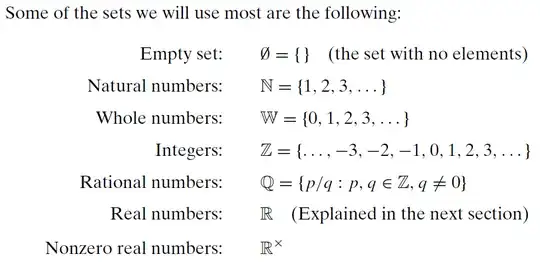
enter image description here

As you can see, $\mathbb{W}$ denotes the set of whole numbers, but this notation is often avoided in favor of $\mathbb{N}$, and even $\mathbb{N}$ itself is often clarified at the beginning of a text or mentioned in context whether or not $\mathbb{N}$ includes $0$.

Also, I should mention that this book never makes use of $\mathbb{W}$ after page 2. It seems to be almost universally avoided and for good reason.

  • This is just a convention in Maddox's book. Usually, whenever ambiguity may arise authors state at the beginning weather they assume $0 \in \Bbb{N}$ or not. – A.P. Apr 19 '15 at 21:48
  • 2
    @A.P. Fair point. By "authoritative," I really meant something along the lines of "this notation actually appears in the mathematical literature and here is a description" as opposed to "this is the definition...". Maybe that makes more sense. And yes, what you mentioned at the end of your comment concerning $\mathbb{N}$ is what I meant in the penultimate paragraph of my answer--the definition of $\mathbb{N}$ being used is nearly always clarified at the outset. At least that's been my experience when reading books and papers. – Daniel W. Farlow Apr 19 '15 at 21:55
1

The natural numbers, $\mathbb N$, are sometimes called the whole numbers, $\mathbb W$. It's ambiguous, because $-1$ is also a whole number, since it has no fractional parts.