I'm writing an article about a lecture that mentioned hyperbolic space. I wondered if anyone had a friendly way of describing it to the general public.
(I will rewrite any definitions in my own words, or credit you. No plagiarism here!)
I'm writing an article about a lecture that mentioned hyperbolic space. I wondered if anyone had a friendly way of describing it to the general public.
(I will rewrite any definitions in my own words, or credit you. No plagiarism here!)
Most of the features of hyperbolic space already occur in dimension $2$.
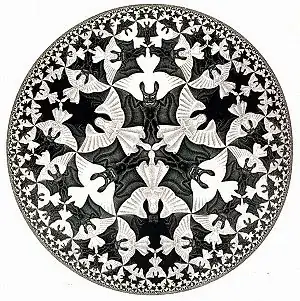
One option is to use pictures of (uniform) tilings of the hyperbolic plane, and point out that, in hyperbolic geometry, the tiles are isometric and in particular have the same area.
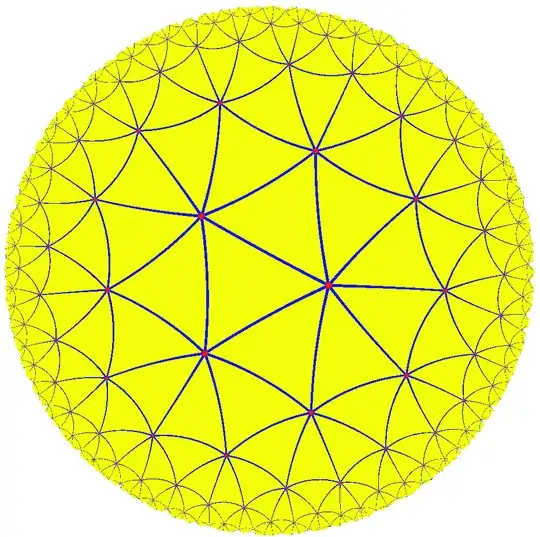
M. C. Escher drew four such tilings himself, all of them pretty. It might well be useful to contrast this with analogous tilings of the sphere and plane.
It would be illustrative to contrast hyperbolic plane with the sphere and plane in other ways too: For example, the circumference of a circle of radius $r$ is $2 \pi r$, less than $2 \pi r$ on a sphere (draw a picture!), and more than $2 \pi r$ on hyperbolic plane. Analogous statements are true for area and in higher dimensions.

